
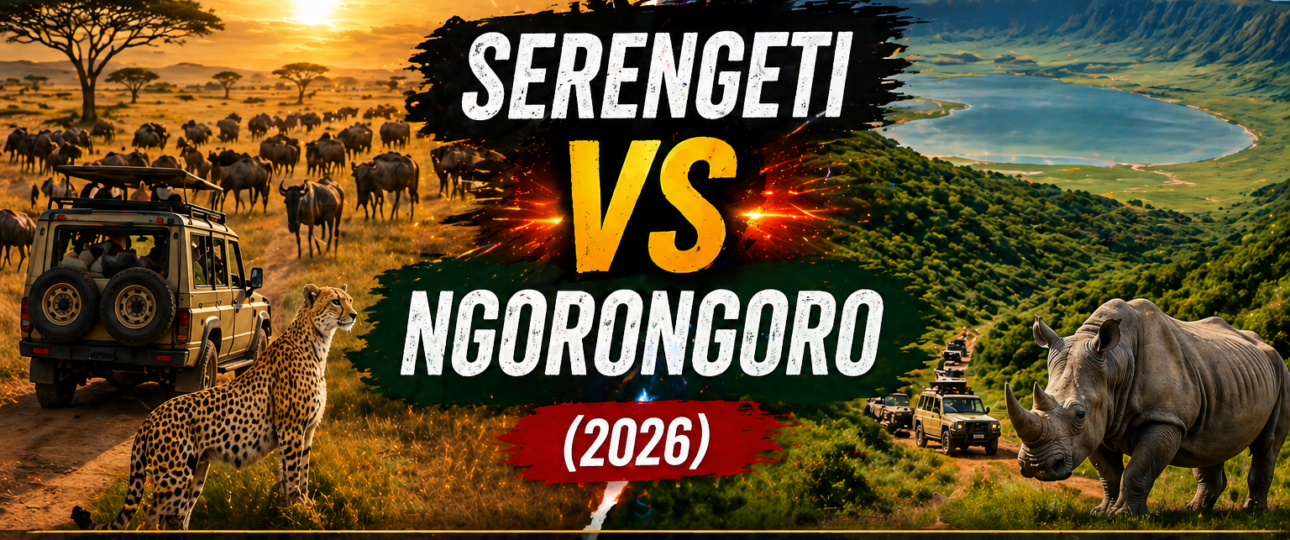
Serengeti vs Ngorongoro Crater (2026): Which Safari Is Better?
Serengeti vs Ngorongoro Crater (2026): Compare wildlife, cost & experience. Which safari is better? Get expert advice from Mara Triangle Safaris.
✅ Serengeti vs Ngorongoro – Key Takeaways
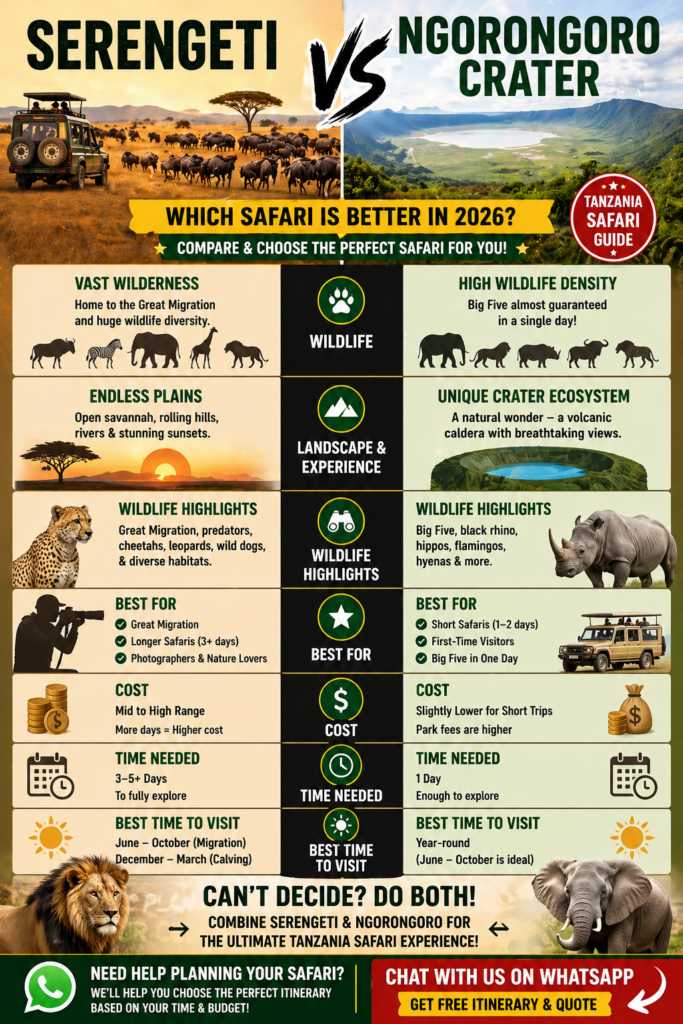
- Wildlife: Serengeti = migration & predators. Ngorongoro = dense Big Five in a small area.
- Cost: Ngorongoro cheaper for 1 day; Serengeti better value for 3+ days.
- Time needed: Serengeti = 3–5 days. Ngorongoro = 1–2 days.
- Experience: Serengeti = vast, adventurous. Ngorongoro = scenic, efficient, guaranteed sightings.
- Best for first-timers: Both – but 5-day combined trip is the ultimate Tanzania safari.
Serengeti vs Ngorongoro Crater (2026): Which Safari Is Better?–Mara Triangle Safaris
You’re planning a Tanzania safari.
You’ve heard two names over and over:
Serengeti. Ngorongoro Crater.
Both are world-famous.
Both are on every bucket list.
But which one is actually better for you?
Here’s the thing! they’re completely different experiences.
One is endless savannah with a moving river of wildebeest.
The other is a collapsed volcano packed with animals like a natural zoo.
Picking the wrong one could mean missing the wildlife you came for or blowing your budget on the wrong kind of trip.
We’ve run safaris to both for years. We know which one delivers for first-timers, which one is better for photographers, and which one makes sense if you’re on a tight budget.
This guide compares Serengeti vs Ngorongoro Crater head-to-head – wildlife, cost, experience, travel time, and everything in between. By the end, you’ll know exactly which one to book (or why you should do both).
Let’s settle this.
Which is better Serengeti or Ngorongoro Crater? (Quick Answer)
The Serengeti offers a larger, more diverse safari experience with the Great Migration, while Ngorongoro Crater provides incredibly high wildlife density in a stunning volcanic bowl. The best choice depends on your time, budget, and what you want to see.
Here’s the short version:
- Pick Serengeti if: You want the classic migration, endless plains, and a multi-day safari adventure.
- Pick Ngorongoro if: You have only 1–2 days, want almost guaranteed Big Five sightings, and love dramatic scenery.
But honestly, most travellers do both. And we’ll show you why.
📧 Email: info@maratrianglesafaris.co.ke | deals@maratrianglesafaris.co.ke
📞 Call / WhatsApp: +254 705 635 886 | +254 768 212 702
🌐 Contact form: https://maratrianglesafaris.co.ke/contact/
Overview of Both Destinations
Before we compare apples to oranges (or savannah to crater), let’s look at what each place actually is.
Serengeti National Park
The Serengeti is massive – 14,750 square kilometres. That’s roughly the size of Northern Ireland or Connecticut. It’s a vast ecosystem of open plains, woodlands, rivers, and kopjes (rocky outcrops). The main event is the Great Wildebeest Migration – over 1.5 million animals moving in a constant clockwise circuit.
Key facts:
- Established: 1951
- UNESCO World Heritage Site: Yes (1981)
- Best for: Multi-day safaris, migration viewing, predator action
- Typical stay: 3–7 days
Ngorongoro Crater
The Ngorongoro Crater is actually part of the larger Ngorongoro Conservation Area. It’s a volcanic caldera – a collapsed volcano – about 20 kilometres wide. The floor is 600 metres below the rim, creating a self-contained ecosystem with over 25,000 large animals. It’s often called the “Eighth Wonder of the World.”
Key facts:
- Established: 1959 (as conservation area)
- UNESCO World Heritage Site: Yes (1979)
- Best for: Short visits, high-density wildlife, scenic views
- Typical stay: 1–2 days
Our take: Think of the Serengeti as a multi-course meal – you sit down and enjoy hours of discovery. Ngorongoro is an express lunch – quick, satisfying, and leaves you full. Both are delicious.
Wildlife Comparison (The Main Event)
This is what you came for. Let’s see how the animals stack up.
Animal Density
| Aspect | Serengeti | Ngorongoro Crater |
|---|---|---|
| Animal density | Lower overall (huge area) | Extremely high (small crater floor) |
| Total area | 14,750 km² | 260 km² (crater floor) |
| Large mammals | 70+ species | 25,000+ individuals |
| Chance to see Big Five in one day | Low – they’re spread out | High – often possible |
Winner for density: Ngorongoro Crater. You’ll see more animals per square kilometre than almost anywhere in Africa.
The Big Five (Lion, Leopard, Elephant, Buffalo, Rhino)
| Animal | Serengeti | Ngorongoro |
|---|---|---|
| Lion | Excellent (largest population in Africa) | Excellent (dense population) |
| Leopard | Good (especially in Seronora) | Fair (shy, but present) |
| Elephant | Very good (large herds in North) | Few (migrate out of crater) |
| Buffalo | Excellent (massive herds) | Excellent (large herds) |
| Black Rhino | Very rare (under 100) | Good (one of best places to see them) |
Winner for Big Five: Tie – Serengeti for lions and leopards, Ngorongoro for rhinos and density.
The Great Migration (The Serengeti’s Superpower)
Ngorongoro has no migration. It’s a caldera – herds can’t move in and out easily. The Serengeti, on the other hand, is the migration destination.
- Serengeti: Over 1.5 million wildebeest, 250,000 zebras, and 300,000 gazelles moving year-round. River crossings, calving, predator chases – it’s the greatest wildlife show on earth.
- Ngorongoro: Resident wildlife only. No migration. What you see is what lives there permanently.
Winner for spectacle: Serengeti, hands down.
Predators (Lions, Cheetahs, Leopards, Hyenas)
| Aspect | Serengeti | Ngorongoro |
|---|---|---|
| Lion prides | Large prides, famous for tree-climbing in some areas | Good, but smaller prides |
| Cheetah | Common on eastern plains | Rare (not enough space for their hunting style) |
| Leopard | Good sightings in Central | Uncommon |
| Hyena | Large clans | Very large clans (some of Africa’s biggest) |
Winner for predators: Serengeti – more species, more action, more drama.
Birdlife
Both are excellent. Serengeti has 500+ species, Ngorongoro has 400+. But Ngorongoro’s crater floor has a higher concentration of birds, especially flamingos on Lake Magadi (seasonal).
Winner: Tie.
Verdict on Wildlife
- Pick Ngorongoro if: You have limited time and want a guaranteed show – almost guaranteed to see lions, elephants, buffalo, and rhinos in one morning.
- Pick Serengeti if: You want the migration, more predator variety, and don’t mind driving longer distances to find the best spots.
Our honest take: If you only have one day, do Ngorongoro. If you have three or more days, Serengeti will blow your mind.
Safari Experience (What’s It Actually Like?)
Serengeti Experience
You wake up before sunrise. Your 4×4 bumps along dusty tracks. You stop at a kopje to watch lions stretch in the golden light. You spend full days driving, searching, waiting. Some hours are quiet. Then suddenly – a leopard in a tree, a river crossing, a cheetah chase. It’s immersive. It’s unpredictable. It’s real.
Vibe: Adventurous, wild, requires patience.
Game drive style: Full-day or half-day drives. You cover a lot of ground. Guides use radios to share sightings. You’ll see other vehicles at major events (crossings, kills), but the park is huge enough to escape crowds.
Ngorongoro Crater Experience
You drive up the crater rim before breakfast. The view at sunrise is staggering – a bowl of green grassland 600 metres below. You descend a steep road onto the crater floor. Within 20 minutes, you’ve seen zebras, wildebeest, and a sleeping lion. It’s compact. You can circle the whole floor in 4–5 hours. You’ll likely see the Big Five before lunch.
Vibe: Scenic, efficient, almost like a wildlife drive-through.
Game drive style: Half-day (4–6 hours) on the crater floor. You stay on designated tracks. The density is so high you don’t need to drive far. It’s perfect for families or travellers short on time.
Winner for experience: Depends on your style. Serengeti for adventure and variety. Ngorongoro for convenience and guaranteed sightings.
Cost Comparison (Real 2026 Numbers)
Let’s talk money. This is where many travellers make their decision.
Entry Fees (2026)
| Fee Type | Serengeti (24hrs) | Ngorongoro (24hrs) |
|---|---|---|
| Adult non-resident | ~$83 | ~$71 |
| Child (5–15) | ~$24 | ~$24 |
| Crater service fee | N/A | ~$295 per vehicle (one-time) |
| Vehicle fee | ~$40 per vehicle | Included in crater fee |
Note for Ngorongoro: The crater service fee is steep – $295 per vehicle for a 6-hour visit. Plus the $71 per person park fee. For a couple in a private vehicle, that’s ~$437 just for the crater descent.
Accommodation Costs (Per Night)
| Type | Serengeti | Ngorongoro Crater Rim |
|---|---|---|
| Budget camping | $30–$50 | $40–$60 (Simba campsite) |
| Mid-range lodge | $250–$500 | $300–$600 |
| Luxury lodge | $600–$1,500+ | $700–$1,800+ |
Safari Package Costs (3–5 days)
| Scenario | Cost per person (approx) |
|---|---|
| 3-day Ngorongoro only (2 nights) | $800 – $1,200 |
| 4-day Serengeti only (3 nights) | $1,200 – $2,200 |
| 5-day combined (both) | $1,800 – $3,500 |
Winner for cost: Ngorongoro is cheaper for a very short trip (1–2 days). But for a proper multi-day safari, Serengeti offers better value because you’re not paying the one-off $295 crater fee. The best value is combining both.
Our advice: Don’t choose one over the other based on a $200 difference. The experience is so different that the extra money for Serengeti is absolutely worth it if you have the time.
Accessibility & Travel (Getting There)
From Arusha (Safari Hub)
| Destination | Driving Time | Road Conditions | Fly-in Option |
|---|---|---|---|
| Serengeti (Naabi Hill Gate) | 5–7 hours | Rough, dusty, 4×4 required | Yes ($200–$400 one way) |
| Ngorongoro Crater (rim) | 3–4 hours | Paved to gate, then good dirt road | No (no airstrip near crater) |
Practical Considerations
- Serengeti: The drive is long and bumpy. Most budget travellers suck it up. Those with more money fly into Seronera or Kogatende airstrips. Once inside, you’re driving a lot – the park is huge.
- Ngorongoro: Easier to reach. The road from Arusha is mostly paved. You drive to the rim, park your vehicle, and descend. Less driving overall.
Winner for accessibility: Ngorongoro – closer to Arusha, better roads, less time in the car.
Best Time to Visit (Seasonal Differences)
Serengeti
| Period | What’s Happening | Crowds |
|---|---|---|
| Jan–Mar | Calving in the South | Moderate |
| Apr–May | Long rains, low season | Low |
| Jun–Jul | Migration in Western Corridor | Moderate |
| Jul–Oct | River crossings in the North | Very high |
| Nov–Dec | Short rains, herds moving south | Low–Moderate |
Best time for Serengeti: June–October (dry, migration action) or January–March (calving).
Ngorongoro Crater
Ngorongoro is good year-round because animals don’t migrate in/out. However:
- Dry season (June–October): Less mud, easier driving, animals gather near water sources. Excellent.
- Wet season (November–May): Green scenery, fewer crowds, but some tracks get muddy. Still very good wildlife.
Best time for Ngorongoro: June–October (driving conditions) or February (green, baby animals).
Winner: Both are great year-round. But Serengeti has more dramatic seasonal variation (migration vs. no migration). Ngorongoro is more consistent.
Pros & Cons Table (Quick Scan)
Serengeti National Park
| Pros | Cons |
|---|---|
| ✅ The Great Migration – world-class spectacle | ❌ Long driving distances between regions |
| ✅ Huge variety of landscapes (plains, rivers, kopjes) | ❌ Peak season very crowded |
| ✅ Excellent for predators (lions, leopards, cheetahs) | ❌ Can be expensive during migration |
| ✅ Flexible – you can spend 5+ days without getting bored | ❌ Longer drive from Arusha |
Ngorongoro Crater
| Pros | Cons |
|---|---|
| ✅ Incredible wildlife density – see Big Five in half a day | ❌ Small area – can feel repetitive after 1 day |
| ✅ Stunning scenery (crater rim views) | ❌ Expensive crater service fee ($295 per vehicle) |
| ✅ Best place in Tanzania for black rhino sightings | ❌ No migration – resident wildlife only |
| ✅ Easy access from Arusha | ❌ Limited to 6 hours on crater floor |
✅ Which One Should You Choose? (Decision Time)
Let’s make this simple.
Choose Serengeti if:
- You want to see the Great Migration (river crossings or calving)
- You have 3+ days for your safari
- You love the idea of wide-open spaces and long game drives
- You’re a photographer chasing predators and dramatic landscapes
- You want the classic African safari experience
Choose Ngorongoro Crater if:
- You only have 1–2 days for a safari
- You want almost guaranteed Big Five sightings in a short time
- You’re travelling with young kids or elderly parents (less driving)
- You love scenic views (the crater rim at sunrise is iconic)
- You’re on a tight budget for a very short trip (1 day crater is cheaper than 2 days Serengeti)
Choose BOTH (Highly Recommended) if:
- You have 4–7 days total
- You want the ultimate Tanzania safari – the density of Ngorongoro plus the vastness of Serengeti
- You’re flying from overseas (why travel 10 hours to see only one?)
Our honest take: 80% of our clients do both. A typical 5-day itinerary: 1 night Ngorongoro rim, 3 nights Serengeti (Central + North/South), 1 night back. You get the best of both worlds. Don’t choose – combine.
Can You Visit Both? (Yes – And Here’s How)
Absolutely. Most of our packages are combined.
Sample 5-Day Combined Itinerary
- Day 1: Arusha → Ngorongoro Crater rim. Overnight rim lodge/camp.
- Day 2: Early descent into crater for half-day game drive → drive to Serengeti (Central). Afternoon game drive en route.
- Day 3: Full day Central Serengeti (predators, kopjes).
- Day 4: Drive to Northern Serengeti (if migration season) or explore Western/Southern. Overnight in Serengeti.
- Day 5: Morning game drive → return to Arusha.
Cost for combined (mid-range, 5 days): ~$2,500 – $4,000 per person
We specialise in combined itineraries. Tell us your dates, and we’ll build a plan that hits both parks perfectly.
Frequently Asked Questions
Is Ngorongoro Crater worth visiting?
Yes – Ngorongoro Crater is one of the best places in Africa to see the Big Five in a single day. The scenery alone is worth the trip.
Is Serengeti better than Ngorongoro?
The Serengeti is better for longer safaris, the Great Migration, and diverse landscapes. Ngorongoro is better for short, high-density wildlife viewing. They’re different, not one “better” than the other.
How many days for Serengeti vs Ngorongoro?
Serengeti: 3–5 days minimum. Ngorongoro: 1–2 days is enough. Most travellers spend 3–4 days in Serengeti and 1 day in Ngorongoro.
Which is cheaper – Serengeti or Ngorongoro?
Ngorongoro can be cheaper for a 1-day visit. For 3+ days, Serengeti offers better value per day because Ngorongoro’s crater fee ($295 per vehicle) is a fixed cost.
Which has more animals – Serengeti or Ngorongoro?
Ngorongoro has higher animal density (more animals per square kilometre). Serengeti has more total animals and greater variety.
Final Thought (And Your Next Step)
Here’s the truth. You can’t really go wrong. Both Serengeti and Ngorongoro are world-class wildlife destinations. But they serve different purposes.
- Short on time? Do Ngorongoro Crater – you’ll leave ecstatic.
- Want the full African safari experience? Do Serengeti – it’s the gold standard.
- Have 5+ days? Do both – and thank us later.
At Mara Triangle Safaris, we’ve guided thousands of travellers through both parks. We know the best routes, the best camps, and exactly how to time your visit for the migration and crater wildlife. We’ll help you decide – no hard sell, just honest advice.
Ready to Book Your Tanzania Safari?
Stop comparing. Start packing.
👉 Tell us three things:
- Your travel dates (or month)
- Your budget (per person)
- Number of people
We’ll reply within 24 hours with:
✅ A recommended park choice (Serengeti, Ngorongoro, or both)
✅ A custom itinerary with day-by-day breakdown
✅ A full cost quote – no hidden fees
Contact us today:
📧 Email: info@maratrianglesafaris.co.ke | deals@maratrianglesafaris.co.ke
📞 Call / WhatsApp: +254 705 635 886 | +254 768 212 702
🌐 Contact form: https://maratrianglesafaris.co.ke/contact/
👉 Or send us a message on WhatsApp (fastest response)
Explore Your Options
Once you’ve decided (or if you’re leaning towards one):
- Cheapest Serengeti Safari (2026) – Budget, mid-range & luxury
- Best Serengeti Safari Packages (2026) – Budget, mid-range & luxury packages
- Serengeti Safari Cost Calculator (2026) – Step-by-step budget planner
- 5-Day Serengeti Itinerary (2026) – Day-by-day route
- Best Time to Visit Serengeti – Month-by-month migration guide
- Serengeti National Park Guide – Map, wildlife, travel tips