
What Animals Can You See During the Great Migration Safari? (2026 Guide)
Discover the incredible animals you can see during the Great Migration Safari in Kenya, from wildebeest and zebras to lions, cheetahs, crocodiles, elephants, and black rhinos.
🐘 Wildlife Takeaways
8 must-know facts — your ultimate Great Migration wildlife checklist
What Animals Can You See During the Great Migration Safari? (2026 Guide)-Mara Triangle Safaris
When you ask what animals you can see during the Great Migration safari, your mind probably goes straight to wildebeest.
And honestly, that makes total sense, they’re the stars of the Great Wildebeest Migration.
But here’s the thing:
the migration is actually a massive moving ecosystem.
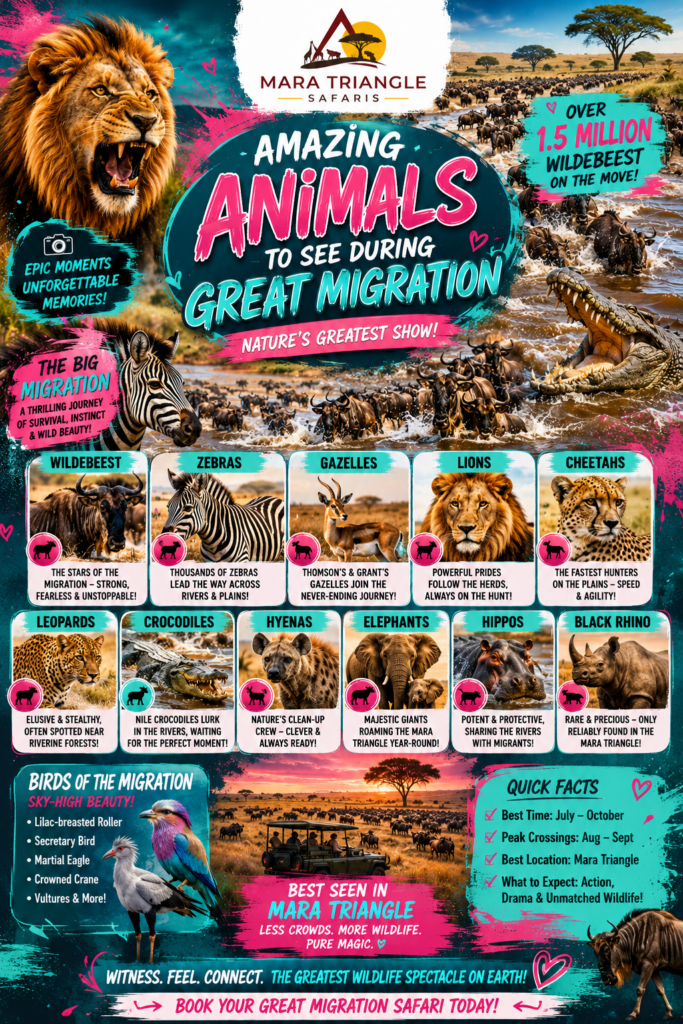
Around 1.3 to 2.5 million wildebeest travel alongside hundreds of thousands of zebras and gazelles, with predators hot on their heels across the Serengeti National Park in Tanzania and the Masai Mara National Reserve in Kenya.
The whole thing is a year-round wildlife drama that you get to witness firsthand.
The herds move because they’re chasing fresh grass and rain.
And wherever they go, the predators follow.
You’ve got African lions waiting in the tall grass, cheetahs sprinting across open plains, African leopards hiding in riverine trees, and Nile crocodiles lurking in the Mara River.
It’s not just a migration—it’s the greatest wildlife show on Earth.
And the Mara Triangle is where you want to be for the best wildlife viewing.
Quick answer:
The Great Migration is way more than just wildebeest.
You’ll see zebras, gazelles, lions, cheetahs, leopards, hyenas, Nile crocodiles, hippos, elephants, giraffes, buffaloes, and if you’re lucky black rhinos.
The Mara Triangle delivers the highest concentration of wildlife, making it the best spot for ticking off your safari bucket list.
The Great Migration: More Than Just Wildebeest
When you ask what animals you can see during the Great Migration safari, your mind probably goes straight to wildebeest. And honestly, that makes total sense—they’re the stars of the Great Wildebeest Migration. But here’s the thing: the migration is actually a massive moving ecosystem. Around 1.3 to 2.5 million wildebeest travel alongside hundreds of thousands of zebras and gazelles, with predators hot on their heels across the Serengeti National Park in Tanzania and the Masai Mara National Reserve in Kenya.
The whole thing is a year-round wildlife drama that you get to witness firsthand. The herds move because they’re chasing fresh grass and rain. And wherever they go, the predators follow. You’ve got African lions waiting in the tall grass, cheetahs sprinting across open plains, African leopards hiding in riverine trees, and Nile crocodiles lurking in the Mara River. It’s not just a migration—it’s the greatest wildlife show on Earth. And the Mara Triangle is where you want to be for the best wildlife viewing.
Wildebeest – The Stars of the Migration
The wildebeest (also called a gnu) are the main drivers of the entire Great Migration. Between 1.3 and 2.5 million of them make this incredible journey every single year across the Serengeti and Masai Mara. They’re the ones that create that iconic image—endless columns of grey-brown bodies stretching to the horizon that you’ve probably seen in documentaries.
Here’s what’s wild: about 250,000 wildebeest and 30,000 zebra die during each migration cycle. That’s a lot of death. But it’s also what feeds the predators and keeps the ecosystem balanced. The sheer scale of them moving across the plains is something you genuinely can’t put into words. When you’re on a wildlife safari in Kenya, seeing the wildebeest is always the highlight of your trip.
Best viewing: July to September in the Mara Triangle and Masai Mara National Reserve
Likelihood: Excellent
Plains Zebras – The Migration’s Trailblazers
Plains zebras are the unsung heroes of the Great Migration. They usually lead the way, often crossing rivers before the wildebeest. Around 200,000 zebras travel with the main herds, and they’ve got a pretty good reason for going first—they prefer to graze on taller, tougher grasses, which clears the path for the wildebeest who like the shorter stuff.
Seeing a massive herd of zebras galloping across the plains, their stripes blurring together, is one of those moments that makes your safari unforgettable. The plains zebra is one of the most photogenic animals in the great migration, and you’ll get incredible shots of them.
Best viewing: Throughout the Mara Triangle, especially near the Mara River
Likelihood: Excellent
Thomson’s and Grant’s Gazelles
Gazelles might be smaller, but they’re a key part of the migration entourage. Thomson’s gazelle and Grant’s gazelle travel with the herds, picking off the shorter grazing opportunities that the zebras and wildebeest leave behind. They’re part of the incredible animals in the great migration that you’ll see everywhere.
They’re also prime targets for cheetahs. If you see a cheetah sprinting across the plains, there’s a good chance it’s chasing a gazelle. These little antelopes are fast, but cheetahs are faster. Both Thomson’s and Grant’s gazelles are common sights during the migration, and they add so much life to the savannah.
Best viewing: Open plains across the Mara Triangle
Likelihood: Excellent
African Lions – Following the Herds
The Mara has one of the highest lion densities in Africa. Over 3,000 African lions live across the Serengeti-Mara ecosystem, and they absolutely know when the migration is coming. When the herds arrive, the lions are ready and waiting for you to watch them.
The famous Marsh Pride near Musiara is probably the most well-known lion pride in the world—they’ve been featured in BBC documentaries for years. You’ll see African lions lounging under acacia trees during the heat of the day, and hunting at dawn and dusk. During the migration, they pick off wildebeest and zebras that stray too far from the herd. African lions are undoubtedly one of the top predators during the migration, and watching them hunt is absolutely thrilling.
Best viewing: Throughout the Mara Triangle, especially near the Mara River
Likelihood: Excellent
African Leopards – Elusive Hunters Along the Rivers
African leopards are harder to spot than lions, but the Mara Triangle is one of the best places to find them. They love the riverine forests along the Mara River, where they can hide in trees and ambush their prey. They’re solitary and mostly nocturnal, but with a good guide, you’ve got a solid chance of seeing one.
Some guides use coded phrases to talk about leopard sightings so they don’t attract a swarm of safari vehicles. If you hear your guide mention “Kuro” (Waterbuck) while looking at a thicket, they might be talking about an African leopard. Leopards are a key part of the big five during the Great Migration, and spotting one is always a special moment on your safari.
Best viewing: Riverine forests and rocky outcrops, especially along the Oloololo Escarpment
Likelihood: Very Good
Cheetahs – Masters of Speed
Cheetahs prefer the open plains where they can use their speed to chase down gazelles and young wildebeest. The area between Talek Gate and the eastern boundary is so good for cheetahs that locals call it “Cheetah Alley.”
The Mara has unusually high cheetah densities because the flat terrain gives them the perfect hunting ground. Watching a cheetah sprint across the savannah at 100 km/h is one of those safari moments you’ll never forget. Cheetahs are among the most exciting predators during the migration to watch, and they’re absolutely incredible animals to photograph during the migration.
Best viewing: Open grasslands, especially the Eastern Plains
Likelihood: Excellent during migration season
Nile Crocodiles – The Mara River’s Ambush Predators
The Mara River crossings wouldn’t be nearly as dramatic without the Nile crocodiles waiting below. These massive reptiles can grow up to 5 meters long, and they’ve been lying in wait for the herds for generations. They’re one of the most feared mara river animals.
When thousands of wildebeest and zebras plunge into the river, the Nile crocodiles pick off the weak, the slow, and the unlucky. It’s brutal but unforgettable. And it’s why the river crossing is considered the most dramatic part of the migration. Nile crocodiles are always one of the most talked-about migration predators, and seeing them in action is something else.
Best viewing: Mara River crossing points, July–October
Likelihood: Excellent
Spotted Hyenas – Nature’s Opportunists
Spotted hyenas get a bad rap, but they’re one of the most successful predators in the Mara. Around 8,000 hyenas live across the ecosystem, and they’re smart, social, and relentless.
They’re scavengers, sure, but they also hunt. During the migration, they follow the herds and pick off the weak and injured. Their cackling calls at night are one of the most iconic sounds of the African bush. Spotted hyenas are key migration predators that often get overlooked, but they’re fascinating to watch.
Best viewing: Throughout the Mara Triangle, year-round
Likelihood: Excellent
African Elephants in the Mara Triangle
African elephants are year-round residents in the Mara Triangle, and seeing them is always a highlight of your safari. The riverine forests and open plains give you incredible opportunities to watch these gentle giants up close.
Unlike the migration herds, African elephants don’t move with the wildebeest. They stay put, and the Mara Triangle has a healthy, stable population. Watching a family of elephants at a waterhole, with the Oloololo Escarpment in the background, is pure safari magic. African elephants are a must-see on any Kenya safari animals checklist, and you’ll love watching them interact.
Best viewing: Mara River and waterholes in the Triangle
Likelihood: Excellent
Black Rhinos – Rare Giants of the Mara Triangle
Here’s something special: the Mara Triangle is the only part of the Masai Mara where you can reliably find black rhinoceros. This makes it the only true Big Five area in the entire Mara ecosystem, and that’s a big deal for your wildlife safari Kenya experience.
But let’s be honest—seeing a black rhinoceros isn’t guaranteed. The population is only about 55 to 70 individuals across the whole reserve, with around 10 in the Triangle. They’re shy, they hide in thick bush, and their eyesight is terrible. You need a good guide and a bit of luck. Black rhinoceros sightings are what make the Mara Triangle truly special and are the ultimate prize for wildlife viewing in the Mara Triangle.
If seeing a black rhinoceros is your top priority, consider combining the Mara with Ol Pejeta or Lake Nakuru, where rhino sightings are more reliable.
Best viewing: Mara Triangle, especially near the Oloololo Escarpment
Likelihood: Good (but not guaranteed)
African Buffaloes and Other Plains Wildlife
Beyond the migration herds, the Mara Triangle is packed with resident wildlife. African buffaloes gather in large herds near water sources, and hippos laze in the Mara River. Masai giraffes roam the open plains, adding to the incredible wildlife viewing. These are some of the best animals to see on a Kenya safari.
African buffaloes are part of the Big Five and are frequently seen throughout the Mara Triangle. Together with African elephants, African lions, African leopards, and black rhinoceros, they complete the Big Five during the Great Migration. You’ll also see hippos, giraffes, warthogs, and countless other species that make this place so special.
Best viewing: Throughout the Triangle, year-round
Likelihood: Excellent
Birds You Can Spot During the Great Migration
The Mara Triangle is a birdwatcher’s paradise, with over 470 recorded bird species. What birds can you see in the Mara Triangle? Keep your eyes peeled for:
- Lilac-breasted roller — Kenya’s national bird, stunningly colorful
- Secretary bird — tall, striking, and often seen hunting snakes
- Martial eagle — Africa’s largest eagle
- Vultures — circling above predator kills
- Oxpeckers — riding on rhinos and buffalo, picking ticks
These birds are some of the best animals to see on a Kenya safari, especially for photography enthusiasts looking for animals to photograph during the migration. They add another whole dimension to your wildlife viewing experience.
Best viewing: Throughout the Triangle, year-round
Likelihood: Excellent
Why the Mara Triangle Offers Exceptional Wildlife Viewing
The Mara Triangle is managed by the Mara Conservancy, which means fewer vehicles, better roads, and effective anti-poaching. It’s less crowded than the main reserve, so you get more exclusive, unhurried sightings. Mara Triangle wildlife is simply unmatched in density and diversity.
It’s also the only part of the Mara where you can reliably see the Big Five—African lion, African leopard, African elephant, African buffalo, and black rhinoceros—all in one safari. That’s a big deal. The best wildlife safari in Kenya has to include the Mara Triangle, and your great migration wildlife checklist will be completely ticked off.
🐘 Wildlife Viewing Guide
Your quick reference — best areas, peak seasons & likelihood
| 🐾 Animal | 📍 Best Viewing Area | 📅 Peak Season | ⭐ Likelihood |
|---|---|---|---|
|
🦓
Wildebeest
|
Mara River & plains | Jul–Sep | Excellent |
|
🦓
Plains Zebra
|
Open plains | Jul–Sep | Excellent |
|
🦁
African Lion
|
Throughout Mara Triangle | Year-round | Excellent |
|
🐆
African Leopard
|
Riverine forests | Year-round | Very Good |
|
🐆
Cheetah
|
Open grasslands | Jul–Sep | Excellent |
|
🐊
Nile Crocodile
|
Mara River | Jul–Sep | Excellent |
|
🐘
African Elephant
|
Mara Triangle | Year-round | Excellent |
|
🦏
Black Rhinoceros
|
Mara Triangle | Year-round | Good |
|
🦛
Hippo
|
Mara River | Year-round | Excellent |
|
🐾
Spotted Hyena
|
Throughout ecosystem | Year-round | Excellent |
|
🐃
African Buffalo
|
Throughout Triangle | Year-round | Excellent |
Frequently Asked Questions
What animals migrate with the wildebeest?
Around 200,000 plains zebras and hundreds of thousands of Thomson’s gazelle and Grant’s gazelle migrate alongside the wildebeest. They follow the same routes and cross the same rivers across the Serengeti and Masai Mara.
Can you see the Big Five during the Great Migration?
Yes. The Mara Triangle is the only part of the Masai Mara National Reserve where you can reliably see all Big Five—African lion, African leopard, African elephant, African buffalo, and black rhinoceros—during a single safari. That’s the big five during the great migration.
Are crocodiles always at the river crossings?
During the migration season (July to October), Nile crocodiles are always in the Mara River waiting for the herds to cross. Outside of migration, they’re still there, just not as active.
Where can you see black rhinos in the Mara?
The Mara Triangle is the best place. There are about 10 black rhinoceros in the Triangle, often near the Oloololo Escarpment and Partakilat drainage. They’re shy and hard to spot, so you need a good guide.
What birds can you see in the Mara Triangle?
Over 470 bird species, including lilac-breasted rollers, secretary birds, martial eagles, vultures, and oxpeckers. The Mara Triangle is excellent for birdwatching.
Is the Mara Triangle good for wildlife photography?
Yes. Fewer vehicles mean you’re not fighting for position, the light is incredible, and the landscapes are stunning. The animals to photograph during the migration are abundant and diverse.
Which predators are most active during the migration?
African lions, cheetahs, African leopards, spotted hyenas, and Nile crocodiles all become more active when the herds arrive. These migration predators make the safari experience truly thrilling and are what predators hunt during the great migration.
What animal is the hardest to spot?
Black rhinoceros. They’re elusive, shy, and there are only about 55–70 in the entire Masai Mara National Reserve. Patience and a good guide are essential for wildlife viewing in the Mara Triangle.
🐘 Ready to See All These Animals in One Trip?
The 2026 Great Migration is coming, and the Mara Triangle is the place to be. Fewer vehicles, exclusive sightings, and the highest wildlife density in the Masai Mara—including the Big Five. Whether you’re looking for the best wildlife safari in Kenya or want to tick off your great migration wildlife checklist, we’ve got you covered.
| Guide / Article | Category | Link |
|---|---|---|
|
🏆 Great Migration pillar article The definitive guide to the Serengeti Great Migration — when, where, and how to see it |
Migration | Read More → |
|
⏳ When Does the Great Wildebeest Migration Reach the Mara River? |
Timing | Read More → |
|
📅 Best Time for the Great Migration |
Best Time | Read More → |
|
🧭 Mara Triangle Safari Guide Complete map, navigation tips, wildlife hotspots, and travel guide |
Guide | Read More → |
|
🎒 Great Migration Safari Packages Budget, mid-range, luxury, and fly-in safari prices compared |
Packages | Read More → |
|
🗺️ Great Migration Itineraries 3, 4, 5 & 7-day safari plans — find the perfect safari length |
Itineraries | Read More → |
|
🏕️ Best Camps in the Mara Triangle Top 10 luxury lodges, tented camps, and budget stays reviewed |
Accommodation | Read More → |
|
📞 Contact / Book a Safari Get a personalized quote & book your dream adventure |
Booking | Get in Touch → |