
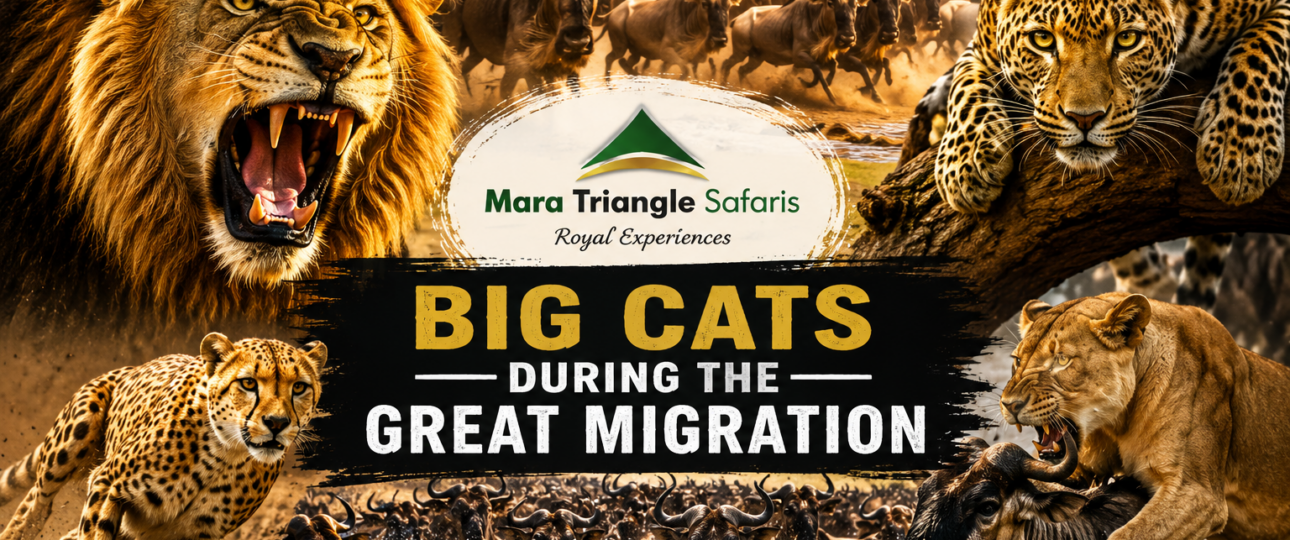
Big Cats During the Great Migration: Best Places to Spot Lions, Leopards & Cheetahs
Discover the best places to spot lions, leopards, and cheetahs during the Great Migration in Kenya. Learn where predators hunt, the best months to visit, and expert safari tips.
🐆 Big Cats Takeaways
Track the kings of the savanna — your ultimate predator safari guide
Big Cats During the Great Migration: Best Places to Spot Lions, Leopards & Cheetahs (2026)-Mara Triangle Safaris
When you think about a safari in Kenya, your mind probably jumps straight to the big cats.
And honestly, why not?
Lions, leopards, and cheetahs are the ultimate wildlife celebrities.
But spotting them isn’t just about luck, it’s about knowing where and when to look.
During the Great Migration, predators follow the herds, creating some of the most dramatic hunting action on Earth.
The Mara Triangle is ground zero for big cat sightings, with fewer vehicles and expert guides who track prides and leopards daily.
Whether you’re a photographer or first-timer, this guide shows you exactly where to find them.
Let’s jump straight!
Quick answer:
The Great Migration attracts big cats because it provides an abundance of prey. Lions, leopards, and cheetahs follow the herds across the Serengeti-Mara ecosystem, and the Masai Mara National Reserve offers some of the best opportunities to see them.
Lions and cheetahs are most visible during the migration months (July–October), while leopards can be spotted year-round in riverine forests.
The Mara Triangle is widely considered one of Africa’s premier destinations for big cat sightings.

Why Big Cats Follow the Great Migration
The Great Migration is one of the largest mass movements of land animals on the planet. Over a million wildebeest, 200,000 zebra, and 350,000 Thomson’s gazelles form vast herds as they follow the rains in search of fresh grass . And wherever these herds go, predators follow .
This annual migration brings an enormous concentration of prey into one area, creating a hunting bonanza for lions, leopards, and cheetahs. Predator populations play a critical role in the ecosystem, particularly during the calving season when herds do their best to avoid encountering big cats hoping to snatch a snack on the open plains .
The influx of prey animals is precisely what makes the Masai Mara so exceptional for big cats . The reserve’s plains grasslands and woodlands, dotted with flat-topped acacia trees, provide ideal habitat for both herbivores and their predators.
Lions: Kings of the Mara Plains
African lions are the easiest of the big cats to spot on safari, thanks to their love of daytime dozing in the African savanna. No safari is complete without seeing these majestic felines, their thunderous roars echoing across the plains at night.
During the Great Migration, lions are particularly active, following the herds and picking off wildebeest and zebras that stray too far from the safety of the group. Lions are often found near river crossings where prey congregates, and watching them hunt is an absolutely thrilling experience .
The Masai Mara has one of the highest lion densities in Africa, with over 3,000 lions living across the Serengeti-Mara ecosystem. The famous Marsh Pride, featured in BBC’s Big Cat Diary, is just one of many prides that call this area home.
Best Places to Spot Lions During the Migration
The Mara Triangle is renowned for its excellent lion sightings. With fewer vehicles and strict regulations, you get more exclusive, unhurried views of lion prides in action. The Triangle’s open plains and riverine areas provide perfect hunting grounds for lions, especially during the migration season from July to October .
The Olare Motorogi Conservancy, bordering the northern edge of the Masai Mara National Reserve, hosts the highest concentration of big cats on the continent. The conservancy model keeps vehicle numbers low while maintaining access to prime lion territory .
Near the Mara River crossings, lions lie in wait for exhausted survivors. As thousands of wildebeest and zebras plunge into the river, lions stalk the banks, ready to pick off the weak and unlucky.
The dry season (June to October) offers the best lion viewing, as shorter grass makes it easier to spot these golden cats on the savanna .
Leopards: Masters of Stealth Along Riverine Forests
Leopards are harder to spot than lions—solitary, shy, and amazingly good at hiding. They are nocturnal and very well camouflaged, often taking their prey up trees to avoid losing it to hyenas and lions .
But the Mara Triangle is one of the best places in Africa to find them. Leopards thrive in riverine forests along the Mara River, where they can hide in trees, stalk prey, and ambush from above . Their distinctive dark spots, officially called rosettes, help them blend perfectly into the dappled light of the riverine woodlands.
Spotters often find leopards lounging on the branches of sausage trees, using them as a vantage point to scan for prey. They are remarkably adaptable and can survive in varied habitats, from savanna grasslands to semi-desert regions .
Where to Find Leopards in the Mara Triangle
The riverine forests along the Mara River are prime leopard territory. The thick vegetation and abundance of trees give them perfect cover for ambushing prey.
The Oloololo Escarpment and its rocky outcrops offer excellent leopard habitat. These areas provide good vantage points for spotting these elusive cats.
Private conservancies like Mara North and Olare Motorogi also host healthy leopard populations with fewer vehicles. The low vehicle density makes for more relaxed animals and more natural behavior .
Leopards can be seen year-round in the Mara, as they are resident animals that don’t follow the migration. However, sightings are “Very Good” rather than guaranteed, as these cats are masters of concealment .
Cheetahs: Speed Across the Open Grasslands
Cheetahs are the fastest animals on land, capable of reaching speeds up to 110 km/h. They need plenty of space to make the most of their spectacular acceleration and are found year-round in open, grassy plains .
Unlike lions and leopards, cheetahs are uniquely adapted for speed with a narrow, lightweight body and long, slender limbs. They are the only big cats with spots rather than rosettes, and they purr rather than roar .
Sadly, cheetahs are now classified as critically endangered, with only about 7,000 left in the wild. This makes them the most endangered big cat in Africa, so seeing one is a truly special experience .
Best Areas to Spot Cheetahs During the Great Migration
The open grasslands of the Mara Triangle are prime cheetah territory. The flat terrain gives them perfect conditions to chase down gazelles and young wildebeest. Cheetahs are best spotted in the dry season when the grass is short enough to reveal their ground-hugging shapes .
The area between Talek Gate and the eastern boundary is so good for cheetahs that locals call it “Cheetah Alley.” The Eastern Plains offer wide-open spaces where cheetahs can use their speed to hunt.
Private conservancies like Olare Motorogi and Mara North also offer excellent cheetah sightings, with fewer vehicles and more relaxed animals .
For great migration wildlife viewing, cheetahs are most active from July to September when the herds are present and prey is abundant. They often choose termite mounds or slightly elevated ground to scan the horizon for prey .
Best Time to See Big Cats During the Migration
July–October is the prime season for big cat viewing in the Masai Mara. During these months, the Great Migration herds are in Kenya, bringing an abundance of prey that attracts lions, cheetahs, and leopards .
August and September are particularly excellent months for predator sightings, as this is when the highest concentration of herds and the most dramatic river crossings occur.
Cheetahs and lions are most visible during the dry season when the grass is shorter and animals congregate around water sources .
Leopards can be spotted year-round, though they remain elusive regardless of the season.
Early morning and late afternoon game drives offer the best chances for big cat sightings, as predators are most active during these cooler hours.
🐆 Big Cats Viewing Guide
Your quick reference — best habitat, peak months & likelihood
| 🐾 Big Cat | 🌍 Best Habitat | 📅 Best Months | ⭐ Chance of Seeing |
|---|---|---|---|
|
🦁
Lion
|
🌾
Open plains & river crossings
|
Jul–Oct | Excellent |
|
🐆
Leopard
|
🌳
Riverine forests & rocky outcrops
|
Year-round | Very Good |
|
🐆
Cheetah
|
🏜️
Open grasslands
|
Jul–Sep | Excellent |
Why the Mara Triangle Offers Outstanding Predator Viewing
The Mara Triangle is managed by the Mara Conservancy, which ensures well-maintained roads, effective anti-poaching, and sustainable tourism practices . With only two permanent camps within the Triangle and strict regulations on vehicle numbers, you won’t be fighting for position at a sighting .
Fewer vehicles mean animals remain more relaxed and behave more naturally. This is critical for meaningful, high-quality wildlife viewing—especially for big cats, which are easily disturbed by crowds .
The Triangle is the only area in the Masai Mara where rhino are reliably found, making it the only true Big Five area within the Mara ecosystem .
Expert guides know the terrain and animal behavior intimately, tracking predator movements using fresh tracks, alarm calls, and herd behavior.
Year-round wildlife means even outside migration season, lion prides, cheetahs, and leopards remain active. The action doesn’t stop when the herds move on .
Photography Tips for Capturing Big Cats
Bring a telephoto lens (400mm+) to capture big cats at a distance without disturbing them.
Shoot at dawn and dusk when the golden hour light is most dramatic and predators are most active .
Focus on eyes for compelling portraits. Sharp eyes draw viewers into the image.
Use high-speed burst mode to capture cheetahs sprinting or lions hunting .
Be patient—some of the best shots come from waiting quietly and observing natural behavior.
Consider a hot air balloon safari for a unique perspective over the Mara plains, though most big cat photography is best done from a game vehicle at ground level.
Night drives in private conservancies offer opportunities to see leopards and other nocturnal predators that are rarely active during the day.
How Long Should You Stay for the Best Chances?
3 days gives you a moderate chance of seeing big cats—maybe a lion, potentially a cheetah, but leopard sightings are less likely.
5 days significantly improves your odds, giving you an excellent chance of spotting all three big cats, especially with expert guides tracking them daily.
7+ days pushes your odds to outstanding, allowing time for the best predator encounters and photography opportunities.
For migration safari with local guides who know every pride and leopard territory, longer stays make a real difference. Private migration safaris with flexible itineraries maximize your chances of memorable predator encounters.
Frequently Asked Questions
Why do lions follow the Great Migration?
Lions follow the Great Migration because it provides an abundance of prey. When the herds of wildebeest and zebras arrive, the lions are ready to hunt. The massive concentration of prey animals makes hunting easier and more successful, especially for prides with cubs to feed.
Where is the best place to see leopards in the Mara?
The riverine forests along the Mara River and the Oloololo Escarpment in the Mara Triangle are prime leopard territory. Private conservancies like Mara North and Olare Motorogi also offer excellent leopard sightings with fewer vehicles. Leopards can be seen year-round, though they remain elusive.
Are cheetahs common during the Great Migration?
Cheetahs are most common during the Great Migration from July to September. The open grasslands of the Mara Triangle and the Eastern Plains offer ideal hunting grounds for cheetahs, especially when the grass is dry and short. However, cheetahs are critically endangered, so sightings are special.
Which big cat is hardest to spot?
The leopard is the hardest of the three big cats to spot. They are solitary, shy, nocturnal, and amazingly good at hiding. Leopards are very well camouflaged, so you need sharp eyes and a good guide to find them.
Can you see all three big cats on one safari?
Yes! With a 5-day safari in the Mara Triangle, you have an excellent chance of seeing lions, leopards, and cheetahs. The Mara Triangle’s high predator density and expert guides make it one of the best places in Africa for this.
What time of day are big cats most active?
Big cats are most active during early morning and late afternoon/early evening. Lions often hunt at dawn and dusk, while leopards are primarily nocturnal. Cheetahs are active during daylight hours, especially in the cooler parts of the day.
How many days should I stay for the best sightings?
5 days gives you an excellent chance of seeing all three big cats, while 7+ days pushes your odds to outstanding. Private migration safaris with experienced guides and flexible itineraries maximize your chances.
Is the Mara Triangle good for predator photography?
Yes. The Mara Triangle offers fewer vehicles, exclusive sightings, and expert guides who know where to find predators. The stunning landscapes and golden-hour light make it a photographer’s paradise.
🐆 Ready to Track Big Cats During the Great Migration?
The 2026 Great Migration is coming, and the Mara Triangle offers the best big cat sightings in Africa. Fewer vehicles, exclusive sightings, and expert local guides who know where lions, leopards, and cheetahs are hiding.
| 🦁 Explore More Great Migration Guides | |
|---|---|
| 🌍 Book Your Great Migration Safari | Start Planning |
| 🦓 Animals You’ll See During the Migration | Wildlife Guide |
| 🌊 Mara River Crossing Guide | River Crossings |
| 🏕 Best Camps & Lodges | Accommodation |
| 📍 Best Migration Viewing Spots | Safari Maps |
| 💰 Great Migration Safari Costs | Budget Planning |
| 🗺 Complete Mara Triangle Map | Travel Guide |