
Serengeti National Park Guide (2026): Map, Wildlife, Costs & Travel Tips
Your 2026 Serengeti safari sorted: migration guide, wildlife, costs & insider tips. Let Mara Triangle Safaris handle the rest. Book now.
Serengeti National Park Guide (2026): Map, Wildlife, Costs & Travel Tips-Mara Triangle Safaris
Alright, let’s get this show on the road.
You’re not after some stuffy, encyclopedia-style breakdown.
You want the real deal, a no-nonsense, down-to-earth guide for your 2026 Serengeti safari.
You’ve saved up, you’ve dreamed about it, and now it’s time to turn those dreams into dust on a safari jeep. We’ve put this guide together to give you the honest truth about costs, wildlife, and the best spots to be, without all the fluff.
So, grab a cup, get comfortable, and let’s dive into the ultimate guide to the greatest show on earth.
We are Mara Triangle Safaris, and we’re here to make sure you have an absolute ripper of a time in the Serengeti.
“Plan Your Exclusive Safari with Experts”
📩 info@maratrianglesafaris.co.ke
📞 +254 705 635 886
📅 [Check availability for August–September 2026 →]
What is Serengeti National Park famous for?
Serengeti National Park is famous for the Great Wildebeest Migration, Big Five wildlife, and vast savannah ecosystems that make it one of Africa’s top safari destinations.
The Serengeti is the big league of wildlife watching, simple as that. The headline act is, of course, the Great Wildebeest Migration, a jaw-dropping spectacle where over 1.5 million wildebeest, along with hundreds of thousands of zebras and gazelles, embark on a 800-kilometre round trip in search of fresh grass and water.
But that’s not all. It’s also one of the best places on the continent to spot the legendary Big Five lions, leopards, elephants, buffalo, and the elusive black rhino. With its vast, seemingly endless plains, the Serengeti delivers a sense of raw, untamed wilderness that’s hard to find anywhere else. It’s a UNESCO World Heritage Site for a reason, and for us at Mara Triangle Safaris, it’s the ultimate playground.
Serengeti National Park Map & Layout
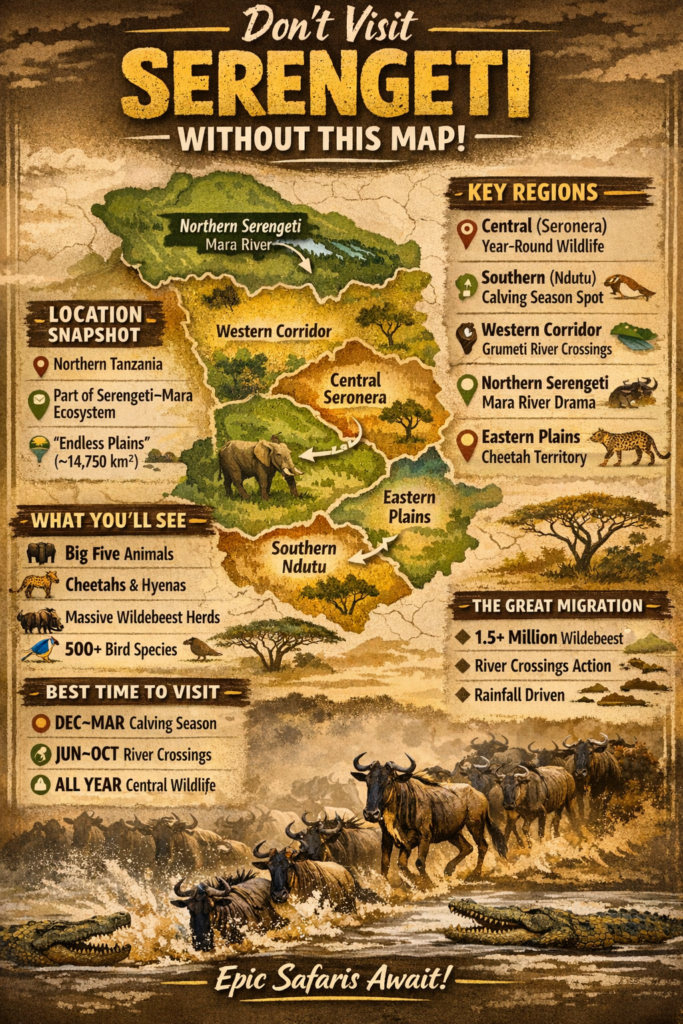
The Serengeti spans over 14,750 km² and is divided into four main safari regions: Central (Seronera), Northern (Mara River), Southern (Ndutu), and Western Corridor (Grumeti River).
Understanding the Serengeti’s geography is essential for planning your safari. The park is not a uniform expanse — each region offers different wildlife experiences, seasonal advantages, and accommodation types. Below is a detailed breakdown of each area.
📍 Central Serengeti (Seronera)
- Best for: Year-round wildlife viewing, especially predators
- Key features: Seronera River, kopjes (rock outcrops), dense leopard population
- Accommodation: Seronera Wildlife Lodge, Serena Serengeti, campsites
- Accessibility: 1.5-hour flight from Arusha to Seronera airstrip
The Central Serengeti is the park’s heart and the most popular region for first-time visitors. The Seronera River attracts wildlife even during the dry season, making game viewing reliable year-round. This area is famous for its high lion and leopard density — you’re almost guaranteed to see big cats hunting, resting in trees, or raising cubs on the kopjes. The short grass plains also make it easier to spot cheetahs and hyenas.
📍 Northern Serengeti
- Best for: Mara River crossings (July–October)
- Key features: Mara River, dramatic riverbanks, large crocodiles
- Accommodation: Sayari Camp, Mara Under Canvas, Kogatende lodges
- Accessibility: Flights to Kogatende or Lamai airstrips
The Northern Serengeti is where the Mara River crossings happen — perhaps the most dramatic wildlife spectacle on Earth. Thousands of wildebeest and zebras plunge into crocodile-infested waters, creating a frenzy of splashing, drowning, and predation. This region is remote, with fewer lodges and lower visitor numbers, offering a true wilderness experience. The crossings are unpredictable, so plan to spend at least 3–4 days here if river crossings are your priority.
📍 Southern Serengeti (Ndutu Area)
- Best for: Calving season (January–March)
- Key features: Short grass plains, nutrient-rich soils, newborn calves
- Accommodation: Ndutu Safari Lodge, mobile camps
- Accessibility: 45-minute drive from Ngorongoro Crater rim
The Southern Serengeti — often called the Ndutu area — is the calving grounds for the Great Migration. Between late January and March, over 500,000 wildebeest calves are born within a few weeks. This abundance of newborns attracts predators at peak activity. Lions, cheetahs, leopards, and hyenas hunt almost constantly. It’s also the best time for photographers: dramatic light, golden grasses, and action-packed scenes.
📍 Western Corridor
- Best for: Grumeti River crossings (May–July)
- Key features: Grumeti River, giant Nile crocodiles, fewer crowds
- Accommodation: Kirawira Camp, Mbalageti Lodge
- Accessibility: Flights to Grumeti airstrip; road from Mwanza
The Western Corridor stretches toward Lake Victoria and is defined by the Grumeti River. From May to July, the migration crosses this river, encountering some of the largest Nile crocodiles in Africa — some over 5 meters long. This region is less visited than Central or Northern Serengeti, offering a more exclusive safari. It’s also excellent for birdwatching, with over 350 species recorded.
Pro Tip: Use a Serengeti National Park map (available at any gate or online via TANAPA) to plan your routes. Distances between regions are vast: Seronera to Kogatende is about 160 km but takes 5–6 hours of rough driving. Always factor in transfer times.
Serengeti Wildlife: What Animals Can You See?
You can see: Lions, leopards, elephants, buffalo, rhinos (Big Five); wildebeest migration herds; cheetahs, hyenas, giraffes, zebras, hippos, crocodiles.
The Serengeti supports over 70 large mammal species and more than 500 bird species. Below is a complete Serengeti National Park animals and wildlife guide.
🦁 The Big Five (All Present in Serengeti)
| Animal | Best Region | Sightings Probability | Notes |
|---|---|---|---|
| Lion | Central Serengeti | Very High | Largest population in Africa (over 3,000) |
| Leopard | Seronera riverine forest | High | Often seen in trees |
| Elephant | Northern Serengeti | High | Large herds (up to 100+) |
| Buffalo | Everywhere | Very High | Often in hundreds |
| Black Rhino | Moru Kopjes (remote) | Low (rare) | Fewer than 100 individuals; need expert guide |
Other Carnivores
- Cheetah: Eastern plains and Southern Serengeti (best sightings: morning hunts)
- Spotted Hyena: Widespread; largest clan sizes in Africa (up to 80 members)
- Jackals (golden and side-striped): Common in open areas
- Bat-eared Fox: Nocturnal; seen at dawn/dusk
🦓 Herbivores (Beyond the Migration)
- Giraffe (Masai giraffe): Common in woodlands
- Hippopotamus: Hippo pools along Seronera and Grumeti rivers
- Crocodile: All major rivers; largest in Grumeti
- Eland, Topi, Hartebeest, Oribi, Dik-dik, Bushbuck
🦅 Birdlife Highlights
- Ostrich: Common on short-grass plains
- Secretary Bird: Walks on long legs hunting snakes
- Kori Bustard: Heaviest flying bird in Africa
- Vultures (7 species): Abundant near kills
- Fish Eagle, Kingfishers, Herons, Storks
Serengeti vs Masai Mara differences: While both share similar wildlife, Serengeti is larger (14,750 km² vs 1,510 km²), has year-round migration, and offers more remote areas. Masai Mara has denser wildlife during peak season but is smaller and more crowded.
The Great Wildebeest Migration Guide 2026
Over 1.5 million wildebeest, hundreds of thousands of zebras and gazelles move seasonally across the Serengeti–Masai Mara ecosystem. The migration is a continuous year-round circuit, not just one event.
The Serengeti Great Migration guide 2026 requires understanding the annual cycle. Unlike popular belief, the migration never stops. Here is the month-by-month breakdown:
📅 Migration Calendar 2026
| Months | Location | Key Event |
|---|---|---|
| January–March | Southern Serengeti (Ndutu) | Calving season: ~8,000 calves born daily |
| April–May | Central/Western Corridor | Long rains; herds spread out on rutted roads |
| June–July | Western Corridor (Grumeti) | First river crossings; giant crocodiles |
| August–October | Northern Serengeti (Mara River) | Dramatic crossings; peak tourism |
| November–December | Eastern Woodlands/return south | Short rains; herds moving back |
🔥 Why 2026 is Special
- 2026 calving season predicted to be largest in five years due to favorable rains in 2025.
- River crossings in Northern Serengeti expected mid-August to mid-October.
- New mobile camps opening in Western Corridor for 2026.
🎯 How to Plan Your Migration Safari
- Pick your season: Calving (Jan–Mar) for baby animals; Crossings (Jul–Oct) for drama.
- Book 9–12 months in advance for July–October peak.
- Stay 3+ nights per region — the migration moves unpredictably.
- Use a specialist operator who tracks migration daily via satellite.
Best time to visit Serengeti for migration: For river crossings, July–October; for calving, January–March; for best overall game viewing without crowds, June or November.
Serengeti Safari Cost 2026 (Complete Breakdown)
A Serengeti safari typically costs: Budget: $200–$350/day; Mid-range: $400–$700/day; Luxury: $800–$1,500+/day. Costs include park fees, accommodation, transport, and guide services.
Many travelers ask: “How much does a Serengeti safari cost per day?” The answer depends on accommodation, group size, season, and inclusions. Below is the most detailed 2026 cost guide available.
🧾 Daily Safari Budget Per Person (2026 Estimates)
| Safari Type | Budget | Mid-Range | Luxury | Ultra-Luxury |
|---|---|---|---|---|
| Per day (all-inclusive) | $200–350 | $400–700 | $800–1,500 | $1,600–3,000+ |
| Accommodation | Camping/public campsites | Tented camps/lodges | Luxury lodges | Private villas |
| Vehicle | 6-seater safari jeep (shared) | 4×4 Land Cruiser (shared) | Private 4×4 | Private + fly-in |
| Meals | Self-catering or basic | Full board | Full board + drinks | All-inclusive premium |
Serengeti Entry Fees Tanzania 2026 (TANAPA Official)
| Category | Fee (USD per person per 24 hours) |
|---|---|
| Non-resident adults | $82.60 (approx. 210,000 TZS) |
| Non-resident children (5–15) | $23.60 |
| Children under 5 | Free |
| East African residents (adults) | $35.40 |
| Tanzanian citizens | $11.80 |
Fees are subject to TANAPA adjustments. Always reconfirm before booking.
Other Mandatory & Optional Costs
| Cost Item | Amount (2026 est.) | Notes |
|---|---|---|
| Vehicle entry fee | $40–60 per vehicle | Paid at gate |
| Concession fees | $20–50 per person | Inside park camps/lodges |
| Crater fee (if adding Ngorongoro) | $70.80 per adult | Separate permit |
| Balloon safari | $550–650 per person | 1-hour flight + champagne breakfast |
| Guide/driver tip | $15–30 per person/day | Not included in tour price |
| Travel insurance | $50–150 | Mandatory for medical evacuation |
💡 How to Reduce Costs
- Travel in April–May (low season) — up to 40% discount on lodges.
- Join a group joining safari (6–8 people) instead of private.
- Stay in public campsites ($30–50 per night) and self-cater.
- Book from Kenya (e.g., Nairobi) — often cheaper than booking from Europe/US.
- Use local tour operators directly instead of international agents.
Example 7-day mid-range safari cost (2026): ~$3,500–$4,500 per person including flights from Arusha, all park fees, accommodation, game drives, and transfers. Excludes international flights and tips.
Serengeti Entry Fees Tanzania 2026 (Detailed)
Adults: approx. $60–$83 per day; Children (5–15): $20–$30; Below 5: Free. Fees are paid in Tanzanian Shillings or USD cash/card at gates.
Serengeti entry fees are set by TANAPA (Tanzania National Parks Authority) and increase every few years. For 2026, here is the exact breakdown:
Payment Methods
- Credit/debit card (Visa/Mastercard) accepted at major gates (Naabi Hill, Seronera)
- Cash USD (bills printed after 2015, undamaged)
- Tanzanian Shillings (exchange rate ~1 USD = 2,500 TZS approximate)
Multi-Day vs. Single Day
- Fees are per 24-hour period, not per calendar day.
- Enter at 10:00 AM on Monday → valid until 10:00 AM on Tuesday.
- Overnight inside the park means you pay for each 24-hour block.
Special Fee Notes
- Students (with valid ID): 50% discount on adult resident rates.
- Vehicle fee: $40 per vehicle (up to 6 seats) + $10 per extra seat.
- Camping fee: $30 per adult per night (public campsites); $50–100 for special campsites.
Pro tip: If you are combining Serengeti with Ngorongoro Crater safari, the Ngorongoro Conservation Area Authority (NCAA) charges separate fees: $70.80 per adult per 24 hours + $295 crater service fee per vehicle.
Best Time to Visit Serengeti (Month-by-Month 2026)
Jan–Mar: Calving season (Southern Serengeti); Jul–Oct: River crossings (Northern Serengeti); Jun–Oct: Best overall wildlife viewing.
Choosing the best time to visit Serengeti depends on your priorities. Here is a month-by-month breakdown for 2026.
🌦️ Seasonal Overview
| Month | Migration Location | Weather | Crowds | Wildlife Highlights | Rating (1-5) |
|---|---|---|---|---|---|
| January | Southern Ndutu | Short rains end | Low | Calving begins | ⭐⭐⭐⭐ |
| February | Southern Ndutu | Dry & sunny | Medium | Peak calving | ⭐⭐⭐⭐⭐ |
| March | Southern/Central | Start of long rains | Low | Last calving | ⭐⭐⭐⭐ |
| April | Central/Western | Heavy rains | Very low | Green scenery | ⭐⭐⭐ |
| May | Western Corridor | Rains continue | Low | Grumeti build-up | ⭐⭐⭐ |
| June | Western/Northern | Dry | Medium | First Grumeti crossings | ⭐⭐⭐⭐ |
| July | Northern Serengeti | Dry & cool | High | Mara River starts | ⭐⭐⭐⭐⭐ |
| August | Northern Serengeti | Dry | Very high | Peak crossings | ⭐⭐⭐⭐⭐ |
| September | Northern Serengeti | Dry | Very high | Dramatic crossings | ⭐⭐⭐⭐⭐ |
| October | Northern/Eastern | End of dry | High | Crossings continue | ⭐⭐⭐⭐⭐ |
| November | Eastern Woodlands | Short rains | Low | Herds moving south | ⭐⭐⭐ |
| December | Southern Serengeti | Rainy | Low | Calving preparation | ⭐⭐⭐ |
Best Times for Specific Activities
- Photography: February (golden light, green grass) or August (dusty drama)
- Avoiding crowds: April–May or November
- Budget travel: April–May (lodges at 50–60% off)
- Birdwatching: November–April (migratory birds from Europe)
- Walking safaris: June–October (dry season)
When is the best time to visit Serengeti for the Great Migration? For river crossings: mid-July to mid-October. For calving: February. For avoiding crowds but still seeing migration: June or November.
Serengeti Safari Itinerary Suggestions (3, 5 & 7 Days)
A typical Serengeti safari itinerary includes: arrival via Kilimanjaro or Arusha, transit via Ngorongoro Crater rim, 3–5 nights inside Serengeti with daily game drives, and optional add-ons like balloon safari or Lake Manyara.
Below are three sample itineraries for 2026. All assume you start/end in Arusha (the safari capital of Tanzania).
📆 3-Day Express Safari (Best for time-limited travelers)
- Day 1: Arusha → Ngorongoro Crater rim (4 hours). Afternoon crater tour. Overnight at rim lodge.
- Day 2: Descend into Crater for morning game drive → drive to Serengeti (Naabi Hill gate) → afternoon game drive in Central Serengeti. Overnight Seronera.
- Day 3: Morning game drive in Central Serengeti → drive to Arusha via Manyara (optional). Fly out.
📆 5-Day Classic Safari (Best for first-timers)
- Day 1: Arusha → Lake Manyara National Park (flamingos, tree-climbing lions) → overnight Manyara.
- Day 2: Manyara → Ngorongoro Crater (full day crater floor) → overnight rim.
- Day 3: Crater rim → Serengeti (Central). Afternoon game drive.
- Day 4: Full day Central Serengeti (morning & afternoon drives). Optional balloon safari.
- Day 5: Morning game drive → return to Arusha.
📆 7-Day Migration Focus Safari (Best for serious wildlife enthusiasts)
- Day 1: Arusha → Ngorongoro Crater (half-day) → overnight rim.
- Day 2: Rim → Central Serengeti. Afternoon game drive.
- Day 3: Central Serengeti (predator hunting focus).
- Day 4: Central → Northern Serengeti (Kogatende). Afternoon near Mara River.
- Day 5: Full day Northern Serengeti (river crossings waiting).
- Day 6: Northern → Eastern Serengeti (Lobo area) → overnight.
- Day 7: Morning game drive → fly from Kogatende airstrip to Arusha.
Serengeti safari itinerary tip: Always add one “buffer day” for migration chasing. The wildebeest don’t follow schedules.
Serengeti Travel Tips 2026 (Packing, Safety & Logistics)
Neutral safari clothing (khaki, green, beige); binoculars + camera; sunscreen & insect repellent; light jacket for mornings. Always choose accommodation based on migration movement — not just price. Safari drives can take 8–10 hours between regions, not the “short transfers” many itineraries suggest.
Here is your complete Serengeti safari packing list and practical tips.
🎒 Essential Packing List
| Category | Items |
|---|---|
| Clothing | Neutral-colored shirts/pants (no black or blue, attracts tsetse flies); fleece jacket (mornings are 10°C/50°F); waterproof jacket (rainy season); wide-brimmed hat; swimwear (lodges have pools) |
| Footwear | Closed walking shoes (game drives have dusty exits); sandals (camp/lodge) |
| Gear | Binoculars (minimum 8×42); camera with 200mm+ zoom; extra batteries/power bank; headlamp (campsites) |
| Health | Malaria prophylaxis (consult doctor); insect repellent (DEET 30%+); sunscreen SPF 50+; basic first aid kit; rehydration salts |
| Documents | Passport (6+ months validity); yellow fever certificate (if coming from endemic country); travel insurance; e-visa printout |
🚗 Safari Driving Tips
- Road conditions: Extremely dusty and bumpy (expect “African massage”). 4×4 mandatory.
- Distances: Seronera to Kogatende = 5–6 hours. Seronera to Ndutu = 2–3 hours.
- Gate hours: Open 6:00 AM – 6:00 PM. Entering after 4:00 PM is not recommended.
- Fuel: Only available at Seronera (expensive, unreliable). Fill up in Arusha or Ngorongoro.
🦁 Safety & Etiquette
- Never get out of vehicle except at designated picnic sites.
- Keep windows up around lions and hyenas (they can jump into vehicles).
- Respect speed limits (max 50 km/h on main roads, 30 km/h on tracks).
- No night drives inside Serengeti (except special permits).
- Tipping guide: $15–30 per person/day (shared among group).
📶 Connectivity & Money
- Mobile signal: Vodacom/Tigo/Airtel works in Central Serengeti only. No signal in North/South.
- Wi-Fi: Available at most lodges (slow, expensive).
- ATMs: None inside the park. Bring enough USD cash (small bills for tips).
- Credit cards: Accepted at Seronera visitor center and luxury lodges (surcharge 3–5%).
Serengeti travel guide from Kenya: Many travelers fly into Nairobi, then take a connecting flight to Kilimanjaro or Arusha. Alternatively, drive from Nairobi to Namanga border (4 hours), then to Arusha (1.5 hours), then to Serengeti (6 hours). A cheaper option: fly Nairobi to Mwanza (Tanzania) then drive 4 hours to Western Serengeti.
Serengeti vs Masai Mara: Key Differences
Serengeti is larger (14,750 km² vs 1,510 km²), has year-round migration, lower vehicle density, but higher park fees and longer driving distances. Masai Mara has more predictable river crossings (July–Oct) and is easier to access from Nairobi.
For travelers choosing between these two iconic destinations, here is an honest comparison for 2026.
| Feature | Serengeti National Park | Masai Mara National Reserve |
|---|---|---|
| Size | 14,750 km² | 1,510 km² |
| Country | Tanzania | Kenya |
| Migration period | Year-round (circuit) | July–October only |
| Vehicle density | Low outside Central | High (especially around crossings) |
| Park fees (2026) | $82.60/adult/day | $100/adult/day (peak) |
| Road quality | Poor (very dusty, bumpy) | Better (some tarmac) |
| Night game drives | Not allowed | Allowed (extra fee) |
| Hot air balloon | Yes ($550–650) | Yes ($450–500) |
| Nearest airport | Kilimanjaro (JRO) or Arusha (ARK) | Nairobi (NBO) or Mara airstrips |
| Best for | True wilderness, longer safaris | Short trips, photography, luxury camps |
🤔 Which One Should You Choose in 2026?
- Choose Serengeti if: You have 5+ days, want to see the migration outside July–October, prefer fewer crowds, or are combining with Ngorongoro Crater.
- Choose Masai Mara if: You have only 2–3 days, want guaranteed river crossings (August–September), prefer easier flights from Europe, or want night game drives.
Can you do both? Yes! A 10-day “Twin Safari” is popular: 4 days Masai Mara (Kenya) + 6 days Serengeti & Ngorongoro (Tanzania). Requires crossing at Isebania border post (allow 4 hours).
Final Thoughts
The Serengeti National Park is not just a safari destination it is a living wildlife ecosystem where nature unfolds on a massive scale every day.
Whether you’re chasing the Great Migration, photographing predators stalking through golden grass, or simply sitting on a kopje watching the sun set over an endless horizon, Serengeti delivers one of the most unforgettable travel experiences on Earth.
For 2026, plan ahead, book early for peak season (July–October), respect the wildlife, and leave nothing but footprints. The Serengeti will reward you with memories that last a lifetime.
Frequently Asked Questions (FAQs)
What is Serengeti National Park famous for?
Serengeti National Park is famous for the Great Wildebeest Migration, Big Five wildlife, and vast savannah ecosystems that make it one of Africa’s top safari destinations.
How much does a Serengeti safari cost in 2026?
A Serengeti safari typically costs: Budget: $200–$350/day; Mid-range: $400–$700/day; Luxury: $800–$1,500+/day. Costs include park fees, accommodation, transport, and guide services.
What animals can you see in Serengeti National Park?
You can see: Lions, leopards, elephants, buffalo, rhinos (Big Five); wildebeest migration herds; cheetahs, hyenas, giraffes, zebras, hippos, crocodiles.
When is the best time to visit Serengeti?
Jan–Mar: Calving season (Southern Serengeti); Jul–Oct: River crossings (Northern Serengeti); Jun–Oct: Best overall wildlife viewing.
Where is Serengeti National Park located?
Serengeti is located in northern Tanzania, bordering the Masai Mara (Kenya) ecosystem.
How many days do you need in Serengeti?
Minimum 3 days (but rushed). Recommended 5–7 days to see multiple regions and increase wildlife sighting odds.
Do I need a visa for Serengeti (Tanzania)?
Yes. Most nationalities require a Tanzanian e-visa ($50–100). Apply online at least 2 weeks before travel. Visas on arrival available at JRO airport ($50–100 cash).
Is Serengeti safe for tourists?
Yes. Serengeti is one of the safest safari destinations. Crime against tourists is extremely rare. Wildlife poses the only danger — always follow your guide’s instructions.
Ready to plan your Serengeti safari in 2026? Book accommodations 6–12 months in advance for peak season (July–October) and always check TANAPA’s latest fee updates before finalizing your budget.
More Reading from Mara Triangle Safaris
| Article | What You’ll Find |
|---|---|
| The Ultimate A‑Z Safari Animal Guide | 100+ animals from aardvark to zebra. Photos, facts, and a printable checklist. |
| Safari Travel Insurance: What You Need and Why | Essential coverage for medical evacuation, trip cancellation, and gear. |
| Kenya eVisa Guide: How to Get Yours Fast | Step‑by‑step application tips and common mistakes to avoid. |
| Safari Animals 101: The Ultimate Guide for First-Timers | What you’ll actually see, where, and when. |