
When Does the Great Wildebeest Migration Reach the Mara River? (2026 Guide)
Planning to witness the Mara River crossings? Learn when the Great Wildebeest Migration reaches the Mara River in 2026, the best months to visit, and expert safari tips.
⚡ Key Takeaways
When Does the Great Wildebeest Migration Reach the Mara River? (2026 Guide)-Mara Triangle Safaris
When does the Great Migration hit the Mara River?
That’s the million-dollar question every safari planner asks.
The short answer: late July through September 2026.
But here’s the thing!
These wildebeest don’t follow calendars.
They follow rain and fresh grass.
One day the riverbanks are empty, the next day chaos erupts as thousands plunge into crocodile-infested waters.
We’ve been tracking this spectacle for years, and we know exactly where to position you for front-row seats.
Timing matters, but knowing where to be matters more.
This guide gives you everything, timing, locations, tips, so you show up ready for the greatest show on Earth.
Let’s get started.
Quick answer:
The Great Wildebeest Migration typically reaches the Mara River in late July, with the most dramatic crossings happening from August through September 2026. The exact timing depends on rainfall, grazing conditions, and herd movement—so flexibility is key.
The herds usually arrive in Kenya’s Masai Mara from Tanzania around mid to late July,
with peak river crossing activity from late July through September, sometimes stretching into early October.
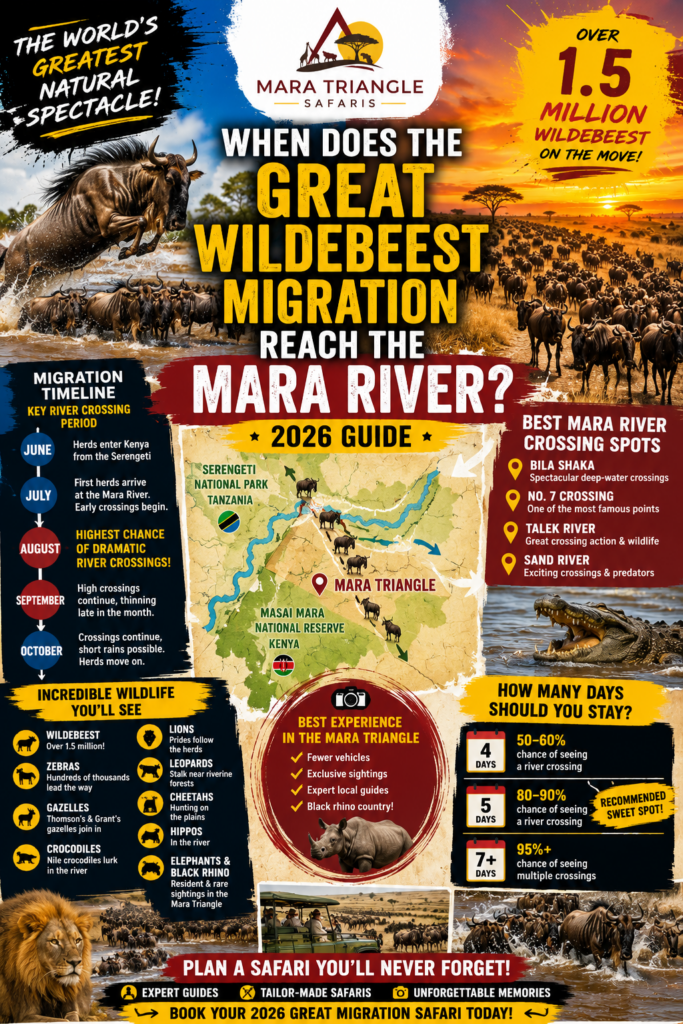
The Great Wildebeest Migration Timeline
The Great Migration is a year-round, clockwise movement of over 1.5 million wildebeest, joined by hundreds of thousands of zebras and gazelles, across the Serengeti-Mara ecosystem. It’s not one single event but a continuous journey shaped by rainfall and grass availability.
The animals calve in the southern Serengeti near the Ngorongoro Conservation Area from late January through March. As conditions change, the herds move west and north through the Serengeti around April to June, then typically reach the Mara River around July through September.
By October, the herds begin shifting south again with the short rains, completing the loop. This movement isn’t rigid—rainfall can push everything earlier or later in any given year.
Key dates for 2026:
- January–March: Calving season in southern Serengeti/Ndutu area
- April–June: Herds trek north through central and western Serengeti
- July: First herds arrive in the Maasai Mara; early crossings begin
- August–September: Peak Mara River crossing season
- October: Crossings continue early month; herds begin southward return
When Does the Migration Reach the Mara River?
The herds typically begin arriving in the Maasai Mara from mid to late July, moving northward from Tanzania’s Serengeti. The most dramatic and frequent Mara River crossings are expected from late July through August and into September 2026, with the busiest weeks often falling in August.
In a typical year, August and September are the most reliable months for crossings. But we’ve seen years where July was better and years where October produced the biggest crossings. The herds move based on rainfall, not a calendar.
2026 crossing window:
- July 15 – early August: Herds arriving + early crossings begin
- August – September: Highest chances of dramatic Mara River crossings
- Late September – early October: Possible continued crossings with fewer crowds
Why the Mara River Crossings Are Unpredictable
Here’s the thing nobody can guarantee: exact dates. The wildebeest don’t check calendars. They cross when they feel like it—sometimes in the morning, sometimes at noon, sometimes not for days.
River crossings happen when three conditions align:
- A sufficient wildebeest gathering (at least several thousand)
- Moderate river flow speed (too slow lacks impact, too fast deters wildebeests from entering)
- Moderate predator activity (crocodiles, hippos)
Crossings usually occur at dawn or dusk, each lasting 10-30 minutes, with millions of wildebeests charging into the rapids.
Rain dictates everything. When rain falls in the south, the herds move north. When dry spells hit, they bunch up at rivers. If the rains come late in Tanzania, the crossings shift later.
That’s why we always recommend booking enough days to improve your odds. A 3-day safari gives you about a 30-40% chance of seeing a crossing. A 5-day safari pushes that to 80-90%.
Best Months to Witness the Mara River Crossings
July: The first herds start arriving from the Serengeti. Crossings can be sporadic this early, but early birds sometimes get the best views. Smaller crossings happen at the Sand River and later at the Mara River in the north.
August: Peak month. The famous footage you’ve seen on TV happens here. Hundreds of thousands of wildebeest on the Kenya side. Crossings are at their most frequent and dramatic. Lodges are at their most expensive and most booked.
September: Still peak season. Crossings continue. Crowds thin slightly after the first week as summer holidays end. Dry, warm, and less hectic than August. A slightly better value if your dates are flexible.
October: The migration herds start heading south. Crossings still happen early October. By late October, the short rains can begin, though timing varies. The Mara is still productive for resident wildlife. Prices begin to ease.
| Month | Crossing Likelihood | Crowds | Weather | Park Fees |
|---|---|---|---|---|
| July | Moderate → Building | Increasing | Dry, overcast mornings | Peak ($200/day) |
| August | Highest | Peak | Dry, warm | Peak ($200/day) |
| September | High → Thinning late | High | Dry, warm | Peak ($200/day) |
| Early October | Moderate | Lower | Dry, possible short rains | Peak easing |
Where Are the Best Mara River Crossing Locations?
The Mara River flows through both Kenya’s Masai Mara and Tanzania’s Serengeti. Crossing points vary, but the most reliable spots are in the Maasai Mara’s Mara Triangle.
Key crossing points in the Mara Triangle:
- Bila Shaka Riverbank — where lions wait for exhausted survivors
- No. 7 Crossing — fewer vehicles, better photography angles
- Talek River — smaller crossings but more frequent
- Sand River — shallower, often has early-season activity
The Mara Triangle offers some of the most exclusive and rewarding safari experiences in the greater Masai Mara. Managed by the Mara Conservancy, this region ensures well-maintained roads, effective anti-poaching patrols, and sustainable tourism practices.
With fewer lodges and vehicles, sightings feel exclusive and unhurried, especially during the Great Migration’s dramatic river crossings. The landscape is a stunning mix of open plains, riverine forest, and seasonal marsh, alive with big cats, elephants, black rhino, and prolific birdlife.
The Mara Triangle is the only area in the Masai Mara where rhino are reliably found—making it the only true Big Five area within the Mara ecosystem.
Why the Mara Triangle Offers Incredible River Crossing Experiences
Fewer vehicles, better views. With only two permanent camps within the Triangle itself, and strict regulations on vehicle numbers, you won’t be fighting for position at a crossing. Fewer vehicles pressing into sightings means the animals remain more relaxed and behave more naturally.
Expert guides who know the land. Our guides monitor herd movements daily. They know the crossing points, the patterns, and the signs that suggest a crossing is about to happen.
Access to both sides of the Mara River. This unique position opens up more space, more wildlife, and fewer crowds. You can follow the action without being boxed in.
Year-round wildlife. Even when the herds move on, the spectacle endures. Lions hunt the plains. Elephants stir the riverine forest. Birdlife dazzles with over 470 recorded species.
Conservation-focused experience. The Mara Conservancy’s public-private partnership ensures sustainable tourism practices and effective wildlife protection. Your visit directly supports conservation efforts.
Wildlife You Can Expect During the River Crossings
Wildlife You’ll See During the Mara River Crossing
- Wildebeest — Over 1.5 million moving in vast columns across the plains and rivers.
- Zebras — Hundreds of thousands often lead the migration and cross first.
- Gazelles — Thomson’s and Grant’s gazelles join the migration herds.
- Nile Crocodiles — Lurking in the river, waiting for crossing moments.
- Lions — Prides follow the herds, targeting weak and exhausted animals.
- Leopards — Found near riverine forests, silently stalking prey.
- Cheetahs — Fast hunters chasing prey on open plains.
- Hippos — Sharing the river channels with migrating herds.
- Elephants — Resident herds roaming the Mara Triangle.
- Black Rhino — Rare and iconic, reliably found in the Mara Triangle.
Photography Tips for Capturing River Crossings
Want to come back with incredible photos? Here’s what you need:
Gear essentials:
- Telephoto lens (400mm+) — capture the fear in wildebeests’ eyes and crocodile attacks in detail
- High-speed burst (1/2000s+) — freeze the moment wildebeests leap across the riverbank
- Low-angle shots — shoot from vehicle rooftops with wide-angle lenses for dramatic impact
Best times: Dawn and dusk offer the best lighting for dramatic river crossing photos.
Patience pays: Some groups wait at crossing points for hours and see nothing. Others catch two crossings in a single morning. It’s not a scheduled performance.
Consider a hot air balloon safari — drift above the river crossings at sunrise for a National Geographic-worthy perspective.
Frequently Asked Questions
Ready to Witness the Greatest Show on Earth?
The 2026 Great Migration is coming, and the Mara Triangle is the place to be. With fewer vehicles, exclusive sightings, and the highest density of wildlife in the Masai Mara, we offer the ultimate river crossing experience.
Contact Mara Triangle Safaris
📱 WhatsApp: +254 705 635 886 | +254 768 212 702
✉️ Email: info@maratrianglesafaris.co.ke | deals@maratrianglesafaris.co.ke
Plan your 2026 safari now — peak season books up months in advance. By March, the popular river-adjacent camps are usually full for July-August.
Our packages include:
- Expert guides with daily herd tracking
- Premium accommodation in the Mara Triangle
- Vehicles with guaranteed window seats
- Flexible itineraries to maximize crossing opportunities
- Conservation fees supporting the Mara Conservancy
Don’t gamble on a once-in-a-lifetime trip. Book with the experts who know the Mara River crossings best.
| Topic | Article / Resource | Category |
|---|---|---|
| The Great Migration & River Crossings Wildebeest crossings, crocodiles & predators |
Serengeti Safari Booking Guide (2026) | Migration |
| Year‑Round Wildlife in the Mara Triangle Lions, cheetahs, elephants & the only reliable rhino sightings |
Home – Mara Triangle Safaris | Wildlife |
| Lodges & Where to Stay (2026) Best camps, map locations & how to choose |
Mara Triangle Lodges Guide 2026 | Lodges |
| Exclusivity: Only Two Permanent Camps Low‑density tourism for a private safari experience |
Home – Mara Triangle Safaris | Exclusive |
| Eco‑Friendly Safari Experiences Sustainable lodges & responsible travel |
Best Eco‑Friendly Safari Experiences 2026 | Eco‑Tourism |
| Mara Triangle vs Masai Mara Reserve Which one offers a better safari? |
Home – Mara Triangle Safaris | Conservation |
| Mara Conservancy & Sustainable Management Anti‑poaching, road maintenance & vehicle limits |
Home – Mara Triangle Safaris | Conservation |
| The Big Five in the Mara Triangle Lion, leopard, elephant, buffalo & rhino |
Home – Mara Triangle Safaris | Big Five |
| Best Time to Visit for the Migration When to catch the river crossings |
Serengeti Safari Booking Guide (2026) | Planning |
| Budget vs Luxury Safari Options From affordable to all‑inclusive packages |
Home – Mara Triangle Safaris | Safari |