

Safari Animals 101: The Ultimate Guide for First-Timers
First safari? Here’s your complete guide to African wildlife. From the Big Five to everyday stars, plus where to find them. Your ultimate animal name list for planning.
Safari Animals 101: What You’ll Actually See in Kenya and Tanzania | Mara Triangle Safaris
Right then. You’re going on safari.
First time. Big trip. Probably been dreaming about it for years.
But let’s be honest. You’re also wondering: What animals will I actually see?
Not the National Geographic version. Not the documentary where they spent three months waiting for one shot. Real life. In your vehicle. With your own eyes.
Good question. Because Africa isn’t a zoo. Animals don’t show up on schedule. And nobody wants to come home and say “we saw grass for a week.”
So let’s cut through the noise.
This guide covers exactly what you can expect. The animals you’ll almost definitely see. The ones you’ll have to work for. The ones that’ll make you the coolest person at dinner when you get home.
No fluff. No guarantees. Just honest advice from people who do this every single day.
Let’s meet the locals. 🦁
Listen for alarm calls.
If antelopes are staring at a spot and
snorting, there’s a predator there.
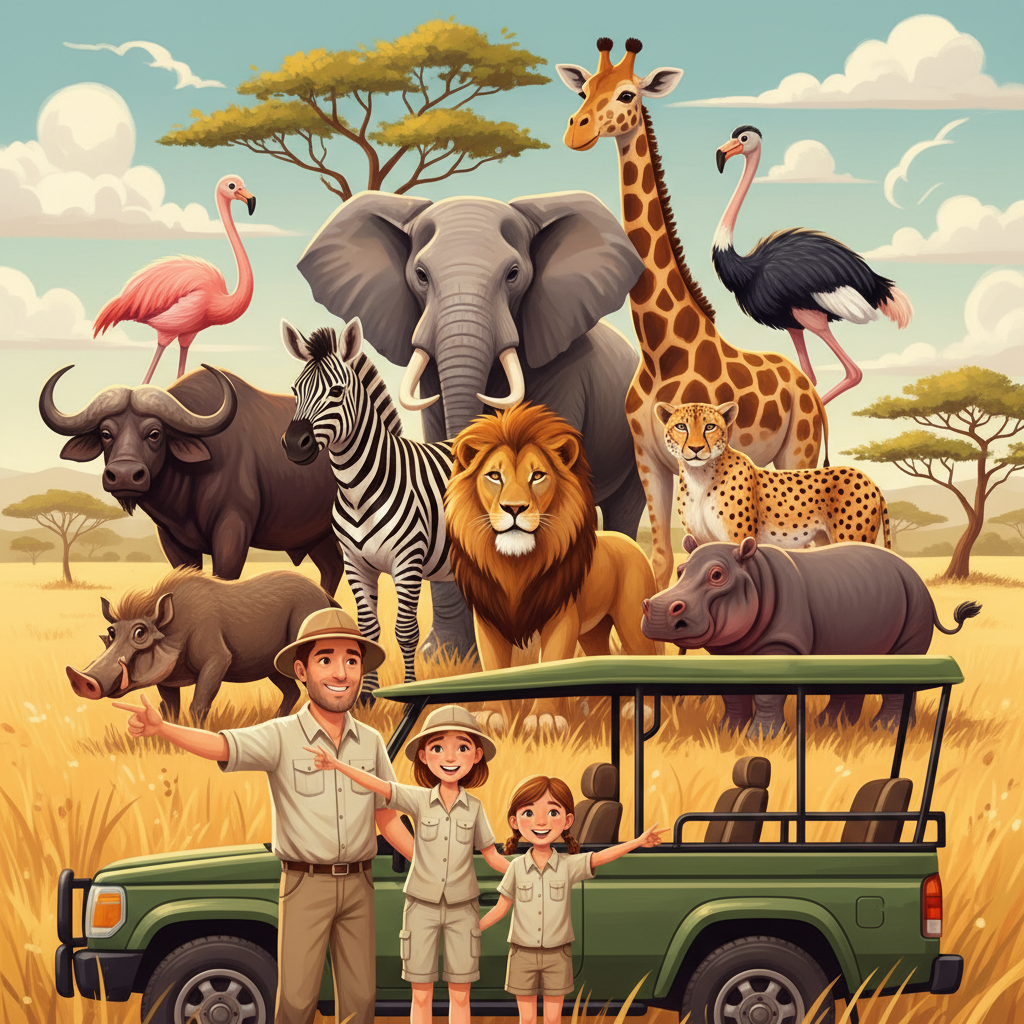
Quick Reference: What You’ll Actually See
Here’s the honest truth. Some animals are everywhere. Some take patience. Some are pure luck.
| Animal | Where to Find It | Best Time | Likelihood |
|---|---|---|---|
| Zebra | Everywhere | Year-round | ★★★★★ (Certain) |
| Wildebeest | Mara, Serengeti | Year-round | ★★★★★ (Certain) |
| Giraffe | Mara, Amboseli, Serengeti | Year-round | ★★★★★ (Certain) |
| Impala | Everywhere | Year-round | ★★★★★ (Certain) |
| Elephant | Amboseli, Mara, Serengeti | Year-round | ★★★★☆ (Very Likely) |
| Buffalo | Mara, Amboseli, Serengeti | Year-round | ★★★★☆ (Very Likely) |
| Hippo | Mara River, hippo pools | Year-round | ★★★★☆ (Very Likely) |
| Crocodile | Mara River, hippo pools | Year-round | ★★★★☆ (Very Likely) |
| Lion | Mara, Serengeti | Year-round | ★★★★☆ (Very Likely) |
| Hyena | Everywhere | Year-round | ★★★★☆ (Very Likely) |
| Baboon | Everywhere | Year-round | ★★★★☆ (Very Likely) |
| Warthog | Everywhere | Year-round | ★★★★☆ (Very Likely) |
| Gazelle | Mara, Serengeti | Year-round | ★★★★☆ (Very Likely) |
| Topi | Mara, Serengeti | Year-round | ★★★☆☆ (Likely) |
| Cheetah | Mara, Serengeti | Year-round | ★★★☆☆ (Likely) |
| Leopard | Mara, Serengeti | Year-round | ★★★☆☆ (Likely) |
| Ostrich | Open plains | Year-round | ★★★☆☆ (Likely) |
| Flamingo | Lake Nakuru, Lake Natron | Year-round | ★★★☆☆ (Likely) |
| Rhino | Conservancies, Ngorongoro | Year-round | ★★☆☆☆ (Possible) |
| Wild Dog | Laikipia, Selous | Year-round | ★☆☆☆☆ (Rare) |
| Pangolin | Night drives | Night | ★☆☆☆☆ (Very Rare) |
| Aardvark | Night drives | Night | ★☆☆☆☆ (Very Rare) |
Look up.
Leopards love trees, especially
along rivers and in rocky areas.
The Big Five: The Legends
Let’s start with the famous ones. The ones that made safari famous. Here’s the honest truth about each.
Lion
Where to find it: Maasai Mara, Serengeti (highest densities in Africa)
The lion is the king for a reason. It’s the only truly social cat, living in prides of up to 30 individuals. Females do most of the hunting—together, they can take down buffalo and even young elephants.
What to expect: In the Mara and Serengeti, lions are common. You’ll almost certainly see them. Often in the middle of the road, completely unbothered by your vehicle.
Best time: Any time. But mornings and evenings are when they’re most active.
Leopard
Where to find it: Maasai Mara, Serengeti, Samburu
The ghost cat. Solitary, secretive, and absolutely beautiful. Leopards are masters of camouflage, spending their days draped over tree branches or hidden in thick bush.
What to expect: You’ll work for this one. Even in the Mara, leopards require patience. Your guide will listen to the radio network and track recent sightings.
Best time: Dawn and dusk. They’re nocturnal but often active in low light.
Elephant
Where to find it: Amboseli (biggest tuskers), Mara, Serengeti, Tsavo
The gentle giant. Elephants are the soul of Africa. In Amboseli, you’ll see giants with tusks that nearly touch the ground. In the Mara, you’ll see families with tiny babies.
What to expect: Almost guaranteed. Elephants are everywhere. You’ll hear them before you see them—the rumble of a herd, the crack of branches.
Best time: Year-round. But Amboseli in March offers crystal-clear Kilimanjaro views behind them.
Watch the matriarch. She leads.
If she stops and faces you, stop too.
Give them space.
Buffalo
Where to find it: Everywhere. Mara, Amboseli, Serengeti—they’re everywhere.
The Black Death. Old hunters called them that for a reason. Buffalo are responsible for more hunter deaths than any other animal in Africa. They’re fiercely protective of their herd.
What to expect: Massive herds. Often hundreds of them. They’ll stare at you with that grumpy expression, then go back to grazing.
Best time: Year-round.
Rhino
Where to find it: Private conservancies, Ol Pejeta, Ngorongoro Crater
The hardest of the Big Five. Rhinos are critically endangered, which means seeing one is special. Black rhinos are browsers, with hooked lips. White rhinos are grazers, with square mouths.
What to expect: Not guaranteed. You need to be in the right place. Conservancies like Ol Pejeta and the Ngorongoro Crater are your best bets.
Best time: Year-round. But you’re at the mercy of where they are that day.
Don’t confuse black and white.
Colour is the same grey.
White comes from “wyd” (wide), referring to the mouth.
The Everyday Stars: You’ll See These Daily
These animals might not be on your bucket list. But they’re the ones that make the savannah feel alive.
Zebra (Burchell’s)
Everywhere. Hundreds of them. Their stripes are unique to each individual—like fingerprints. They’re closely related to horses and donkeys, with a distinctive braying call. In the Mara, you’ll see them grazing alongside wildebeest, a symbiotic relationship.
Why you’ll love them: They’re photogenic. They travel in big families. And they always look like they’re wearing pyjamas.
Wildebeest (Blue)
The workhorse of the savannah. They’re not pretty. They’re not graceful. But there are millions of them, and they run the show. During the migration, they carpet the plains. In March, they’re calving in the southern Serengeti—thousands of babies dropping daily.
Why you’ll love them: They’re the reason the ecosystem works. And watching a herd cross the Mara River? Unforgettable.
Giraffe (Masai)
The tallest animal on earth. Masai giraffes have jagged, irregular spots that look like oak leaves. Their tongues are up to 45 centimetres long and dark-coloured to prevent sunburn. Despite those long necks, they have the same number of neck vertebrae as humans—seven.
Why you’ll love them: They’re absurdly elegant. Walking, eating, even running—everything a giraffe does looks like ballet.
Impala
The most common antelope. Males have lyre-shaped horns. Females don’t. They’re the McDonald’s of the savannah—every predator’s favourite fast food. When alarmed, the whole herd springs in all directions. It’s pure chaos and beautiful.
Why you’ll love them: They’re everywhere. And they’re gorgeous. The “M” on their rump is the “McDonald’s” joke. You’ll never unsee it.
Warthog (Pumbaa)
Pumbaa’s real-life cousin. They kneel to feed, using their tough calloused knee pads. They run with tails straight up—a signal to follow the leader. They’re surprisingly fast and often use aardvark burrows to escape danger.
Why you’ll love them: They’re hilarious. They trot around with that tufty tail up, looking like they’re on a mission.
Never get between a buffalo and its herd.
In your vehicle, you’re safe.
But respect them.
The Predators Beyond Lions
Lions get the glory. But these hunters are just as impressive.
Cheetah
The fastest land animal on earth. 120 km/h in short bursts. But they can’t sustain it—20-30 seconds, then they’re done. Unlike other big cats, cheetahs can’t roar. They chirp like birds to communicate.
Where to find them: Open plains of the Mara and Serengeti. They need space to run.
Best time: Morning and late afternoon.
Pro tip: Look for them on termite mounds. They use them as lookout points.
Spotted Hyena
Often misunderstood. They’re not just scavengers—they’re skilled hunters, taking down wildebeest and zebra. Females are larger and dominate the clan. Their “laugh” is actually a social communication, not a joke.
Where to find them: Everywhere. They’re the most common large carnivore.
Best time: Dawn and dusk.
Pro tip: Watch them hunt. They’re smarter than lions. Pack coordination is incredible.
Black-backed Jackal
Monogamous and mate for life. They’re opportunistic omnivores, eating everything from fruit to small antelopes. Their distinctive black saddle makes them easy to identify. They often shadow lions and hyenas, hoping for scraps.
Where to find them: Open plains.
Best time: Dawn and dusk.
Pro tip: Listen for their high-pitched howl at night.
African Wild Dog (Painted Wolf)
One of Africa’s most endangered carnivores. They hunt in packs with incredible coordination, often succeeding in 80% of their chases—far higher than lions. Their coats are unique to each individual, like fingerprints.
Where to find them: Laikipia, Selous, Ruaha. Rare in the main Mara circuit.
Best time: Morning.
Pro tip: If you see them, consider yourself lucky. Few travelers do.
The Antelope Family: Spotting the Differences
Africa has dozens of antelope species. Here are the ones you’ll actually encounter.
| Species | How to Spot It | Where |
|---|---|---|
| Gazelle (Thomson’s) | Small, white stripe on side | Serengeti, Mara |
| Gazelle (Grant’s) | Larger, no stripe, bigger horns | Serengeti, Mara |
| Topi | Muscular, purplish-red, stands on mounds | Mara, Serengeti |
| Hartebeest | Oddly shaped horns, sloping back | Open plains |
| Eland | Largest antelope, spiral horns | Light woodland |
| Waterbuck | White ring on rump, smells bad | Near water |
| Bushbuck | Shy, forest-dwelling, males dark | Thick bush |
| Kudu (Greater) | Spiral horns, grey with white stripes | Bushland, northern Tanzania |
| Gerenuk | Long neck, stands on hind legs | Samburu, northern Kenya |
| Oryx (Beisa) | Straight horns, horse-like | Samburu, northern Kenya |
The easiest way to tell them apart is the rump.
Zebra have stripes.
Impala have the “M.” Waterbuck have a white ring.
Topi have dark patches.
Primates and Small Mammals
These guys are the characters of the bush.
Baboon (Olive)
Highly social, living in troops of up to 150 individuals. They have complex hierarchies and even friendships. Watch them groom each other—it’s their version of a coffee date.
Where to find them: Everywhere. Camps, roadsides, forests.
Best time: Any time.
Pro tip: Keep your vehicle windows up around them. They’ll steal anything that looks like food.
Vervet Monkey
The cheeky monkeys you’ll see around lodges. They have black faces with white brow bands. Males have bright blue scrotums—a sign of social status. They have distinct alarm calls for different predators: leopard, eagle, snake, and baboon.
Where to find them: Everywhere.
Best time: Any time.
Pro tip: Don’t feed them. Seriously. They’ll become aggressive.
Banded Mongoose
Live in troops of up to 40 individuals. They’re highly social, grooming each other and even babysitting each other’s young. They move through the bush in a group, chattering constantly, often crossing roads in single file.
Where to find them: Woodland, near termite mounds.
Best time: Morning.
Pro tip: Watch them hunt. They work as a team, flushing out insects.
Rock Hyrax
Looks like a guinea pig. Closest living relative? The elephant. Yes, really. They share similarities in foot structure, tooth formation, and testicle location. They sunbathe on rocks in the morning, always watching for eagles.
Where to find them: Rocky outcrops (kopjes).
Best time: Morning.
Pro tip: They’re the most common “weird” animal you’ll see. And they’re adorable.
Birds That Steal the Show
You might come for the mammals. You’ll leave talking about the birds.
Ostrich (Masai)
The world’s largest bird. Can’t fly, but runs at 70 km/h—faster than a lion. Their eggs are the largest of any living animal, weighing up to 1.5 kilograms. Males have black and white plumage; females are brown.
Where to find them: Open plains.
Best time: Year-round.
Lilac-breasted Roller
Kenya’s national bird. Arguably Africa’s most beautiful. Lilac breast, turquoise belly, multiple shades of blue on its wings. It’s called a roller for its acrobatic mating flight.
Where to find them: Everywhere. They sit on treetops and wires.
Best time: Year-round.
Flamingo (Lesser and Greater)
Millions can gather on a single lake, creating a sea of pink. They get their colour from the algae and crustaceans they eat. Lake Natron in Tanzania is their primary breeding ground.
Where to find them: Lake Nakuru, Lake Bogoria, Lake Natron.
Best time: Year-round, but water levels affect numbers.
African Fish Eagle
Its call is the soundtrack of African documentaries—that haunting, far-carrying cry. It snatches fish from the water with powerful talons, often spotting prey from high in the trees.
Where to find them: Near lakes and rivers.
Best time: Year-round.
Secretary Bird
A raptor that hunts on foot. It stalks through grass, stomping snakes and rodents to death with its powerful legs. Its name comes from the quill-like feathers behind its head.
Where to find them: Open grasslands.
Best time: Year-round.
Rare Ones Worth the Wait
These are the trophies. The ones that make your safari legendary.
Pangolin
The holy grail. A walking pinecone covered in scales. When threatened, it curls into a tight ball. Critically endangered, nocturnal, and incredibly shy. Seeing one is a once-in-a-lifetime event.
Where to find them: Night drives. Pure luck.
Best time: Night.
Pro tip: If you see one, you’ve won the wildlife lottery.
Aardvark
Pig-like snout. Rabbit-like ears. Incredible digger. Hunts termites at night. Solitary. Secretive. Almost never seen.
Where to find them: Night drives. Even rarer than pangolin.
Best time: Night.
Honey Badger
Famous for its fearlessness. It will take on lions, leopards, and even buffalo. Its skin is so thick that bites and stings barely penetrate. They’re also incredibly smart—using tools to escape enclosures.
Where to find them: Night drives. Dawn.
Best time: Early morning or night.
Caracal
Medium-sized cat with distinctive black ear tufts. Incredible jumper—leaps three metres into the air to catch birds. Secretive. Blends perfectly into tall grass.
Where to find them: Dry woodland. Night drives.
Best time: Dawn and dusk.
Serval
Longest legs of any cat relative to its body size. Enormous ears detect rodents moving underground. Leaps high and pounces with precision—successful in 50% of hunts.
Where to find them: Tall grass near water.
Best time: Dawn and dusk.
If you want to see rare animals, book night drives.
Half of Africa’s wildlife is nocturnal.
The “Secret Seven” (aardvark, African wild cat, civet, genet, pangolin, porcupine, serval) are almost exclusively active after dark.
Where to Find Them by Park
Not all parks are created equal. Here’s where to go for what.
| Destination | Best For |
|---|---|
| Masai Mara | Lions, leopards, cheetahs, resident wildebeest, elephants, hippos, crocodiles, topi |
| Serengeti | Everything. Migration (south in March), lions, leopards, cheetahs, elephants |
| Amboseli | Elephants (biggest tuskers), buffalo, zebra, Kilimanjaro backdrop |
| Samburu | Grevy’s zebra, gerenuk, oryx, reticulated giraffe, Somali ostrich, lesser kudu |
| Ngorongoro Crater | Rhinos, lions, elephants, wildebeest, zebra, flamingos |
| Lake Nakuru | Rhinos, flamingos, waterbuck, baboons |
| Tsavo | Red elephants, lions, giraffes |
| Laikipia / Ol Pejeta | Rhinos, wild dogs, night drives, walking safaris |
| Zanzibar | Green sea turtles, dolphins, reef fish |
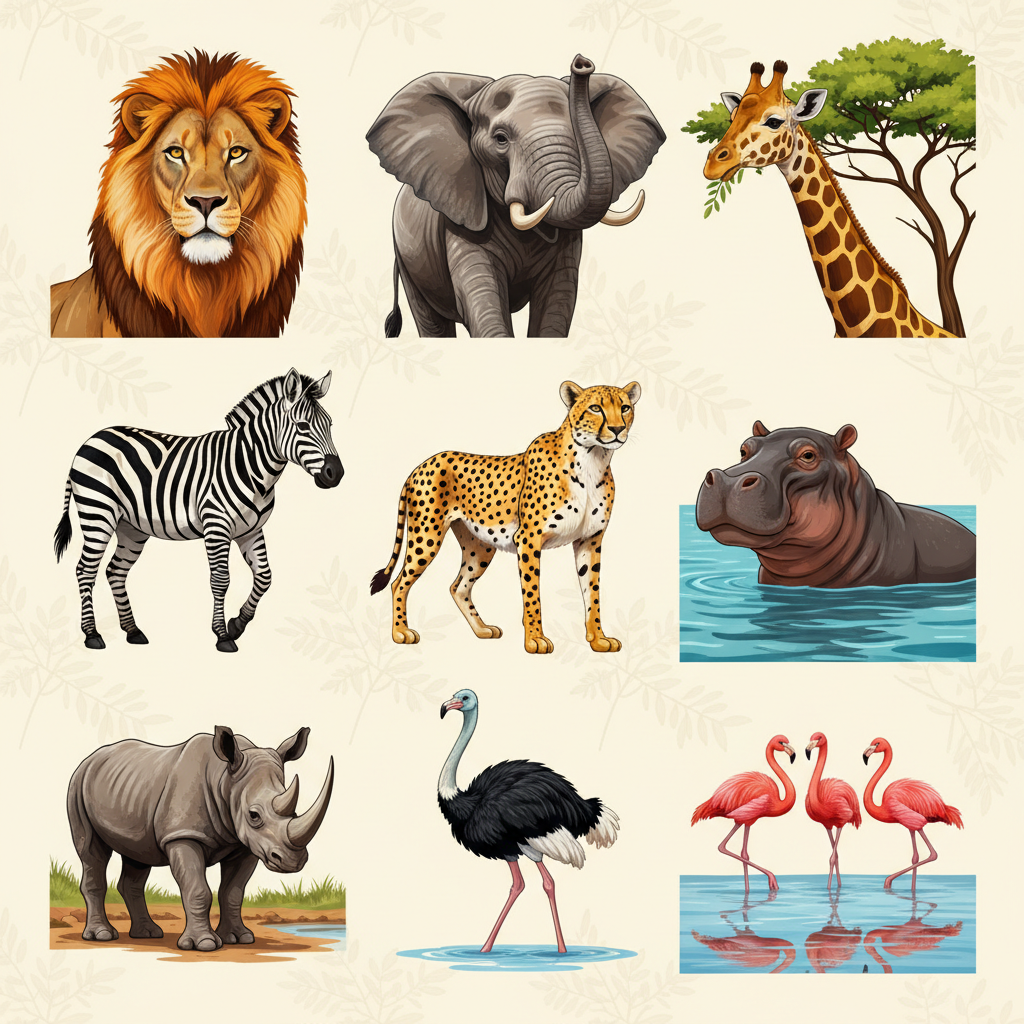
Printable Checklist: 25 Animals to Tick Off
Download this or screenshot it. Tick ’em off as you go.
| Animal | Seen? | Animal | Seen? |
|---|---|---|---|
| Lion | ☐ | Giraffe | ☐ |
| Leopard | ☐ | Zebra | ☐ |
| Elephant | ☐ | Wildebeest | ☐ |
| Buffalo | ☐ | Hippo | ☐ |
| Rhino | ☐ | Crocodile | ☐ |
| Cheetah | ☐ | Hyena | ☐ |
| Wild Dog | ☐ | Jackal | ☐ |
| Baboon | ☐ | Vervet Monkey | ☐ |
| Warthog | ☐ | Mongoose | ☐ |
| Impala | ☐ | Gazelle | ☐ |
| Topi | ☐ | Waterbuck | ☐ |
| Ostrich | ☐ | Flamingo | ☐ |
| Lilac-breasted Roller | ☐ |
Frequently Asked Questions
What animals am I guaranteed to see on safari?
Zebra, wildebeest, giraffe, impala, warthog, baboon, buffalo, and elephants are almost certain. Lions and hippos are very likely. Leopards, cheetahs, and rhinos take more work.
What is the Big Five and why are they called that?
Lion, leopard, elephant, buffalo, rhino. Originally trophy hunters’ terms for the hardest animals to hunt on foot. Today, they’re the most sought-after sightings.
What time of day is best for animal viewing?
Early morning (6:00-9:00) and late afternoon (4:00-6:30). Animals are most active when it’s cool. Midday is for napping in the shade.
Are there tigers in Africa?
No. Tigers are native to Asia, not Africa. The big cats here are lions, leopards, cheetahs, and smaller cats like servals and caracals.
What animals are dangerous?
Hippos kill more people in Africa than any other large animal. Elephants, buffalo, and lions are also dangerous if threatened. But stay in your vehicle, follow your guide’s instructions, and you’re perfectly safe.
What if I don’t see a leopard?
It happens. Leopards are elusive. But your guide will work hard to find one. The Mara and Serengeti have the highest densities in Africa, so your chances are good.
Can I see the Great Migration in March?
Yes but in the southern Serengeti, not the Mara. March is calving season. Hundreds of thousands of wildebeest gather on the short-grass plains. Predator action is intense.
What’s the rarest animal on this list?
Pangolin. Then aardvark. Then wild dog and striped hyena. If you see any of these, you’re having an exceptional safari.
Where can I find an animal name list for kids?
Right here! This whole guide is written in simple language. For younger kids, the Quick Reference table and the checklist work great.
Ready to See Them in Person?
You’ve read the guide. You know what you’re looking for. Now it’s time to actually go.
Here’s what we need from you:
Tell us what animals are at the top of your list. How many days you have. Your rough budget. Your travel style.
We’ll take that and build you a safari that puts you in front of the wildlife you came to see. With guides who know exactly where to look.
Because that’s what we do at Mara Triangle Safaris. We’re not just booking agents. We’re locals. We’re guides. We’re the people who grew up knowing these animals like neighbours.
Let’s make your list a reality.
Let’s Start Planning
The easiest way to start? Head over to our contact page.
Drop us an email at info@maratrianglesafaris.co.ke with your questions. Or give the team a call:
+254 705 635 886
+254 768 212 702
We’re here Monday through Saturday, 8:30 am to 5:00 pm East Africa time. Email works anytime—we’ll get back within 24 hours.
Tell us what you’re thinking. We’ll give you straight answers, honest advice, and a safari worth every penny.
More Reading from Mara Triangle Safaris
| Article | What You’ll Find |
|---|---|
| The Ultimate A‑Z Safari Animal Guide | 100+ animals from aardvark to zebra. Photos, facts, and a printable checklist. |
| How to Spot Rare Animals on a Kenyan Safari | Your guide to the pangolin, aardvark, wild dog, and other elusive creatures. |
| March Safari vs. Peak Season: Which Offers Better Value? | Honest breakdown of crowds, costs, and wildlife. See which season fits you. |
| Top 3 Destinations for an Unforgettable Safari in March | Maasai Mara, Serengeti, or Amboseli? We help you choose. |
| Kenya eVisa Guide: How to Get Yours Fast | Step‑by‑step application tips and the most common mistakes to avoid. |