
Serengeti Great Migration Guide: Where & When to See It (2026 Safari Guide)
Discover the Serengeti Great Migration—when and where to see millions of wildebeest, zebra, and predators in action. Get the best viewing months, routes, and safari tips to plan your 2026 African safari with Mara Triangle Safaris.
🎉 Serengeti Great Migration – Cheat Sheet 🦓
Your quick & colourful guide to the greatest wildlife show on Earth 🌍
📍 July – October
🦁 Northern Serengeti / Maasai Mara
📍 January – March
🦒 Southern Serengeti (Ndutu)
📍 June – July
🐊 Western Corridor (fewer crowds!)
- 🐾 Who’s moving? 1.5M wildebeest + 200K zebras + 300K gazelles
- ⏰ Best time for photos: Calving = Jan–Mar | Crossings = Jul–Oct
- 💰 5‑day safari cost: Budget $1,600–2,500 | Mid $2,800–4,500 | Luxury $5,000+
- 📅 Book early! Peak season lodges fill 6–12 months ahead
- 🌟 Pro tip: Stay 3+ nights near Mara River – crossings are unpredictable!
✨ Get a custom quote – fast & free ✨
Serengeti Great Migration Guide: Best Time, Locations & Viewing Tips (2026 Safari Guide)-Mara Triangle Safaris
You’ve seen the videos.
A river of wildebeest, thousands upon thousands, pouring across a crocodile-infested river.
Dust clouds rise.
Zebras bark.
Lions wait on the far bank.
It’s chaos. It’s life.
It’s the Serengeti Great Migration – the greatest wildlife show on earth.
But here’s the thing most travel blogs won’t tell you: the migration isn’t a single event. It’s a year-round, 800-kilometre loop. Show up in the wrong place and you’ll see nothing but empty plains. Show up in the right place and you’ll witness something that will blow your mind.
We’ve guided thousands of travellers through the Serengeti and Maasai Mara. We know exactly where the herds are month by month, and we know how to get you in position for the action.
This guide breaks down everything – the timeline, best viewing spots, river crossing secrets, costs, and how to pick between Serengeti and Maasai Mara.
Let’s get you in front of the migration.
What is the Serengeti Great Migration and when is the best time to see it?
The Serengeti Great Migration is the annual movement of over 1.5 million wildebeest, hundreds of thousands of zebras, and gazelles across the Serengeti ecosystem in Tanzania and into the Maasai Mara in Kenya. The best time to see it depends on location: December to March (southern Serengeti calving season), June to July (Grumeti River crossings), and July to October (Mara River crossings in northern Serengeti and Maasai Mara). This is one of the most dramatic wildlife events in the world.
That’s the headline. Now let’s dive into the nitty-gritty – month by month, river by river, predator by predator.
What is the Serengeti Great Migration? (The Basics)
The Serengeti Great Migration is the seasonal movement of wildebeest, zebras, and gazelles across the Serengeti–Maasai Mara ecosystem in search of fresh grazing and water.
Here’s what you’re actually watching: over 1.5 million wildebeest, 200,000 zebras, and 300,000 Thomson’s gazelles moving in a massive clockwise circle. They follow the rains. They follow the grass. And behind them come the predators – lions, leopards, cheetahs, hyenas, and the giant Nile crocodiles waiting in the rivers.
The migration never stops. It’s a continuous loop that covers roughly 800 kilometres every year. The animals are always on the move, and where they are depends entirely on the season.
Why do they do it? Simple: food and water. The wildebeest and zebras need fresh grass. After the rains, the southern Serengeti plains are lush. When that dries up, they move west and north. It’s a survival instinct that has played out for millions of years.
What’s in it for you? Front-row seats to one of nature’s greatest dramas – river crossings, predator chases, newborn calves, and brutal kills. It’s not always pretty, but it’s always unforgettable.
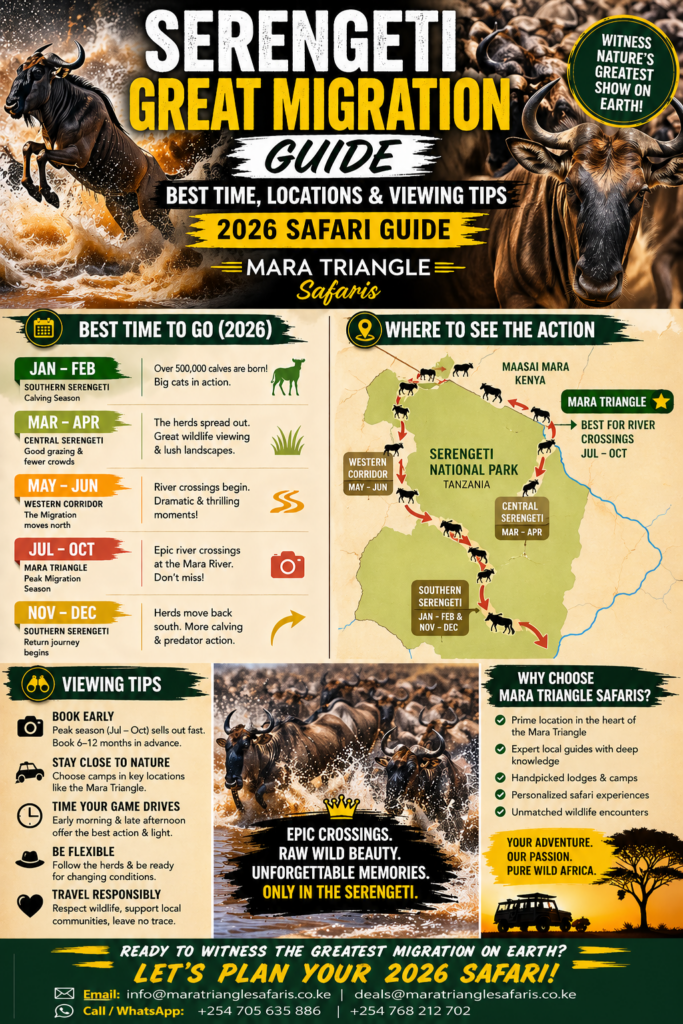
Great Migration Timeline Month-by-Month (2026)
The best time to see the migration is July to October for river crossings (northern Serengeti/Maasai Mara), and January to March for calving season in the southern Serengeti (Ndutu).
Here’s your month-by-month cheat sheet.
January – March: Calving Season (Southern Serengeti / Ndutu)
Location: Southern Serengeti plains, Ndutu area, Ngorongoro Conservation Area
What’s happening: Over 500,000 wildebeest calves are born in just a few weeks – roughly 8,000 per day. The grass is short and green, packed with nutrients. The herds are spread across the open plains.
Wildlife highlight: Newborn calves taking their first steps. Predators – lions, cheetahs, hyenas – are incredibly active. It’s kitten season for carnivores. You’ll see more chases and kills than any other time of year.
River crossings? None. But you don’t need them. The calving action is arguably more intense than the crossings.
Best for: Photographers, first-time safari goers, anyone who loves baby animals (and the grim reality that follows).
April – May: The Long Rains (Western Corridor Movement)
Location: Herds spread out between southern Serengeti and the Western Corridor
What’s happening: The long rains hit. Roads get muddy. Many camps close for low season. The herds break into smaller groups and move north-west toward the Grumeti River.
Wildlife highlight: This is a quiet period for tourism, but the herds are on the move. You’ll see fewer vehicles and get cheaper rates.
River crossings? Grumeti River crossings may start late May, but it’s hit-or-miss.
Best for: Budget travellers, those who don’t mind rain, serious migration trackers.
June – July: Grumeti River Crossings (Western Corridor)
Location: Western Serengeti, Grumeti River area
What’s happening: The herds reach the Grumeti River. This is the first major obstacle. The river is narrower than the Mara, but the crocodiles here are enormous – some over 5 metres long.
Wildlife highlight: Crocodile attacks. The crossings are smaller and less chaotic than the Mara, but still thrilling. Fewer tourists make for a more exclusive experience.
Best for: Travellers who want migration action without the July–October crowds.
August – October: Mara River Crossings (Northern Serengeti & Maasai Mara)
Location: Northern Serengeti (Kogatende, Lamai area) and Maasai Mara (Mara Triangle, Kenya)
What’s happening: This is the big one. The herds gather along the Mara River, preparing to cross. The river is wide, the current is strong, and the crocodiles are relentless. Crossings are unpredictable – you might wait 6 hours and see nothing, or watch three crossings in one morning.
Wildlife highlight: The drama. Wildebeest and zebras leaping into churning water. Crocodiles lunging. Lions and hyenas waiting on the opposite bank. It’s chaos, noise, dust, and life-and-death action.
Best for: Bucket-list chasers, photographers, anyone who wants the classic migration image.
November – December: Short Rains (Return South)
Location: Eastern Serengeti, moving back to southern plains
What’s happening: The herds start their long walk back south. The short rains trigger fresh grass growth on the southern plains. The wildebeest arrive just in time for the next calving season.
Wildlife highlight: Large herds on the move across the eastern woodlands. Fewer tourists. Good birdwatching (migratory birds arrive).
Best for: Shoulder season value, travellers who want good wildlife without peak prices.
Best Places to See the Serengeti Great Migration
Top viewing locations include Northern Serengeti (Mara River crossings), Grumeti River (Western Corridor), Ndutu Plains (calving season), and the Maasai Mara National Reserve (Kenya side, July–October).
Let’s break down each hotspot.
1. Southern Serengeti / Ndutu Plains (January – March)
Best for: Calving season, predator action, green landscapes
Access: Fly to Ndutu airstrip (seasonal) or drive from Arusha via Ngorongoro Crater (4-5 hours).
Where to stay: Ndutu Safari Lodge, Lemala Ndutu Camp, Lake Masek Tented Camp.
Our take: This is our personal favourite time of year. The light is golden, the grass is short, and the predator action is non-stop. You’ll see newborn wildebeest running within minutes of birth. And you’ll see the lions, cheetahs, and hyenas that follow them.
2. Western Corridor / Grumeti River (June – July)
Best for: Smaller crowds, giant crocodiles, first river crossings
Access: Fly to Grumeti airstrip or drive from Arusha (6-8 hours).
Where to stay: Singita Faru Faru, Kirawira Serena Camp, Mbalageti Lodge.
Our take: Most tourists skip the Western Corridor, which is a shame. The Grumeti River holds some of the largest crocodiles in Africa, and the crossings are less frantic but still thrilling. Plus, you’ll often have the riverbanks almost to yourself.
3. Northern Serengeti – Kogatende / Lamai (July – October)
Best for: Mara River crossings, the classic migration experience
Access: Fly to Kogatende or Lamai airstrips (from Arusha, 1.5 hours). Drive from Central Serengeti (5-6 hours).
Where to stay: Sayari Camp, Lemala Kuria Hills, Serengeti Bushtops, &Beyond Serengeti Under Canvas.
Our take: This is the migration “money shot.” The Mara River is wide and deep. The crossings are chaotic and dramatic. But be prepared: it’s busy. Peak season means lots of vehicles at popular crossing points. Book early (9-12 months ahead) and stay for at least 3 nights to increase your chances.
4. Maasai Mara National Reserve – Kenya Side (July – October)
Best for: Compact viewing, excellent infrastructure, Mara Triangle experience
Access: Fly from Nairobi (1 hour) to Mara airstrips, or drive from Nairobi (5-6 hours via Narok).
Where to stay: Mara Triangle has excellent camps like Mara Serena, &Beyond Kichwa Tembo, Angama Mara.
Our take: The Maasai Mara is smaller than Serengeti, but that’s an advantage during migration. The herds are more concentrated, and river crossings often happen within easy driving distance of lodges. The Mara Triangle (western part of the reserve) has fewer vehicles and better management. We run cross-border tours that include both Serengeti and Maasai Mara – ask us.
Serengeti vs Masai Mara – Which Should You Choose?
Serengeti offers longer viewing seasons and calving, while Maasai Mara offers concentrated river crossings with dramatic predator action. The best choice depends on your timing, budget, and travel style.
Here’s the honest comparison.
| Factor | Serengeti (Tanzania) | Maasai Mara (Kenya) |
|---|---|---|
| Migration season | Year-round (circuit) | July–October only |
| River crossings | July–Oct (Mara River) | July–Oct (Mara River) |
| Calving season | Jan–Mar (excellent) | None |
| Crowds | Lower (except August-Sept) | Higher (more vehicles) |
| Park fees (2026) | $83/adult/day | $100/adult/day (peak) |
| Access from Nairobi | Fly or drive (10+ hours) | Fly or drive (5-6 hours) |
| Best for | Longer safaris, calving, fewer crowds | Short safaris, luxury camps, film crews |
Our recommendation for 2026:
- Choose Serengeti if: You have 5+ days, want calving season (Jan–Mar), or prefer a more remote wilderness feel.
- Choose Maasai Mara if: You’re short on time (2-4 days), want guaranteed high-density crossings (Aug–Sept), or are combining with other Kenya parks.
- Choose BOTH: We offer 10-12 day cross-border safaris that give you the best of both.
Safari Costs & Planning Tips (2026)
How Much Does a Great Migration Safari Cost?
| Safari Type | Duration | Cost (per person) | Includes |
|---|---|---|---|
| Budget camping | 5 days | 1,600–2,500 | Camping, shared vehicle, meals, park fees |
| Mid-range lodge | 5–7 days | 2,800–4,500 | Tented camps/lodges, small group, game drives |
| Luxury fly-in | 5–7 days | 5,000–8,500+ | Flights, high-end lodges, private guide |
Example: 7-day mid-range Serengeti migration safari (August, Northern Serengeti):
- Flights from Arusha to Kogatende (return): $500
- Accommodation (6 nights mid-range camp): $3,000
- Park fees (7 days × 83):581
- Guide and vehicle (shared, 4 people): $700
- Total per person: ~$4,800
We offer payment plans and group discounts. Contact us for a custom quote based on your dates.
Essential Planning Tips
- Book early for peak season (July–October). Like, 9-12 months ahead. The best camps in the Northern Serengeti sell out by March.
- Stay at least 3 nights in the crossing area. River crossings are unpredictable. You need time to wait.
- Use a local operator. We track the migration daily using ground reports and satellite data. We’ll position you exactly where the herds are.
- Be flexible. If a crossing happens, your guide should be allowed to adjust the itinerary. Rigid schedules kill migration magic.
- Pack for dust and sun. Neutral colours, binoculars, zoom lens, sunscreen, lip balm. The Mara River area is dusty.
- Consider a mobile camp. Some operators (including us) offer camps that move with the migration. You wake up steps from the action.
Can I See the Great Migration from Kenya?
Yes. The migration enters Kenya’s Maasai Mara National Reserve between July and October, especially in areas like the Mara Triangle. This is the best time for river crossings on the Kenyan side.
The migration doesn’t recognise borders. The wildebeest cross from the northern Serengeti into the Maasai Mara between July and October. The Mara River runs through both countries, so crossings happen on both sides.
Why choose the Kenyan side? The Maasai Mara is smaller and more accessible from Nairobi. The crossings are often easier to predict because of the river’s narrow points. And the Mara Triangle (west side) has fewer vehicles than the Tanzanian side.
Why choose the Tanzanian side? The Serengeti is much larger, so you can see the migration for more months of the year. The calving season (January–March) is unique to the Serengeti. And if you want a more remote wilderness feel, northern Serengeti has fewer lodges and vehicles.
We do both. We’re a Kenya-Tanzania operator with offices in Nairobi and Arusha. We can build a cross-border itinerary that gives you migration viewing in both countries.
Final Travel Advice for Your 2026 Migration Safari
Book early for peak season. We can’t say it enough. July–October lodges in the northern Serengeti and Maasai Mara fill up 6-12 months ahead. Don’t be the person who waits until May and then finds only overpriced leftovers.
Follow migration tracking reports. The herds don’t follow a calendar. Rains can be early or late. A good operator updates you daily on where the wildebeest actually are – not where they “should” be.
Choose flexibility over fixed schedules. Ask your operator: “Can we change our lodge or route if the migration moves?” Rigid itineraries are the enemy of good migration viewing.
Don’t skip the calving season. River crossings get all the glory, but calving season (January–March) is cheaper, less crowded, and offers incredible predator action. Plus, baby wildebeest are adorable (until a lion eats them).
Protect your gear. The dust in the northern Serengeti is relentless. Bring a rain cover for your camera, zip-lock bags for lenses, and a blower brush.
Respect the wildlife. Stay in your vehicle. Don’t yell or bang on the car to “provoke” a crossing. The animals are stressed enough.
Frequently Asked Questions
When is the best time to see the Serengeti Great Migration?
The best time is July to October for dramatic Mara River crossings and January to March for calving season in the southern Serengeti. June–July also offers Grumeti River crossings with fewer crowds.
Where does the Great Migration start and end?
The migration is a continuous circular route between the southern Serengeti (calving), western corridor (Grumeti River), northern Serengeti (Mara River), and the Maasai Mara ecosystem in Kenya. It never starts or ends – it loops.
Can I see the Great Migration from Kenya?
Yes. The migration enters Kenya’s Maasai Mara National Reserve between July and October, especially in areas like the Mara Triangle. This is the best time for river crossings on the Kenyan side.
What animals are involved in the Great Migration?
Over 1.5 million wildebeest, 200,000 zebras, and 300,000 Thomson’s gazelles. Predators include lions, leopards, cheetahs, hyenas, and Nile crocodiles.
How long does the Great Migration last?
The migration is a year-round cycle. Peak viewing windows vary: calving (Jan–Mar), Grumeti crossings (Jun–Jul), Mara crossings (Jul–Oct).
Is Serengeti or Maasai Mara better for migration viewing?
Serengeti offers longer viewing seasons and calving, while Maasai Mara offers concentrated river crossings with dramatic predator action. The best depends on your timing and preferences.
Plan Your Serengeti Great Migration Safari with Mara Triangle Safaris
You’ve read the guide. Now let’s make it happen.
We’re Mara Triangle Safaris – a local operator with years of experience tracking the migration across the Serengeti and Maasai Mara. We know the river crossing hotspots, the best camps for each season, and the guides who always seem to be in the right place.
What we offer:
- Custom migration itineraries (3–12 days)
- Budget, mid-range, and luxury options
- Cross-border tours (Kenya + Tanzania)
- Daily migration tracking updates
- Best price guarantee
Ready to book? Tell us your travel dates, group size, and budget. We’ll send a full itinerary and quote within 24 hours.
📧 Email: info@maratrianglesafaris.co.ke | deals@maratrianglesafaris.co.ke
📞 Call / WhatsApp: +254 705 635 886 | +254 768 212 702
🌐 Contact form: https://maratrianglesafaris.co.ke/contact/
👉 Or click here to message us on WhatsApp (fastest response)
Your front-row seat to the greatest wildlife show on earth is one message away. Send it now.
Explore More
- Serengeti Safari Cost Calculator (2026) – Build your migration budget
- 5-Day Serengeti Itinerary (2026) – Day-by-day route
- Best Serengeti Safari Packages (2026) – Budget, mid-range & luxury
- How to Get to Serengeti National Park (2026) – Flights, drives & routes
- Serengeti Safari from Nairobi (2026) – Cross-border travel guide