
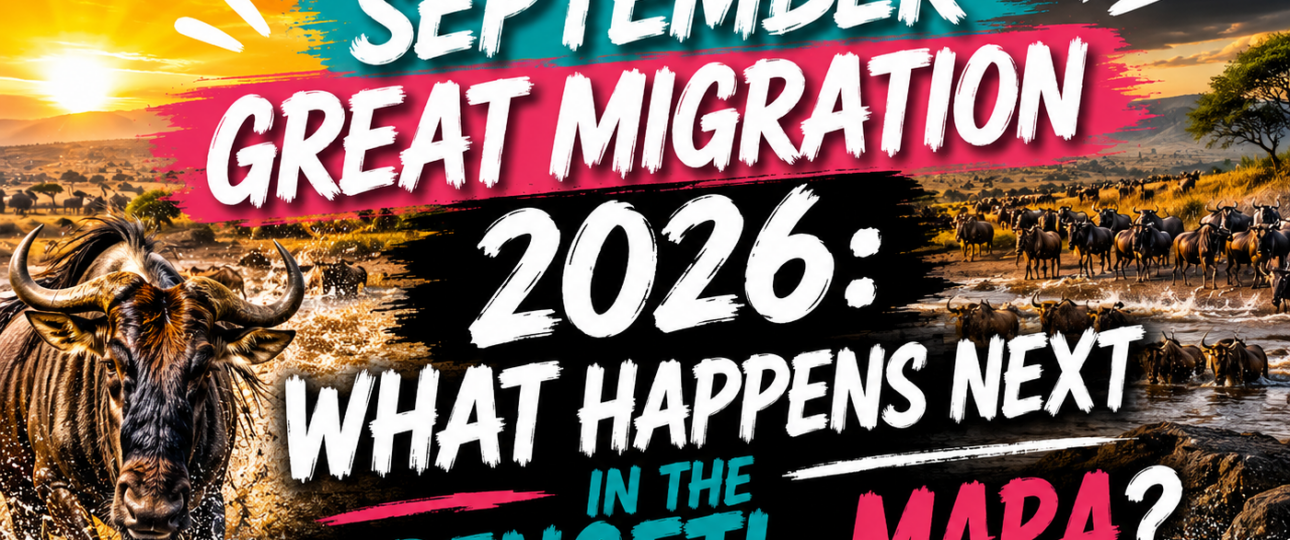
September Great Migration 2026: What Happens Next in the Serengeti–Mara?
September Great Migration 2026: discover where the wildebeest are moving in the Serengeti–Mara, Mara River crossings and what happens next.
September Great Migration 2026: What Happens Next in the Serengeti–Mara?
Great Migration 2026 Seasonal Guide | Serengeti • Northern Serengeti • Mara River • Maasai Mara
🦓🌍 September Is the Next Chapter
August has brought the Great Migration into one of its most dramatic stages. Now the calendar is turning toward September, and the question changes: what happens next in the Serengeti–Mara?
The wildebeest do not suddenly stop moving when August ends. The Mara River does not become irrelevant. And the migration does not finish simply because many animals have already entered Kenya.
Instead, September can bring another fascinating stage of the journey, with migrating herds potentially spread across Northern Serengeti, the Mara River ecosystem and the Maasai Mara.
The exact location remains controlled by nature. Rainfall, grazing conditions, water and animal behaviour continue to influence where the herds move.
🇹🇿 Northern Serengeti
The northern Serengeti remains an important part of the migration story as herds move through the Mara ecosystem.
🌊 Mara River
River crossings can remain a major attraction in September, but their timing and location are never guaranteed.
🇰🇪 Maasai Mara
Some migrating herds may be found on the Kenyan side, where they mix with the Mara’s resident wildlife.
🦁 Predator Action
Large concentrations of prey can create excellent opportunities to observe lions, cheetahs, hyenas and other predators.
🔄 The Next Transition
As the season progresses, the migration will eventually begin another transition toward the southern Serengeti.
🌊 Thinking About a September Migration Safari?
September can be an exciting time to follow the northern chapter of the Great Migration. Plan enough time to follow the herds rather than relying on one guaranteed crossing.
PLAN YOUR SEPTEMBER SAFARI →🌍 September 2026: The Great Migration Enters Its Next Chapter
The Great Migration is not a single event that happens during one particular month.
It is a continuous ecological journey through Tanzania and Kenya.
By September, the migration has already travelled a long way from the southern Serengeti. The calving season is behind the herds, the western movement has passed, and attention has shifted toward the northern Serengeti, the Mara River and the Maasai Mara.
But September is not simply “August again.”
The distribution of the animals can change as grazing conditions change. Some groups may remain in northern Serengeti. Others may be around the Mara River. Others may already be grazing in Kenya.
That is why following the migration requires an understanding of the entire Serengeti–Mara ecosystem, not just one river crossing.
🦓 The Big September Question
Where will the herds be next?
There is no single answer. The migration responds to nature, and conditions can vary across the ecosystem. This uncertainty is exactly why experienced safari guides follow recent animal movements and adapt game drives accordingly.
🦓 Where Are the Wildebeest in September 2026?
During September, the main focus remains the northern part of the Serengeti–Mara ecosystem.
Northern Serengeti is particularly important because it connects Tanzania’s migration route with the Mara River and Kenya’s Maasai Mara.
At the same time, migrating animals may be distributed across a wide area rather than concentrated in one location.
This matters because travellers sometimes imagine the Great Migration as one enormous line of animals moving together.
In reality, different groups can move at different speeds and occupy different parts of the ecosystem.
You could therefore have wildebeest in Northern Serengeti, other groups around the Mara River and additional animals in the Maasai Mara at the same time.
🇹🇿 What Is Happening in Northern Serengeti?
Northern Serengeti becomes particularly important during the migration’s northern phase.
The region provides access to the wider Mara River ecosystem while offering a spectacular safari environment in its own right.
For travellers arriving in September, Northern Serengeti can therefore be part of a broader migration strategy rather than simply a waiting area for a river crossing.
Game drives can reveal large herds, zebra, antelope and resident predators even when no animals are crossing the river.
🇹🇿 Northern Serengeti Is Not Just a Backup Plan
If a river crossing is not happening, that does not mean the safari has failed.
Northern Serengeti is an extraordinary wildlife destination with its own landscapes, predators, resident animals and migrating herds.
The migration experience is much bigger than the moment an animal enters the water.
🌊 Are Mara River Crossings Still Happening in September?
Yes, September remains part of the broader Mara River crossing season.
However, the most important word is “can.”
Crossings are natural events and cannot be scheduled like a bus or flight.
A large herd may approach the river and wait. It may move upstream. It may turn away. Another group may cross later.
This means travellers should avoid choosing a safari based on the promise of a guaranteed crossing on a specific date.
Instead, choose a good location, allow enough safari time and work with guides who can follow the movement of the herds.
🌊 September Mara River Crossings
The river may be quiet one moment and spectacular the next. That is the nature of the Great Migration.
Give yourself time to experience the wider Mara ecosystem while keeping the river crossing as the extraordinary possibility it is.
BOOK A GREAT MIGRATION SAFARI →🇰🇪 What Is Happening in the Maasai Mara?
As migrating herds enter or move through Kenya, the Maasai Mara becomes another important chapter in the journey.
The Mara is already home to abundant resident wildlife, so the arrival or presence of migrating herds adds another layer to an ecosystem that is spectacular throughout the year.
September can therefore offer more than the possibility of watching wildebeest.
You can also encounter lions, cheetahs, leopards, elephants, giraffes, hippos and numerous bird species during your game drives.
This is one reason a migration safari should never be planned entirely around a single species or single event.
🇰🇪 Why the Mara Triangle Matters in September
The Mara Triangle is an important part of the Kenyan side of the wider Serengeti–Mara ecosystem.
For travellers following the migration into Kenya, it offers the opportunity to combine the search for migrating herds with classic Maasai Mara wildlife viewing.
The key is to think beyond the river.
Even if the herds are not crossing during your particular game drive, the Mara Triangle can still deliver excellent wildlife experiences across its open grasslands and riverine habitats.
🇰🇪 Follow the Migration Into the Mara
Make September about the complete Kenyan wildlife experience, not just waiting beside the river.
PLAN YOUR MARA TRIANGLE SAFARI →🔄 Are the Wildebeest Starting to Move South?
Eventually, yes.
But September should not be viewed as the month when the entire migration suddenly turns south.
The migration is a gradual and constantly changing process.
Some animals can remain in the northern ecosystem while conditions continue to provide suitable grazing. Others may begin moving as rainfall and grass conditions change.
As the season progresses toward October and November, the broader migration story will increasingly turn toward the return journey to Tanzania.
This creates an important distinction: September is still a northern migration month, but it is also part of the transition toward the next chapter.
🌧️ Why Rainfall Matters More Than the Calendar
If there is one thing every migration traveller should understand, it is this:
🌧️ The Wildebeest Follow Conditions, Not Dates
Rainfall influences grass growth.
Grass influences grazing.
Grazing influences movement.
Movement determines where the herds may be found.
That simple chain explains why the migration can vary from year to year.
A September safari should therefore be planned with flexibility. The historical migration pattern is useful, but it cannot predict the exact position of every herd.
🌿 Why September Can Be Different From August
August often receives enormous attention because of the famous Mara River crossing images.
By September, the migration can have a slightly different character.
Some herds may already be established in the Maasai Mara. Others may remain around Northern Serengeti. River crossings may continue, but the movement can also become more dispersed.
This can create a broader safari experience because travellers are not necessarily watching the same river scene every day.
Instead, game drives can focus on the changing relationship between migrating herds, resident wildlife and predators across the ecosystem.
🦁 What Wildlife Can You See Beyond the Wildebeest?
Following the Great Migration in September does not mean spending every day looking only for wildebeest.
🦁 Lions
Large concentrations of prey can create excellent opportunities for predator viewing.
🐆 Cheetahs
The open grasslands provide excellent habitat for these fast and highly specialised predators.
🐊 Crocodiles
The Mara River is home to crocodiles that form part of the dramatic river-crossing environment.
🦛 Hippos
River habitats provide opportunities to see hippos alongside other aquatic wildlife.
🐘 Elephants
Resident elephants can be encountered while exploring the wider Mara and Serengeti landscapes.
📍 Northern Serengeti vs Mara Triangle in September
Both locations can be relevant to travellers following the northern migration, but the experience is not identical.
🇹🇿 Northern Serengeti
- Part of the Tanzanian side of the migration.
- Important during the northern migration phase.
- Close to the Mara River ecosystem.
- Excellent wider Serengeti wildlife experience.
- Useful for travellers following herds before or around river crossings.
🇰🇪 Mara Triangle
- Part of the Kenyan side of the Mara ecosystem.
- Excellent for September migration viewing.
- Access to the wider Maasai Mara wildlife experience.
- Strong option for travellers focusing on Kenya.
- River crossings are one attraction among many.
If you have enough time and budget, combining Tanzania and Kenya can provide a much broader view of the Serengeti–Mara Journey.
If your priority is the Kenyan side of the migration, however, the Mara Triangle can be a strong base for exploring the Mara ecosystem.
⏳ How Long Should You Stay for a September Migration Safari?
The more important your river-crossing goal, the more valuable flexibility becomes.
A short safari can still produce an incredible wildlife experience, but additional days increase the opportunity to follow the movement of the animals.
Remember that the wildebeest do not know when your return flight leaves.
They may cross on your first day. They may wait. They may move away from the river.
This is why we generally recommend thinking about time in the ecosystem rather than simply time beside the river.
For more planning guidance, see:
👉 How Long Will the Wildebeest Stay?
🏕️ Where Should You Stay for the Mara River?
Location can make a major difference to the logistics of a migration safari.
However, staying close to the Mara River does not guarantee that animals will cross directly in front of your camp.
The herds can change direction and crossings can occur at different points.
A better approach is to choose accommodation that works well for the wider migration area and allows your safari team to follow wildlife activity.
For accommodation planning, read:
👉 Which Safari Camp Is Closest to Mara River Crossings?
💰 How Much Does a September Migration Safari Cost?
September remains a popular period for the Great Migration, so safari prices depend on accommodation level, location, number of days, park fees, transport and the overall itinerary.
A simple comparison of room rates does not always tell you the true cost of a migration safari.
Consider the entire package, including transport, game drives, accommodation, meals, park fees and guiding.
For a detailed breakdown, explore:
👉 How Much Does a Migration Safari Cost?
💰 Planning a September 2026 Safari Budget?
Tell us your dates, group size and preferred accommodation level, and we can help you plan a migration safari around your priorities.
REQUEST A SAFARI QUOTE →👨👩👧 Is September Suitable for a Family Migration Safari?
Yes, families can enjoy the migration, provided the itinerary is planned around the children’s ages and comfort.
The combination of huge herds, predators, rivers and open landscapes can make the experience memorable for children.
However, river-crossing areas require particular care because this is completely wild territory.
Families should work with experienced guides and follow all wildlife-viewing and vehicle-safety instructions.
For more information:
👉 Can Children Watch Mara River Crossings? Family Safari Guide
🗓️ September 2026 Migration Planning at a Glance
| What to Watch | September Outlook | Planning Advice |
|---|---|---|
| Wildebeest | Northern migration phase | Follow recent herd movements |
| Mara River | Crossings can continue | Allow several days where possible |
| Northern Serengeti | Important migration zone | Do not focus only on the river |
| Maasai Mara | Migrating herds may be present | Combine migration with resident wildlife |
| Predators | Excellent wildlife potential | Explore beyond migration herds |
| Southward Movement | Later-season transition ahead | Watch conditions rather than dates |
🌍 How September Fits Into the Bigger Serengeti–Mara Journey
September is one chapter in a journey that began months earlier.
The story starts in the southern Serengeti.
It moves through the wider Serengeti ecosystem.
The herds travel through the western and northern regions.
They reach the Mara River.
Some move into Kenya.
And eventually, the cycle begins turning south again.
This is why the Great Migration should not be viewed simply as a Mara River attraction.
It is an enormous natural cycle connecting Tanzania and Kenya.
For a wider explanation, read:
👉 The Serengeti–Mara Journey 2026
🔄 September Is a Transition, Not an Ending
The herds may still be crossing the Mara River. They may still be moving through Northern Serengeti. They may be spread across the Maasai Mara.
And eventually, the journey will begin another turn toward Tanzania.
The migration keeps moving.
❓ September Great Migration 2026 FAQs
Is September a good month for the Great Migration?
Yes. September is within the main northern migration season and can offer opportunities to see wildebeest in Northern Serengeti, around the Mara River and in the Maasai Mara.
Are Mara River crossings guaranteed in September?
No. Crossings are natural events influenced by herd behaviour, rainfall, grazing and local conditions. No specific crossing date can be guaranteed.
Where are the wildebeest in September?
They can be spread across Northern Serengeti, the Mara River ecosystem and the Maasai Mara. Their exact location can change quickly.
Is Northern Serengeti still worth visiting in September?
Absolutely. Northern Serengeti is an important part of the northern migration and offers excellent wildlife viewing beyond river crossings.
Can I see the Great Migration in the Mara Triangle in September?
Yes. The Mara Triangle forms part of the greater Maasai Mara ecosystem and can be an excellent destination for travellers following the Kenyan side of the migration.
Will the wildebeest leave Kenya in September?
Not necessarily. The timing of the southward movement varies with environmental conditions. September can still be firmly within the northern migration phase.
How many days should I spend on a September migration safari?
Four to five days can provide a useful migration-focused safari, while longer stays provide greater flexibility for following herds and waiting for potential river activity.
Should I choose Kenya or Tanzania in September?
Both can offer excellent migration experiences. Northern Serengeti is important on the Tanzanian side, while the Maasai Mara and Mara Triangle are major destinations on the Kenyan side.
🌅 What Happens After September?
The migration story does not stop when September ends.
As October approaches, the question becomes increasingly interesting: when will the herds begin their next major movement south?
Some animals may remain in the northern ecosystem while conditions are favourable, while others gradually begin moving toward Tanzania.
That will take us into the next chapter of the 2026 migration story.
Follow the Great Migration Into September 2026
The Herds Are Moving. The Story Is Still Unfolding.
September brings another fascinating chapter to the Serengeti–Mara Journey, from Northern Serengeti and the Mara River to the grasslands of the Maasai Mara.
If you are planning to follow the migration in 2026, let us build your safari around the season, the location and the experience you want most.
START PLANNING YOUR 2026 SAFARI →🦓 September 2026: Keep Following the Journey
The most exciting thing about the Great Migration is that the story keeps changing.
Today, the focus may be the Mara River. Tomorrow, the herds may be further north or deeper into Kenya. Later in the season, the question will become when the animals begin their journey south.
That is why following the migration is so much more rewarding than simply chasing one famous photograph.
The Serengeti–Mara Journey is alive, unpredictable and constantly moving.
And in September 2026, the next chapter is just beginning.
🌍 Ready to Follow the Serengeti–Mara Journey?
Experience the Kenyan side of one of Africa’s greatest wildlife journeys with a safari designed around the migration.
CONTACT MARA TRIANGLE SAFARIS →