
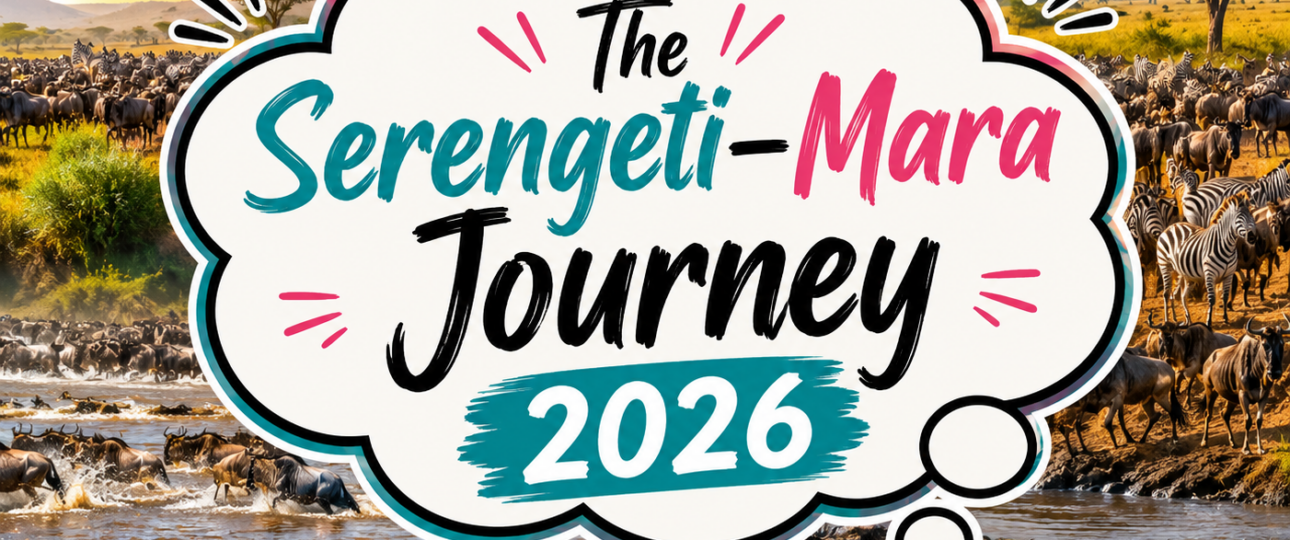
The Serengeti–Mara Journey 2026: Following the Great Migration Across Tanzania & Kenya
The Serengeti–Mara Journey 2026: Following the Great Migration Across Tanzania & Kenya
2026 Great Migration Guide | Serengeti, Northern Serengeti, Mara River & Maasai Mara
🌍🦓 The Journey Is Happening Across Two Countries
The Great Migration is not simply a river crossing. It is not a single event that happens in August or September. And it certainly does not stop at the Kenya–Tanzania border.
The Serengeti–Mara Journey is a continuous movement through one connected ecosystem.
Right now in 2026, the story is moving through its northern chapter, with the migration cycle connecting Tanzania’s Serengeti with Kenya’s Maasai Mara and the Mara River system between them.
The famous river crossings are one spectacular part of this journey. But to understand the migration properly, you need to follow the entire route.
🍼 Southern Serengeti
The cycle begins around the southern Serengeti and Ndutu plains, where seasonal rains create nutritious grazing and the calving season brings a new generation of wildebeest.
🌿 Central & Western Serengeti
As conditions change, the herds spread through the Serengeti, continuing their search for fresh grass and water.
🌊 Northern Serengeti
The journey eventually reaches northern Tanzania, where the Mara River becomes one of the major obstacles in the northern migration phase.
🇰🇪 Maasai Mara
Some herds move into Kenya’s Maasai Mara ecosystem, where the migration meets open grasslands, resident wildlife and spectacular predator activity.
🔄 Back Toward Serengeti
The story does not end in Kenya. The herds eventually begin the return movement, continuing the natural cycle.
🦓 Want to Follow the Migration in 2026?
Whether your dream is the Mara River, the open Serengeti plains or the complete migration journey, your safari should be designed around the movement of the herds.
PLAN YOUR 2026 SAFARI →🌍 Understanding the Serengeti–Mara Journey in 2026
The Great Migration is much bigger than the famous Mara River crossing. In 2026, the journey continues to connect the vast plains of Tanzania’s Serengeti with Kenya’s Maasai Mara through a constantly changing movement of wildebeest, zebra and gazelles.
The animals are not following a fixed timetable. Their movement is influenced mainly by rainfall, fresh grazing and water availability. When new grass appears, the herds respond. When grazing conditions change, they move again. This is why the migration can look slightly different from one year to another.
🌧️ The Migration Follows Nature, Not the Calendar
A safari calendar may tell you that August is migration season. But the wildebeest do not know it is August. They respond to the landscape around them.
Rainfall changes the grass. Grass influences grazing. Grazing influences movement. And movement determines where the herds may be found.
This is why no responsible safari operator can guarantee a particular river crossing on a particular day.
🗺️ The Journey Is Bigger Than Serengeti → Mara River
The migration is better understood as a continuous ecological cycle rather than a straight journey from Tanzania into Kenya.
🍼 Southern Serengeti
The annual cycle begins with the southern Serengeti and Ndutu plains becoming especially important during the calving season. Thousands of newborn wildebeest create an extraordinary period of life and intense predator activity.
🌿 Central Serengeti
As conditions change, the herds spread through the Serengeti while continuing to search for nutritious grazing and water.
🌅 Western Corridor
The western part of the Serengeti forms another important stage of the northward journey. This is also where travellers may encounter the Grumeti River and its surrounding wildlife.
🇹🇿 Northern Serengeti
The herds eventually reach northern Tanzania, where the landscape becomes closely connected with the Mara River ecosystem and the northern migration phase.
🌊 Mara River
The river can become a major obstacle. Herds may gather, hesitate and eventually cross, creating one of the most dramatic wildlife spectacles in Africa.
🇰🇪 Maasai Mara
Some migrating animals move into Kenya’s Maasai Mara ecosystem, joining a landscape already inhabited by large populations of resident wildlife.
🇹🇿🇰🇪 Not Every Wildebeest Crosses Into Kenya
One of the most common misconceptions about the migration is that the entire herd reaches the Mara River and then crosses into Kenya.
The reality is much more complicated.
The migration consists of enormous numbers of animals spread across a huge ecosystem. While some groups may move toward and across the Mara River, others can remain in northern Serengeti or move differently depending on local conditions.
This is important when planning a safari because Northern Serengeti can remain an excellent migration destination even when the biggest attention is focused on the Kenyan side.
🌍 One Ecosystem. Two Countries.
The international border matters to people, governments and park authorities.
It does not matter to a wildebeest.
The animals move according to ecological conditions, creating one connected Serengeti–Mara ecosystem across Tanzania and Kenya.
📍 Where Does the Journey Stand in 2026?
For travellers following the migration during the current August 2026 period, the focus naturally turns toward Northern Serengeti, the Mara River and the Maasai Mara.
This is the northern chapter of the annual journey, when travellers hope to witness herds gathering around river crossings and moving between Tanzania and Kenya.
But the exact location of the animals can change quickly. A herd that appears close to the river can move away, while another group may arrive later. The river can therefore be active one day and much quieter the next.
That unpredictability is not a weakness of the migration experience. It is part of what makes it wild.
🌊 What Makes a Mara River Crossing So Unpredictable?
The animals may approach the river and stop.
They may spend hours along the bank.
They may turn around.
Another group may suddenly enter the water and trigger a mass movement.
Even when thousands of animals are nearby, nature decides when the crossing happens.
🌊 The Mara River Is More Than a Crossing Point
The Mara River is one of the most important features of the northern migration landscape. It is not simply a line that the wildebeest need to cross.
The river provides water and forms part of the wider ecosystem used by wildlife throughout the year. It also creates habitats for animals such as hippos and crocodiles, while its surrounding grasslands support enormous concentrations of herbivores.
For safari travellers, this means the river experience is about more than watching animals enter the water.
You may spend time watching wildebeest gather along the banks, zebra moving through the surrounding plains, crocodiles lying in the water and predators taking advantage of the concentration of prey.
🦓 What Else Can You See Along the Serengeti–Mara Journey?
The migration is driven by wildebeest, but they are only one part of the wildlife story.
- 🦓 Wildebeest: The dominant species of the migration.
- 🦓 Zebra: Often travel alongside the wildebeest and contribute to the movement of grazing animals.
- 🦌 Gazelles: Another important part of the migrating herbivore community.
- 🦁 Lions: Follow areas where prey is concentrated.
- 🐆 Cheetahs: Particularly suited to hunting across open grasslands.
- 🐕 Hyenas: Important predators and scavengers throughout the ecosystem.
- 🐊 Crocodiles: A major feature of the Mara River crossing environment.
- 🦛 Hippos: Commonly associated with the river system.
- 🐘 Elephants: Resident wildlife that can be encountered alongside the migration.
- 🦒 Giraffes and other wildlife: Reminding visitors that the Mara and Serengeti are complete ecosystems, not migration-only destinations.
🚫 Five Things Travellers Often Get Wrong About the Migration
1. “The migration starts in July.”
The migration is a year-round ecological cycle. Different months simply highlight different chapters.
2. “Every wildebeest crosses the Mara River.”
Different groups occupy different areas. Some may remain in northern Serengeti while others move toward Kenya.
3. “The crossing happens on a fixed date.”
Rainfall, grazing conditions and animal behaviour influence when and where crossings occur.
4. “The migration ends in Kenya.”
The Maasai Mara is another chapter. The herds eventually begin their return movement toward Tanzania.
5. “The Mara River is the whole migration.”
The river crossing is one spectacular moment in a journey that covers a huge area and continues throughout the year.
📅 The 2026 Migration Journey at a Glance
| Period | Main Area | What You May Experience |
|---|---|---|
| Jan–Mar | Southern Serengeti | Calving, newborn wildebeest and predator activity |
| Apr–May | Central Serengeti | Northward movement and changing grazing conditions |
| May–Jul | Western & Central Serengeti | Moving herds and the Western Corridor |
| Jul–Aug | Northern Serengeti & Mara | Herds moving toward the Mara River region |
| Aug–Sep | Mara River & Maasai Mara | Potential river crossings and large concentrations of wildlife |
| Oct | Northern Serengeti & Mara | Late northern migration movement |
| Nov–Dec | Serengeti | Return movement toward the southern plains |
🦓 Want to Experience the Kenyan Chapter in 2026?
If your goal is to experience the Mara River and the Kenyan side of the Great Migration, the Mara Triangle can put you in the heart of the action while also offering exceptional resident wildlife viewing.
PLAN YOUR MIGRATION SAFARI →🧭 The Best Way to Follow the Journey
There is no single “perfect” place to see the Great Migration.
The right destination depends on the migration phase you want to experience.
For calving, think southern Serengeti. For the western migration, consider the Western Corridor. For the northern phase, look toward Northern Serengeti and the Mara ecosystem. For the famous river crossings, focus your planning around the Mara River region while allowing enough time for nature to decide when the action happens.
This is why safari planning should consider location, timing and number of days together.
If river crossings are your main goal, our guide to how long wildebeest may stay in an area can help you understand why flexibility matters.
🌊 Planning Around a Mara River Crossing?
Don’t build your entire safari around one guaranteed crossing date. Give yourself enough time to follow the herds and experience the wider Mara ecosystem.
BOOK YOUR 2026 MIGRATION SAFARI →🌍 The Biggest Lesson of the Serengeti–Mara Journey
The Great Migration is not a performance scheduled for visitors.
There is no curtain time. There is no guaranteed crossing. There is no single starting point and no permanent finish line.
There is only a constantly changing relationship between animals, rainfall, grass, rivers and the wider ecosystem.
That is what makes following the migration in 2026 so fascinating.
You are not simply travelling to see wildebeest cross a river. You are entering a living journey that connects Tanzania and Kenya.
🌍 The Great Migration Is a Journey, Not an Event
One of the easiest ways to misunderstand the Great Migration is to think of it as a single event.
You may have seen the famous photographs: thousands of wildebeest packed along the edge of the Mara River before suddenly plunging into the water.
Those moments are extraordinary.
But they represent only a small part of a much larger natural cycle.
Across the Serengeti–Mara ecosystem, wildebeest, zebra and gazelles move in response to rainfall, fresh grazing and water availability.
The migration therefore continues throughout the year, even though different months create very different wildlife experiences. Current 2026 migration guidance places the major Mara River phase broadly in the July–October period, while the southern Serengeti is associated with the calving season earlier in the year. :contentReference[oaicite:0]{index=0}
💡 Think of the Migration as a Giant Natural Clock
The animals are responding to environmental conditions rather than following a calendar written for tourists.
Rain falls. Grass grows. The herds feed. The grass becomes depleted. The herds move.
Then the cycle begins again.
🇹🇿 Where the Serengeti–Mara Journey Begins
The southern Serengeti is one of the most important chapters in the migration cycle.
During the calving season, enormous numbers of wildebeest gather across the short-grass plains.
This is a completely different migration experience from the Mara River crossings.
Instead of watching animals negotiate a dangerous river, you may find yourself surrounded by huge herds spread across open plains, with newborn calves and predators creating a very different kind of drama.
Lions, cheetahs and hyenas take advantage of the abundance of young animals, making the calving period one of the most intense predator-viewing seasons of the year.
🌿 From Southern Serengeti to the Wider Plains
As the season changes, the herds gradually move away from the southern plains.
They travel through the Serengeti ecosystem, following the availability of fresh grazing.
This movement can cover hundreds of kilometres and does not happen as one perfectly organised column.
Different groups spread out. Some move faster. Others remain behind. Some may change direction when local conditions change.
That is why the Great Migration can never be reduced to a simple line on a map.
🦓 There Isn’t Just One Herd
When we say “the wildebeest are moving north,” it does not mean that every animal is standing in the same place and travelling together.
The migration involves huge numbers of animals spread across a vast ecosystem. That is why conditions can be very different in southern Serengeti, western Serengeti, northern Serengeti and the Maasai Mara at the same time.
🇹🇿 Northern Serengeti: Where the Journey Gets Dramatic
As the herds reach northern Serengeti, the character of the journey changes.
The landscape becomes closely connected with the Mara River system and the migration’s movement toward Kenya.
This is where travellers begin thinking seriously about river crossings.
The northern Serengeti is therefore a major destination for travellers who want to experience the migration during its northern phase.
It is also a reminder that you do not necessarily have to wait for the animals to enter Kenya to experience the Mara River migration.
Northern Serengeti and the Maasai Mara are two sides of the same broader ecological story. :contentReference[oaicite:1]{index=1}
🌊 The Mara River Is a Chapter, Not the Destination
The river crossing is perhaps the most famous visual moment of the Great Migration.
But the animals are not travelling hundreds of kilometres simply to cross a river.
They are following the conditions that allow them to survive.
The river becomes an obstacle along that journey.
🌊 The Mara River: One of Nature’s Great Obstacles
The Mara River is where the migration becomes especially dramatic.
Wildebeest may gather along the banks for hours. They may hesitate. They may move upstream or downstream.
Then, suddenly, one group may enter the water and trigger a much larger movement.
The result can be thousands of wildebeest and zebra crossing in a chaotic rush.
The river also contains crocodiles and hippos, while predators on land wait for opportunities created by the concentration of prey.
But there is an important point for safari travellers: no crossing can be guaranteed on a particular day.
Dreaming of a Mara River Crossing?
The best strategy is not to chase a guaranteed date. It is to spend enough time in the migration area and allow your safari team to follow the herds.
PLAN MY MARA MIGRATION SAFARI →🇰🇪 Crossing Into the Maasai Mara
When migrating herds move into Kenya, the journey enters another famous chapter.
The Maasai Mara is an extraordinary wildlife destination even without the migration. During the migration season, however, the arrival of huge numbers of wildebeest and zebra can transform the wildlife experience.
The open grasslands provide grazing for the herds while resident predators benefit from the abundance of prey.
For travellers, this means that a migration safari does not have to be only about waiting beside the river.
There is an entire ecosystem to explore.
🇰🇪 Why the Mara Triangle Matters
The Mara Triangle forms part of the greater Maasai Mara ecosystem and offers travellers a different perspective on the Kenyan side of the migration.
The area is particularly attractive for visitors who want to combine migration viewing with broader wildlife experiences.
You can follow wildebeest and zebra while still looking for elephants, giraffes, lions, cheetahs, leopards and other resident wildlife.
That makes the Mara Triangle more than simply a place to wait for a river crossing.
It is part of the larger safari experience.
🦁 The Predators Follow the Migration Too
Where the herds move, predators pay attention.
The Great Migration creates enormous concentrations of prey, and this changes predator behaviour across the ecosystem.
- 🦁 Lions follow concentrations of wildebeest and zebra.
- 🐆 Cheetahs use open plains to hunt vulnerable prey.
- 🐕 Hyenas take advantage of opportunities around the herds.
- 🐊 Crocodiles wait in suitable sections of the Mara River.
- 🐆 Leopards remain associated with their preferred habitats while benefiting indirectly from the abundance of prey.
This predator-prey relationship is one of the reasons the migration is much more than a spectacle involving wildebeest.
🔄 Does the Migration End in the Maasai Mara?
No.
This is one of the most important things to understand about the Serengeti–Mara Journey.
The Maasai Mara is not the final destination.
The herds eventually begin moving again.
As conditions change and the cycle turns, animals move southward toward Tanzania.
Eventually, the journey returns toward the Serengeti, continuing the cycle once again.
This is why the Great Migration is often described as a circle rather than a straight northbound journey.
You can explore that complete cycle in our detailed guide:
👉 The Great Migration Circle: Serengeti, Masai Mara and Back Again
🇹🇿 Serengeti vs 🇰🇪 Maasai Mara: Which Side Should You Visit?
There is no universal answer.
The better choice depends on what you want from your safari and when you are travelling.
🇹🇿 Choose Serengeti If…
- You want to experience more of the annual migration cycle.
- You are interested in the southern Serengeti calving season.
- You want the scale of a huge Tanzanian ecosystem.
- You want to explore different migration zones.
- You are planning a longer Tanzania safari.
🇰🇪 Choose Maasai Mara If…
- Your priority is the northern migration season.
- You want to experience the Mara River phase.
- You want a Kenya-focused safari.
- You want to combine migration viewing with classic Maasai Mara wildlife.
- You have limited safari time and want to focus on the Kenyan side.
For travellers who have enough time and budget, combining the two countries can create a much broader understanding of the migration.
The migration itself does not recognise the international border.
🇰🇪🇹🇿 Why Choose One When You Can Follow the Journey?
A Kenya–Tanzania itinerary can allow you to experience different chapters of the same incredible migration cycle.
ASK ABOUT A CROSS-BORDER SAFARI →📅 What Does the Serengeti–Mara Journey Look Like in 2026?
The 2026 migration follows the same natural rhythm that has shaped the ecosystem for generations.
January–March
Southern Serengeti: calving season, green plains and intense predator activity.
April–May
Central & Western Movement: the herds continue following changing grazing conditions as the season develops.
June–July
Western & Northern Movement: the journey continues northward, with the Grumeti region forming another important chapter.
July–October
Northern Serengeti & Mara: the famous Mara River phase, with crossings possible on both sides of the ecosystem.
November–December
Return Movement: the herds begin the journey south again as seasonal conditions change.
These periods are useful planning guides rather than guarantees. The exact location of the herds changes with rainfall, grazing and local environmental conditions. :contentReference[oaicite:2]{index=2}
🧭 How Should You Plan Around the Migration?
The most important rule is simple: plan around the migration phase, not just a calendar date.
If you want calving, the southern Serengeti is the key destination.
If you want Mara River crossings, the northern Serengeti and Maasai Mara become much more important.
If you want to experience the migration as a complete story, consider a longer itinerary that follows more than one section of the ecosystem.
⏳ How Many Days Do You Need?
A short safari can give you an excellent taste of the migration, but additional days give you more flexibility.
This matters especially when your main goal is a river crossing.
The animals do not operate according to your departure flight.
They may cross on the first day. They may wait until the third. They may move away from the river entirely.
Our detailed planning guide explains how 3, 4, 5 and 7-day safaris compare:
👉 How Many Days Do You Need for the Great Migration?
💰 What Does a Serengeti–Mara Migration Safari Cost?
Your final safari cost depends on the number of days, accommodation style, transport, park fees, season and whether you are travelling on one side of the ecosystem or combining Kenya and Tanzania.
A cross-border itinerary will naturally involve additional logistics, but it can also provide a much broader migration experience.
Before booking, compare the full safari cost rather than looking only at the accommodation price.
You can explore our current migration safari cost guide here:
👉 How Much Does a Migration Safari Cost? 2026 Guide
💰 Have a Migration Budget in Mind?
Tell us your travel dates, number of travellers and preferred safari style. We can help you shape the Serengeti–Mara experience around your budget.
REQUEST A SAFARI QUOTE →🏕️ Where Should You Stay During the Mara River Phase?
Accommodation location matters during the northern migration.
However, being close to the Mara River does not guarantee that a crossing will happen directly in front of your camp.
The better strategy is to combine a suitable location with enough safari time and a flexible game-drive approach.
If the river crossing is your priority, explore:
👉 Which Safari Camp Is Closest to Mara River Crossings?
👨👩👧 Can Families Experience the Serengeti–Mara Journey?
Yes, families can enjoy the Great Migration, but the itinerary should be designed around the children’s ages, comfort and safety.
The migration can be fascinating for children because it combines huge herds, predators, landscapes and dramatic animal behaviour.
River-crossing viewing requires particular care because the environment is completely wild.
For families considering a migration safari, read:
👉 Can Children Watch Mara River Crossings? Family Safari Guide
🌍 Why the Serengeti–Mara Ecosystem Is So Special
The real magic of this migration is that it crosses landscapes rather than simply moving between tourist destinations.
The animals do not know where Tanzania ends and Kenya begins.
They follow grass.
They follow rain.
They follow instinct.
The result is one of the most extraordinary wildlife systems on Earth.
Recent 2026 coverage continues to describe the migration as a continuous movement between the Serengeti and Maasai Mara, rather than a single isolated event. :contentReference[oaicite:3]{index=3}
🌍 The Border Exists on the Map. Not in the Migration.
A safari traveller sees two countries.
The wildebeest see one ecosystem.
That simple difference explains why the Serengeti–Mara Journey is so fascinating.
🧭 Recommended 2026 Migration Guides
🌍 Migration Circle
Understand the complete Serengeti–Mara cycle and how the herds eventually return south.
Read the Migration Circle Guide →🇹🇿 Serengeti Migration Guide
Explore where and when to see the Great Migration in Tanzania.
Read the Serengeti Guide →⏳ Safari Duration
Compare different safari lengths and understand why more days can help during migration season.
Read the Safari Duration Guide →🌊 Mara River Camps
Explore accommodation considerations for travellers focused on the Mara River.
Explore the Camp Guide →❓ Frequently Asked Questions
What is the Serengeti–Mara Journey?
It is the continuous seasonal movement of wildebeest, zebra and other grazing animals through the Serengeti ecosystem in Tanzania and into Kenya’s Maasai Mara, followed by their eventual return south.
Where is the migration in 2026?
The location changes throughout the year. During the current northern migration phase, northern Serengeti and the Maasai Mara are major areas associated with the Mara River portion of the journey.
When is the Mara River crossing season in 2026?
The broad planning window is July to October, although exact crossing dates depend on natural conditions and cannot be guaranteed.
Is the Serengeti better than the Maasai Mara?
Neither is simply “better.” Serengeti offers access to more stages of the annual migration, while the Maasai Mara is especially attractive during the northern migration and Mara River phase.
Can I combine Serengeti and Maasai Mara?
Yes. A Kenya–Tanzania itinerary can allow you to experience different chapters of the same migration cycle.
Does the migration end after the Mara River crossing?
No. The crossing is only one stage. The migration continues through the Maasai Mara before the herds eventually begin moving south toward the Serengeti again.
How long should I stay for a migration safari?
For a migration-focused safari, 4–5 days is a useful starting point. Longer trips provide more flexibility and can allow you to experience more than one part of the ecosystem.
Follow the Great Migration in 2026
Don’t Just Visit the Destination. Follow the Journey.
From the plains of the Serengeti to the Mara River and the grasslands of the Maasai Mara, the Great Migration is a journey of survival that keeps moving.
Tell us when you want to travel and what you most want to experience, and let’s build your 2026 safari around the migration.
START PLANNING MY 2026 SAFARI →🌍 The Serengeti–Mara Journey 2026: The Story Continues
The Great Migration is sometimes presented as a race toward the Mara River.
But that misses the bigger picture.
The real story begins on the Serengeti plains. It moves through Tanzania. It reaches the northern Serengeti. It meets the Mara River. It continues into Kenya.
And eventually, the journey turns south again.
That is the Serengeti–Mara Journey.
In 2026, just as in previous years, nature remains in control. The herds respond to rainfall, grazing, water and instinct. No calendar can perfectly predict where they will be tomorrow.
And perhaps that is exactly what makes following the Great Migration so extraordinary.
You are not simply travelling to see an event.
You are following one of the world’s greatest living journeys.
🦓 Ready to Follow the Journey?
Experience the Serengeti, Mara River and Maasai Mara as connected chapters of one extraordinary wildlife story.
CONTACT MARA TRIANGLE SAFARIS →