
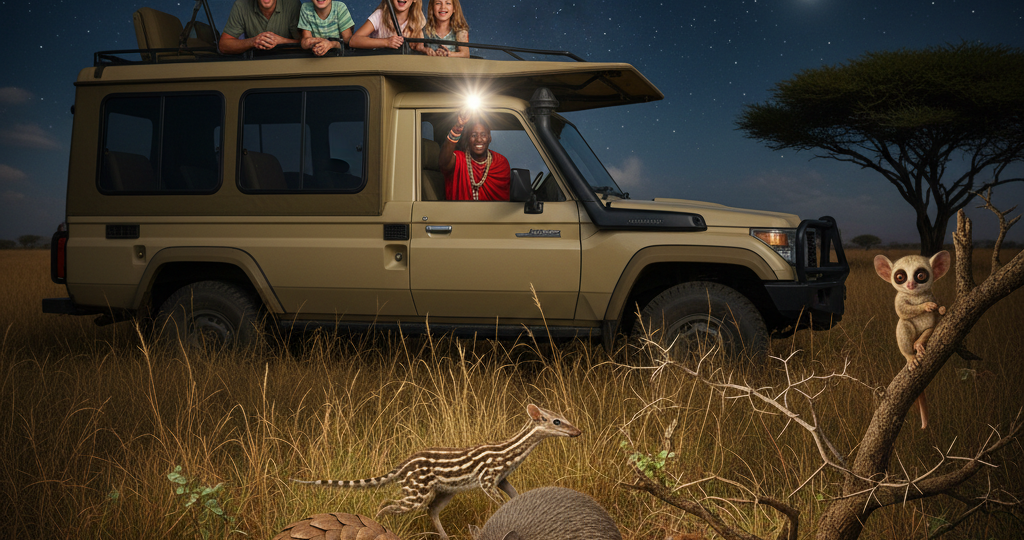
Nocturnal Safari Animals: The Secret World of Africa’s Night Shift
When the sun sets, a new cast emerges. Discover Africa’s most fascinating nocturnal animals—from pangolins to aardvarks—and where to see them on a night safari.
Nocturnal Safari Animals: Africa’s Night Shift | Mara Triangle Safaris
Here’s a question.
You’ve done the daytime game drives. Seen the lions snoozing. Watched elephants march across the plains. Ticked off the Big Five.
But have you ever wondered what happens out there when the sun goes down?
Here’s the thing.
Half the animals in Africa are nocturnal. They spend the daylight hours hidden in burrows, curled up in trees, or tucked into thick bush. When the tourists leave and the savannah goes quiet, that’s when the real action starts.
The predators that hunt under cover of darkness. The shy creatures that never show themselves in daylight. The sounds that make the hair on your neck stand up.
We’ve spent decades guiding safaris through Kenya and Tanzania. We’ve sat through countless nights, watching the bush transform. And honestly? Some of our most unforgettable sightings have happened after dark.
This guide is your ticket to that secret world. The nocturnal animals you never knew existed. Where to find them. How to spot them. And why a night drive might be the best decision you make on safari.
Let’s step into the night. 🌙
Quick Guide: Nocturnal vs. Diurnal vs. Crepuscular
Before we dive in, let’s get the terms straight. Not every animal is either “day” or “night.” There’s a whole spectrum.
| Category | Meaning | Examples |
|---|---|---|
| Nocturnal | Active at night, sleeps during the day | Pangolin, aardvark, bushbaby, genet, civet, porcupine, zorilla |
| Diurnal | Active during the day, sleeps at night | Elephant, zebra, wildebeest, giraffe, baboon |
| Crepuscular | Active at dawn and dusk (twilight) | Lion, leopard, cheetah, hippo, hyena, bushbuck |
Why it matters: The best time to see nocturnal animals is obviously after dark. But the twilight hours early morning and late afternoon—are when many of Africa’s most famous predators are also most active.
A night drive isn’t the only way to see “night” animals.
A pre‑dawn game drive (starting around 5:30 am) often catches nocturnal creatures still active and crepuscular ones just starting their day.
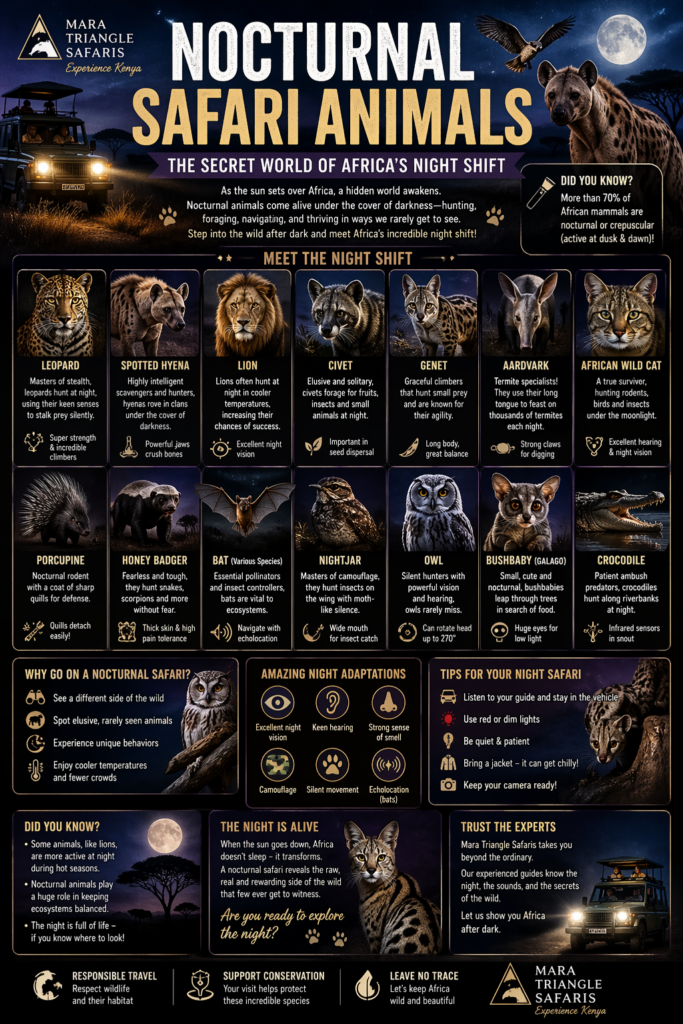
Why Night Drives Are Special
Let’s be honest. The daytime game drive is classic. But a night drive? It’s a whole different world.
Fewer vehicles. Most tourists head back to camp for sundowners and dinner. You’ll often have the bush almost to yourself.
Cooler temperatures. The midday heat is gone. Animals are moving. You’re comfortable.
The spotlight. Guides use a handheld spotlight to scan the bush. When it catches a pair of eyes, the reflection is unmistakable—green, gold, or red, depending on the animal.
The sounds. Lions roar. Hyenas whoop. Bushbabies cry like human babies. The night is alive with sounds you’ll never hear during the day.
The thrill. There’s something primal about moving through the African bush after dark. You’re not just a spectator. You’re part of the night.
Most night drives are offered in private conservancies, not national parks.
Private land allows off‑roading and night driving, which is restricted inside reserves like the Maasai Mara National Reserve.
If you want a night drive, choose a camp in a conservancy.
The Nocturnal A‑List: 10 Animals That Rule the Night
Here are the stars of the night shift. Some are rare. Some are surprisingly common—if you know where to look.
1. Pangolin – The Holy Grail
Let’s start with the one everyone wants to see. The pangolin is a walking pinecone covered in scales. It’s nocturnal, solitary, and critically endangered. When threatened, it curls into an impenetrable ball.
Where to look: Private conservancies like Ol Pejeta, Mara North, or Loisaba. Your guide will know if there have been recent sightings.
Why it’s special: Seeing a pangolin is a once‑in‑a‑lifetime event. Many guides go years without spotting one.
2. Aardvark – The Original Burrower
If a pig, a rabbit, and an anteater had a baby, it would look like an aardvark. It has a pig‑like snout, rabbit‑like ears, and a kangaroo‑like tail. It digs burrows so efficiently that other animals move in after it leaves.
Where to look: Open savanna with termite mounds. Night drives in the Mara or Laikipia.
Fun fact: An aardvark can dig faster than three men with shovels.
3. Honey Badger – The Fearless Weirdo
The honey badger doesn’t care. It’ll take on a lion, a leopard, or a cobra without hesitation. Its skin is so thick that bee stings and porcupine quills barely penetrate. It’s also one of the smartest animals in Africa.
Where to look: Dawn and dusk drives. They’re active during the day in cooler seasons but mostly nocturnal.
Fun fact: Honey badgers have a mutualistic relationship with a bird called the honeyguide. The bird leads them to beehives; the badger breaks the hive open; they both feast.
4. Genet (Common & Giant)
Genets look like a cross between a cat and a mongoose, with a long ringed tail and spotted coat. They’re solitary, nocturnal, and excellent climbers. The giant forest genet is larger and lives in forested areas.
Where to look: Woodland and bush. Common genets are often seen around lodges. Giant forest genets require forest night walks.
Fun fact: Genets have retractable claws like cats, but they can also climb down trees headfirst like squirrels.
5. Civet (African Civet)
The African civet looks like a cat‑like creature with a raccoon‑like face. It produces a musky secretion from its perineal glands—once used as a base for expensive perfumes.
Where to look: Dense bush, night drives. They’re more common than pangolins but still shy.
Fun fact: Civets are omnivorous, eating everything from fruit to small reptiles. Their scat is often full of seeds, making them important seed dispersers.
6. Bushbaby (Galago)
Bushbabies are tiny primates with enormous eyes. They leap between trees with incredible agility and make a cry that sounds like a human baby—hence the name. They mark their territory by urinating on their hands and feet, leaving scent trails as they jump.
Where to look: Forest and woodland. They’re often seen around lodges with trees.
Fun fact: A bushbaby can jump up to 2 metres horizontally and 1.5 metres vertically from a standing start.
7. Porcupine (Crested)
The crested porcupine is Africa’s largest rodent, weighing up to 30 kilograms. Its quills are modified hairs—up to 30 centimetres long. When threatened, it rattles its quills and charges backward, impaling attackers.
Where to look: Rocky areas, dry bush. Night drives often catch them crossing roads.
Fun fact: Porcupines are monogamous and often live in pairs. They communicate with a range of grunts, whistles, and squeaks.
8. Zorilla (Striped Polecat)
The zorilla looks exactly like a skunk—and has the same defence mechanism. It sprays a foul‑smelling liquid when threatened. It’s small, fluffy, and black with white stripes.
Where to look: Open bushland, night drives. They’re part of the “Secret Seven” – a group of nocturnal animals rarely seen by tourists.
Fun fact: The zorilla’s spray is so potent it can deter lions. It’s considered one of the most effective chemical defences in the animal kingdom.
9. Aardwolf – The Termite‑Eating Hyena
It looks like a miniature striped hyena, but it’s a total pacifist. The aardwolf doesn’t scavenge or hunt large prey. It eats termites—up to 300,000 in a single night. Its weak jaws and tiny teeth are built for insects, not bones.
Where to look: Dry savanna and grasslands. Most active on warm, still nights.
Fun fact: Aardwolves use their sticky tongue to lap up termites without destroying the mound. They return night after night to the same termite highways.
10. Bat‑eared Fox – Ears the Size of Its Head
If you’ve ever seen a cartoon fox with comically oversized ears, you’ve seen a bat‑eared fox. Those ears can hear termites moving underground from metres away.
Where to look: Open plains, especially in the Serengeti and northern Kenya.
Fun fact: Bat‑eared foxes live in family groups that often share burrows with aardvarks.
The “Secret Seven” is a term used by safari guides to describe seven of the most elusive nocturnal animals:
aardvark, African wild cat, civet, genet, pangolin, porcupine, and serval.
Spotting all seven on one trip is nearly impossible but it’s a fun challenge!
Creatures of Dusk & Dawn: Crepuscular Animals
While true nocturnal animals are asleep during the day, some of Africa’s most famous predators are most active at twilight. They’re called crepuscular.
| Animal | Best Time | What to Look For |
|---|---|---|
| Lion | Dawn and dusk | Often hunt at twilight. Males patrol territories. |
| Leopard | Early morning, late afternoon | Draped over tree branches or moving through bush. |
| Cheetah | Dawn and late afternoon | Scanning from termite mounds, then running. |
| Hyena | Late afternoon into night | Active around waterholes and near kills. |
| Hippo | Dusk | Leaving the water to graze. This is when they’re most dangerous. |
| Elephant | Dawn and dusk | Moving between water and feeding areas. |
Why this matters: If you’re on a standard game drive (6:00–9:00 am and 4:00–6:30 pm), you’re already in prime time for crepuscular animals. But if you want the true nocturnal species, you need a dedicated night drive.
The “golden hour” just before sunset is spectacular for photography,
but it’s also when the crepuscular animals are stirring.
Don’t rush back to camp. Ask your guide to linger.
Hearing the Night: The Soundtrack of the Bush
You don’t always need to see an animal to know it’s there. Night drives are as much about listening as looking.
| Sound | What’s Making It |
|---|---|
| Deep, guttural roar that carries for kilometres | Lion |
| High‑pitched, eerie whoop | Spotted hyena |
| Wailing cry like a human baby | Bushbaby |
| Rasping, saw‑like call | Leopard (often called “sawing”) |
| Loud, explosive grunt | Hippo (usually from the river) |
| High‑pitched yap | Black‑backed jackal |
| Rustling in the grass | Possibly a porcupine or other small mammal |
Fun fact: A lion’s roar can be heard up to 8 kilometres away. When you hear one at night, it’s both thrilling and humbling.
If you’re on a night drive, ask your guide to stop and turn off the engine for a few minutes.
Sit in silence.
The bush will come alive with sounds you’d miss with the engine running.
The Art of Night Spotting: How Guides Find Animals
Spotting nocturnal animals is a skill. Your guide isn’t just driving around hoping for the best. Here’s what they’re doing.
The Spotlight. A handheld spotlight with a red or orange filter is used to scan the bush. The filter reduces glare and is less intrusive to animals. When the light catches a pair of eyes, the reflection (eyeshine) is distinct. Green eyes? Possibly a leopard or genet. Orange‑red? Likely a hyena. White? That’s a bushbaby or small mammal.
Tracking. Guides look for fresh tracks, especially near waterholes and at the entrance of burrows. They also listen for alarm calls from animals that have spotted something.
Radio Network. Guides communicate with each other. If one finds a pangolin or a leopard, they’ll discreetly share the location so others can view without crowding.
Knowledge of Habits. Certain animals are creatures of habit. A specific termite mound might be a favourite hunting spot for a genet. A particular waterhole might attract hyenas at the same time each night.
The best night drives are with guides who’ve been in the area for years.
They know the individual animals and their routines.
At Mara Triangle Safaris, we work with guides who have that deep local knowledge.
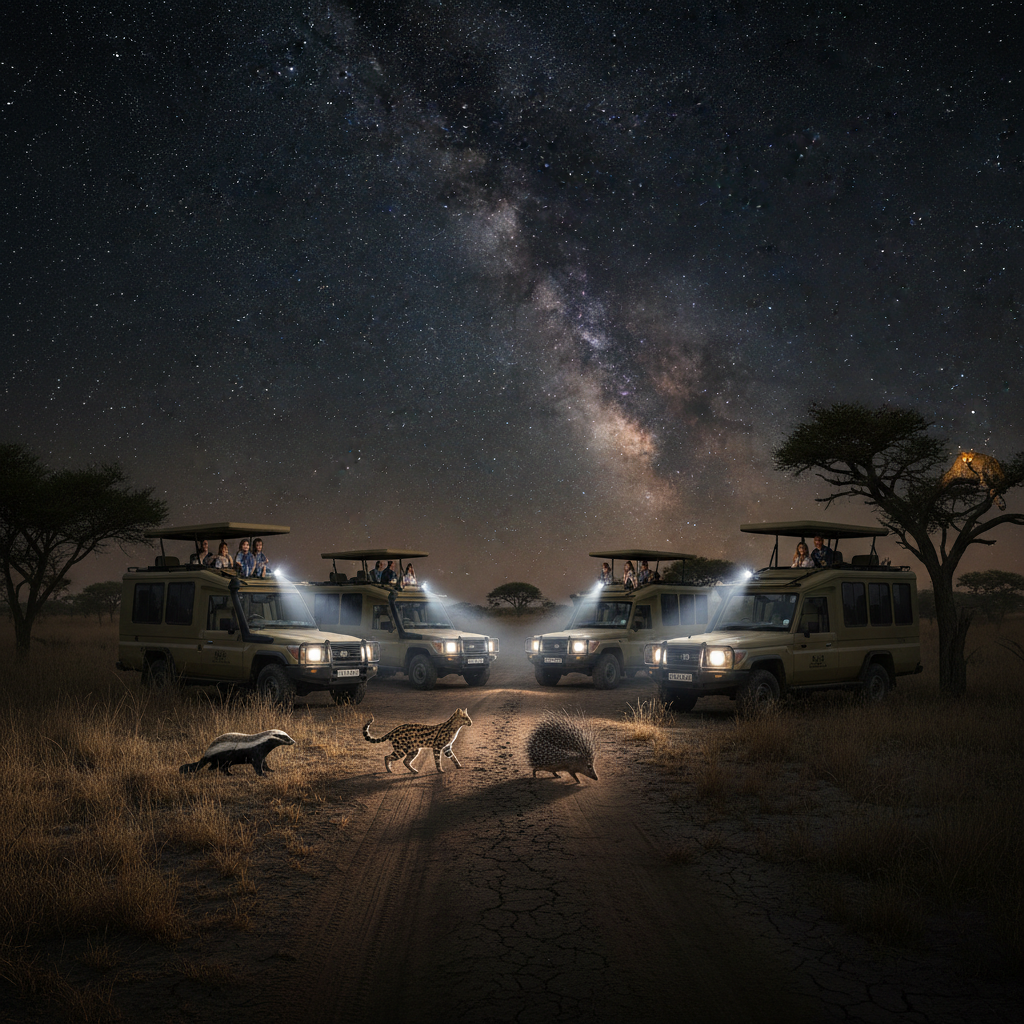
Best Places for Night Drives
Night driving is not permitted in national parks like the Maasai Mara National Reserve, Amboseli, or Serengeti National Park. To experience a night drive, you need to be in a private conservancy.
| Location | What Makes It Great |
|---|---|
| Mara North Conservancy | Adjacent to the Mara Reserve, with excellent leopard and lion populations. Night drives allowed. |
| Olare Motorogi Conservancy | High predator density, including wild dogs. Night drives with spotlights. |
| Naboisho Conservancy | Exclusive, with off‑roading and night drives. Good for genets and bushbabies. |
| Ol Pejeta Conservancy (Laikipia) | Rhinos, wild dogs, and a chance to see pangolins on night drives. |
| Samburu / Namunyak | Desert‑adapted species like gerenuk and Grevy’s zebra, plus nocturnal surprises. |
| Selous / Ruaha (Tanzania) | Remote wilderness with excellent night safari options in private concessions. |
When booking your safari, ask us specifically for a camp that offers night drives.
Many luxury camps in conservancies include one night drive in their package,
but you can often add more.
What to Expect on a Night Drive
If you’ve never been on a night drive, here’s what it’s like.
Timing. Usually starts around 7:30–8:00 pm, after dinner, and lasts 2–3 hours.
Vehicle. You’ll be in a safari Land Cruiser with a pop‑up roof. The guide will use a handheld spotlight. Some vehicles have a red light option that’s less intrusive.
What to Wear. It gets cool at night. Layers are essential. A jacket, closed shoes, and long pants are recommended. Some camps provide blankets.
Photography. Night photography is challenging. A fast lens (f/2.8 or better) and a camera with good high‑ISO performance are helpful. Most people enjoy the experience without worrying about photos. If you want to capture images, ask your guide to hold the spotlight steady.
Safety. Night drives are very safe. You stay in the vehicle at all times. The guide and spotter are experienced. Animals are not startled by the light—they’ve seen it before.
Bring a small flashlight (headlamp is perfect) for when you get in and out of the vehicle.
And don’t forget a pair of binoculars night drives are often the best time to see the “Secret Seven.”
Pro Tips for Spotting Nocturnal Animals
- Start early. Some nocturnal animals are still active just after sunset. Ask your guide to begin your night drive while there’s still a bit of twilight.
- Look for eyes. The spotlight will scan the bush. When you see a reflection, it’s almost always an animal. Your guide will know what it likely is.
- Listen. The engine is off much of the time. Listen for rustles, calls, and the sounds of animals moving.
- Be patient. Night drives can have quiet stretches. That’s normal. The magic often happens when you least expect it.
- Don’t shine your own light. Let the guide handle the spotlight. Multiple lights can confuse animals and ruin the experience.
- Ask questions. Guides love to share their knowledge. Ask about the animals, their habits, and how they track them.
- Bring a camera with good low‑light capability. If you want photos, a fast lens and a monopod or beanbag for stability are essential.
The best night drives happen when there’s a half‑moon or more.
Bright moonlight makes animals easier to see and more active.
Check the moon phase before you book.
Frequently Asked Questions
Are night drives safe?
Absolutely. You stay inside the vehicle at all times. The guide and spotter are experienced. Animals are accustomed to vehicles and spotlights. Night drives are a standard, safe safari activity.
What’s the difference between a night drive and a “spotlight” drive?
Same thing. The guide uses a handheld spotlight to scan for animals. Some camps use red filters to be less intrusive.
Can I take photos on a night drive?
Yes, but it’s challenging. Use a fast lens (f/2.8 or faster), high ISO (1600–6400), and a monopod or beanbag. Focus manually if possible. Alternatively, just enjoy the experience and leave the photos to your memory.
What’s the best time of year for night drives?
Year‑round, but dry season (June–October) means less vegetation and animals concentrated around water. March‑May (green season) can be good too, though occasional rain may affect drives.
Will I see the “Secret Seven”?
Not all in one trip! Spotting pangolin, aardvark, civet, genet, porcupine, African wild cat, and serval is extremely rare. Guides consider it a career achievement. But you’ll almost certainly see some of them—especially genet, bushbaby, and possibly hyena or porcupine.
What if I don’t see anything?
It’s rare to see nothing. Even on quiet nights, you’ll hear the sounds of the bush and likely spot a few animals. Guides know the best areas. And sometimes the thrill is in the anticipation.
Can I do a night drive in the Maasai Mara National Reserve?
No. Night driving is not allowed in the national reserve. You must be in a private conservancy bordering the reserve to do a night drive.
How much does a night drive cost?
It varies. Many camps include one night drive in their package. Extra night drives typically cost $50–$100 per person. Some high‑end camps include unlimited night drives.
What should I wear?
Layers. It gets chilly. A fleece, jacket, long pants, and closed shoes are essential. Some camps provide blankets.
Can I bring children on a night drive?
Most camps allow children over 6 or 8 on night drives. Check with us when booking. It’s an exciting experience for older kids.
Ready to Experience the Night Shift?
You’ve read about the creatures. You know where to find them. Now it’s time to experience the magic yourself.
Here’s what we need from you:
Tell us if you’d like to include a night drive in your safari. How many nights you have. Which habitat you’re most curious about (savanna, forest, desert). Any particular animals you’re hoping to see.
We’ll build you a safari that includes nights in private conservancies—where the real night action happens. With guides who know exactly where to point the spotlight.
Because that’s what we do at Mara Triangle Safaris. We don’t just show you the Africa everyone sees. We show you the Africa that comes alive when everyone else has gone to bed.
Let’s step into the night together.
Let’s Start Planning
The easiest way to start? Head over to our contact page.
Drop us an email at info@maratrianglesafaris.co.ke with your questions. Or give the team a call:
+254 705 635 886
+254 768 212 702
We’re here Monday through Saturday, 8:30 am to 5:00 pm East Africa time. Email works anytime—we’ll get back within 24 hours.
Tell us what you’re after. Daytime safaris are incredible. But the night shift? That’s where legends are made.
More Reading from Mara Triangle Safaris
| Article | What You’ll Find |
|---|---|
| The Ultimate A‑Z Safari Animal Guide | 100+ animals from aardvark to zebra. Photos, facts, and a printable checklist. |
| Safari Animals 101: The Ultimate Guide for First-Timers | What you’ll actually see, where, and when. Perfect for planning. |
| How to Spot Rare Animals on a Kenyan Safari | Your guide to the pangolin, aardvark, wild dog, and other elusive creatures. |
| Beyond the Savanna: The Weirdest, Coolest Animals Hiding in East Africa’s Mountains, Forests, and Deserts | Explore the bizarre creatures that don’t live on the open plains. |