
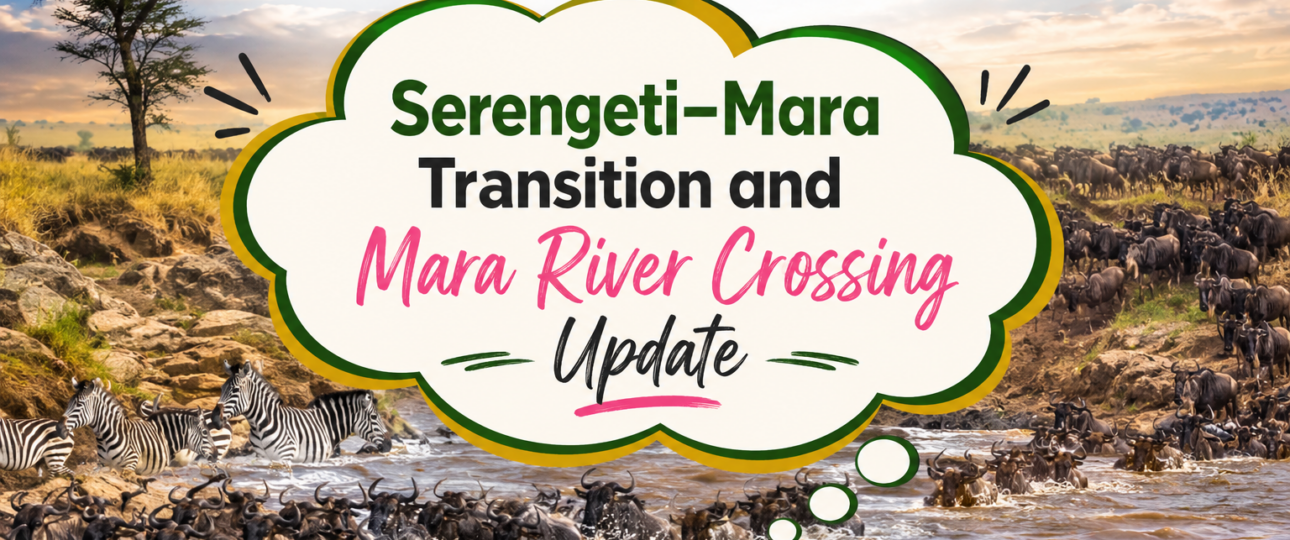
Great Migration Today: Serengeti–Mara Transition and Mara River Crossing Update – August 24, 2026
Great Migration Today: Serengeti–Mara Transition & Mara River Crossing Update – August 24, 2026
Latest update: August 24, 2026 | Current phase: Northern Serengeti–Maasai Mara transition and Mara River crossing season
🦓 The Great Migration Is Now in Its Northern Serengeti–Mara Phase
The Great Wildebeest Migration has reached one of the most closely watched stages of the 2026 season. Large herds are now spread through the northern Serengeti and Maasai Mara ecosystem, with the Mara River remaining one of the major movement and crossing zones.
Recent August reports have documented wildebeest and zebra crossing the Mara River in Kenya, while current migration tracking also records activity and crossings on the northern Serengeti side.
That means the story today is not simply “the migration has arrived in Kenya.” The better description is the Serengeti–Mara transition — a period when different herds can be found on different sides of the ecosystem at the same time.
🇹🇿 Northern Serengeti
A major migration zone as herds gather, graze and move around the northern Serengeti and Mara River system.
🇰🇪 Maasai Mara
Migrating wildebeest and zebra are already being seen in Kenya as the migration continues across the wider Mara ecosystem.
🌊 Mara River
The river-crossing season is active. Crossings have been documented, but their exact timing and location remain unpredictable.
🦁 Predator Action
Large concentrations of prey can attract lions, cheetahs, leopards, crocodiles and other predators.
🦓 Want to Follow the Migration in 2026?
The herds are now moving through the Serengeti–Mara ecosystem. If you’re planning a migration safari, your dates, location and flexibility matter.
TALK TO A SAFARI EXPERT →Where Is the Great Migration Today?
This is probably the biggest question travellers are asking right now: Where are the wildebeest today?
The honest answer is that there is no single location. The Great Migration is a continuous movement involving huge numbers of wildebeest, zebra and gazelles, and the animals do not travel as one perfectly synchronized herd.
As of August 24, different groups can be spread across the northern Serengeti and the Maasai Mara. Some animals may be approaching the Mara River, others may already have crossed, while other groups can still be grazing farther south or east.
This is why the phrase “Serengeti–Mara transition” is more accurate than simply saying the migration has “moved to Kenya.”
🌍 The Migration Does Not Recognize the Kenya–Tanzania Border
The wildebeest are following rainfall, fresh grass and water — not international boundaries. The Serengeti and Maasai Mara form one connected ecological system, and the animals can move between them as conditions change.
Recent coverage also highlights how the two landscapes function as one continuous migration ecosystem.
🌍 The Great Migration Circle: Serengeti to Mara and Back Again
One of the most useful ways to understand today’s migration is to stop thinking of it as a one-way trip.
The animals move through a natural annual cycle. They follow fresh grazing and water, move north toward the Mara ecosystem, cross rivers when conditions lead them to do so, spend time in the northern grazing areas and eventually begin the journey south again.
The exact route and timing change from year to year.
That is why travellers following the migration should think about the entire Serengeti–Mara circle, rather than focusing on one border crossing.
Read the complete migration-circle guide:
The Great Migration Circle: Serengeti, Masai Mara and Back Again →
🌊 What Is Happening at the Mara River?
The Mara River is now one of the most important places to watch as the migration develops.
During crossing season, wildebeest can gather along the riverbank for hours. Sometimes they move toward the water and retreat. Sometimes a small group enters first. At other times, a much larger herd suddenly commits to the crossing.
The scene can change in minutes.
Recent reporting confirms that wildebeest and zebra were photographed crossing the Mara River in the Maasai Mara on August 14, 2026.
Current migration tracking has also recorded Mara River crossing activity on the northern Serengeti side, reinforcing the fact that the river-crossing phase is active across the wider ecosystem.
🌊 Is a Mara River Crossing Happening Today?
We need to make an important distinction.
Yes, this is an active Mara River crossing period. But we should not tell travellers that a crossing is happening at this exact hour unless there is a verified same-day sighting.
The animals decide when and where to cross. A herd may gather at one crossing point and then move to another location, wait until later or turn away from the river altogether.
Dreaming of a Mara River Crossing?
A crossing cannot be guaranteed. But choosing the right area, allowing enough safari time and working with an experienced local guide can improve your opportunity to follow the herds when they are near the river.
PLAN MY MIGRATION SAFARI →🦓 Why August 2026 Is So Important
August is one of the most important months for following the migration around northern Serengeti and Maasai Mara.
Current safari information continues to identify August as a major river-crossing period, while September is also widely regarded as a strong month for crossings.
But a Great Migration safari in August is not simply about sitting beside a river.
It is about following an enormous wildlife event as it unfolds.
- 🦓 Wildebeest gathering across open plains
- 🦓 Zebra moving alongside the herds
- 🌿 Animals searching for fresh grazing
- 🌊 Herds gathering near riverbanks
- 🐊 Crocodiles waiting in the water
- 🦁 Predators following concentrations of prey
- 📸 Dramatic wildlife photography opportunities
🇹🇿 What About Northern Serengeti Right Now?
This is where our current migration story becomes especially important.
Even though Kenya is receiving considerable attention during the crossing season, northern Serengeti remains an essential part of the migration picture.
Current migration tracking has recorded herds and Mara River crossings in northern Serengeti, including a megaherd sighting at a Mara River crossing point.
For travellers choosing Tanzania, the northern Serengeti can therefore be an excellent place to follow the migration around this time of year.
If you’re researching the Tanzania side, continue with:
👉 Serengeti Great Migration Guide: Where & When to See It
🇹🇿 Considering the Serengeti Side?
The migration is a Serengeti–Mara story. If you’re deciding between Tanzania and Kenya, we can help you understand which side fits your dates and safari priorities.
ASK ABOUT YOUR SAFARI OPTIONS →🇰🇪 What Does This Mean for the Mara Triangle?
For travellers planning a Kenya safari, the current migration phase is particularly exciting.
The Mara Triangle is part of the greater Maasai Mara ecosystem and provides an important setting for experiencing the migration alongside the Mara’s resident wildlife.
And there is something important to remember:
You Don’t Need to See a River Crossing to Have an Incredible Migration Safari.
A river crossing is one of nature’s most dramatic spectacles, but it is only one moment in a much larger wildlife experience.
Watching thousands of wildebeest spread across the plains, seeing zebra move alongside them, finding predators nearby or simply sitting quietly while a massive herd passes can be equally unforgettable.
🦁 What Else Can You See During the Migration?
The wildebeest may be the stars of the show, but the migration affects the entire ecosystem.
When huge numbers of grazing animals concentrate in one region, predators have more opportunities too.
- 🦁 Lions following the herds
- 🐆 Leopards around woodland and riverine areas
- 🐆 Cheetahs hunting across open plains
- 🐊 Crocodiles around the Mara River
- 🦛 Hippos in the river
- 🐘 Elephants across the wider Mara landscape
- 🦓 Zebra travelling with wildebeest
- 🦒 Giraffes and resident plains wildlife
👨👩👧 Can Children Watch Mara River Crossings?
Yes, families can experience the migration, but river crossings require careful planning and strict adherence to guide and park safety instructions.
Children can find the migration fascinating because it combines huge animals, dramatic landscapes and a natural event that is happening in real time.
However, parents should remember that river crossings can involve steep banks, deep water, crocodiles, hippos, dust and large moving animals.
Our dedicated family guide explains what parents should consider:
👉 Can Children Watch Mara River Crossings? Family Safari Guide
🏕️ Which Camps Are Closest to the Mara River Crossings?
Accommodation location matters during migration season.
A beautiful camp does not necessarily mean you are close to the herds. The animals can move over considerable distances, and their preferred crossing point can change.
Still, choosing a strategically located camp can make it easier for guides to follow the migration.
Read our guide:
👉 Which Safari Camp Is Closest to Mara River Crossings?
📍 Close to the River Does Not Mean Guaranteed Crossing
This is one of the most important things to understand before booking. The river is part of a huge natural ecosystem. The animals decide where and when they cross.
Your safari should therefore be designed around following the migration, not simply waiting beside one crossing point.
⏳ How Long Will the Wildebeest Stay?
Another major question for travellers planning a 2026 safari is whether the wildebeest will still be in Kenya when they arrive.
There is no fixed departure date.
Different groups can remain in the Mara for different lengths of time depending on rainfall, grazing and local conditions.
The wider Kenyan migration season generally extends into September and October, but exact herd movements cannot be guaranteed.
Read more:
👉 How Long Will the Wildebeest Stay?
💰 How Much Does a Migration Safari Cost?
The cost of a Great Migration safari depends on factors such as accommodation, number of days, transport, park fees, season and safari style.
Peak migration season can also command higher rates because demand is strong.
For travellers focused on the migration, 4–5 days is a useful starting point, while those whose primary goal is a river crossing may benefit from additional flexibility.
Explore the full guide:
👉 How Much Does a Migration Safari Cost? 2026 Guide
💰 Ready to Work Out Your Safari Budget?
Tell us your dates, number of travellers and preferred safari style. We can help you build a migration itinerary around your budget and priorities.
GET A SAFARI QUOTE →🗓️ What Happens After August?
The migration story does not end when August ends.
September can continue to deliver excellent migration viewing, including river crossings and large herds in the Mara ecosystem.
Later in the season, conditions begin to change and some groups start moving back toward Tanzania.
But once again, rainfall and grazing conditions determine what actually happens.
That is why current sightings, experienced guides and flexible game drives are so valuable during migration season.
🧭 Recommended Great Migration Guides
If you’re researching the migration today, these guides will help you understand different parts of the journey:
🌍 Migration Circle
Understand how the Serengeti and Maasai Mara connect in one continuous natural cycle.
Read the Migration Circle Guide →👨👩👧 Family River Crossings
What parents should know before taking children to experience the Mara River crossing season.
Read the Family Guide →💰 Safari Cost Guide
Understand the major factors that determine the cost of a Great Migration safari.
Read the Cost Guide →🏕️ Camps Near the River
Learn why accommodation location matters during the Mara River crossing season.
Explore the Camp Guide →⏳ Wildebeest Timing
Understand how long migrating herds can remain in the Mara and why there is no fixed schedule.
Read the Timing Guide →🇹🇿 Serengeti Migration
Explore the Tanzania side of the migration and learn where and when to look for the herds.
Explore the Serengeti Guide →📖 More Great Migration Reading
For additional background on the annual migration, you can also explore:
👉 The Great Wildebeest Migration: Complete Guide
This provides useful background for understanding the current 2026 migration cycle.
❓ Great Migration Today: Frequently Asked Questions
Where is the Great Migration today, August 24, 2026?
The migration is currently spread across the northern Serengeti and Maasai Mara ecosystem. Different herds can be in different locations at the same time.
Has the Great Migration reached the Masai Mara?
Yes. Recent August reporting confirms migrating wildebeest and zebra in the Maasai Mara, including documented Mara River crossings.
Are the Mara River crossings happening in August 2026?
Yes. Crossings have been documented during August, and the current period is considered part of the main river-crossing season. However, exact crossing dates and locations cannot be guaranteed.
Is the migration in Serengeti or Masai Mara right now?
Both. The migration is spread across the wider ecosystem. Northern Serengeti remains important, while the Maasai Mara is receiving migrating herds.
Is September still a good month?
Yes. September remains an important migration month, particularly for travellers hoping to experience river crossings and large concentrations of wildlife.
How many days should I spend on a migration safari?
A 4–5 day safari is a useful starting point for migration-focused travel. If witnessing a river crossing is your primary goal, more time gives you greater flexibility to follow changing herd movements.
Can I book a migration safari now?
Yes. If you are planning for the remaining 2026 migration season, it is worth discussing your dates, accommodation preferences and priorities as early as possible.
The Migration Is Moving.
Will You Be There?
The Serengeti–Mara migration is now in one of the most exciting stages of the 2026 season. If witnessing the Mara River, following the herds or experiencing the wider Great Migration is on your bucket list, let’s start planning.
START PLANNING MY SAFARI →Mara Triangle Safaris • Kenya Great Migration Safaris
📰 Great Migration Today — The Bottom Line
August 24, 2026 finds the Great Migration firmly in the northern Serengeti–Maasai Mara phase, with the Mara River crossing season underway.
Recent documented crossings in Kenya and current migration tracking from the northern Serengeti show why this is such an important period for migration watchers.
But the most important lesson is that the Great Migration is not a scheduled show.
There is no guaranteed crossing time.
There is no single herd representing the entire migration.
And there is no way to know with certainty where every group will be tomorrow.
That unpredictability is exactly what makes the migration extraordinary.
Today, one herd may be gathering beside the Mara River.
Another may already be grazing in Kenya.
Another may still be in northern Serengeti.
And somewhere nearby, predators are watching and waiting.
The Serengeti–Mara migration is moving. The next dramatic chapter could be anywhere along the route.
We will continue following the 2026 migration as the season develops.
🦓 Ready to Experience the Great Migration?
Whether your dream is a Mara River crossing, huge herds on the plains or a complete Kenya migration safari, let’s plan around what matters most to you.
CONTACT MARA TRIANGLE SAFARIS →