
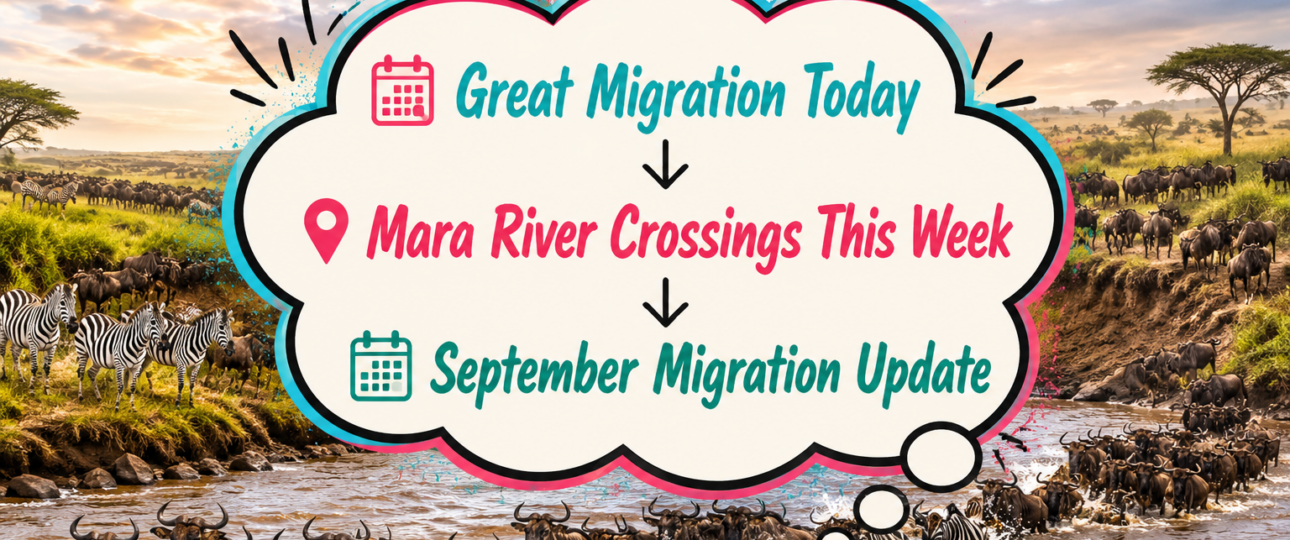
Mara River Crossings This Week: Where the Wildebeest Are Moving in Kenya & Northern Serengeti
Mara River Crossings This Week: Where the Wildebeest Are Moving in Kenya & Northern Serengeti
Migration update: Week of August 25, 2026 | Focus: Mara River crossings, Maasai Mara, Mara Triangle and Northern Serengeti
🌊🦓 The Mara River Is Now at the Centre of the Migration Story
The Great Wildebeest Migration has entered one of the most exciting periods of the 2026 season. As we move into the final week of August, the Mara River and the surrounding Serengeti–Mara ecosystem remain major areas to watch.
Recent documented crossings in the Maasai Mara confirm that wildebeest and zebra are already moving through the river-crossing phase. At the same time, herds continue to occupy areas of the northern Serengeti.
That means this week’s migration story is not simply about Kenya versus Tanzania. It is about a huge moving ecosystem in which different herds can be on different sides of the Mara River at the same time.
🇰🇪 Maasai Mara
Migrating wildebeest and zebra are already in the Kenyan ecosystem, with river crossings forming one of the major spectacles of the season.
🌊 Mara River
Crossing activity is part of the current migration phase, but the animals can gather, wait, move away and return before making a crossing.
🇹🇿 Northern Serengeti
Large herds remain in northern Tanzania, making the Serengeti side an important part of this week’s migration picture.
🦁 Predator Country
Where large concentrations of wildebeest and zebra gather, predators such as lions, cheetahs and crocodiles become part of the story too.
🦓 Planning to See the Migration This Year?
The migration is moving through the Serengeti–Mara ecosystem now. Tell us your travel dates and what you want to experience, and we can help you plan around the current migration season.
TALK TO MARA TRIANGLE SAFARIS →📰 What Is Happening at the Mara River This Week?
The Mara River is currently one of the most important places for migration watchers to follow.
The river is not simply a line that the wildebeest cross once before continuing into Kenya. Animals can move back and forth around the river system as they respond to grazing, water, weather and local conditions.
That is why one of the biggest mistakes a traveller can make is to think: “The migration crossed, so it is finished.”
It is not.
The migration is a continuous natural movement, and different herds can behave very differently.
🌊 The Important Point This Week
August remains a prime Mara River crossing period. But a crossing is never a scheduled event. There may be dramatic activity at one section of the river while another section is quiet.
A good migration safari therefore follows the animals rather than relying on a fixed timetable.
🇰🇪 Where Are the Wildebeest in Kenya?
The Maasai Mara is now a major part of the migration story.
Migrating wildebeest and zebra have already entered Kenya, and documented August crossings show that animals are actively using the Mara River system.
But it is important not to imagine that every wildebeest in the migration is standing beside the river.
Some herds may be grazing on the plains. Others may be moving between feeding areas. Some may be gathering near the river. Others may already have crossed.
This creates a constantly changing wildlife picture across the Mara ecosystem.
🦓 What About the Mara Triangle?
For travellers visiting the Kenyan side, the Mara Triangle deserves particular attention.
The area combines the migration with excellent opportunities to see resident wildlife, giving travellers more than just the possibility of a river crossing.
You may spend a morning following wildebeest before finding zebra, elephants, giraffes, lions or cheetahs later in the same game drive.
And if the herds are near the river, your guide can follow their movements and look for opportunities to observe the crossing behaviour.
🦓 Don’t Make the River Crossing Your Only Goal
A Mara River crossing can be spectacular, but it is also unpredictable.
The wider migration experience can be just as memorable: following a huge herd across the plains, watching predators stalk nearby, seeing zebra move with wildebeest or simply sitting quietly as thousands of animals pass.
🇹🇿 Where Are the Wildebeest in Northern Serengeti?
The Kenya side is receiving much of the attention right now, but northern Serengeti remains extremely important.
The Serengeti–Mara ecosystem does not stop at the international boundary.
Wildebeest can remain in northern Tanzania, move toward the river, cross into Kenya or move back again depending on conditions.
This is why travellers who want to understand the migration should think of northern Serengeti and Maasai Mara as connected migration destinations.
For anyone considering the Tanzania side, our detailed guide is a useful next step:
👉 Serengeti Great Migration Guide: Where & When to See It
🇹🇿🇰🇪 Kenya or Northern Serengeti?
Not sure which side makes more sense for your dates? We can help you understand the current migration pattern and build your safari around the experience you want.
ASK ABOUT YOUR MIGRATION SAFARI →🌊 Why Do Wildebeest Cross the Mara River?
The wildebeest are not crossing the Mara River because someone has told them it is time.
Their movement is driven by natural conditions.
They are searching for food and water and responding to changing grazing conditions across the ecosystem.
The river becomes an obstacle they must negotiate as they move between feeding areas.
And that is what makes the crossings so dramatic.
The animals may gather at the edge. They may hesitate. They may follow one another. They may suddenly rush into the water.
Sometimes the waiting lasts much longer than visitors expect.
⚠️ A Crossing Cannot Be Guaranteed
Even during peak migration season, nobody can honestly guarantee a Mara River crossing on a particular day.
The herds decide when to move. Rainfall, river conditions, grazing and the behaviour of the animals can all influence what happens.
That is why spending several days in the migration area gives you more flexibility than making a very short trip built around one specific crossing prediction.
Want to Give Yourself More Time for a Crossing?
The secret is not predicting the exact hour. It is giving your safari enough time and allowing your guide to follow where the herds are moving.
PLAN MY MARA SAFARI →🐊 What Makes the Mara River Crossing So Dramatic?
The river itself is only one part of the spectacle.
A crossing can involve thousands of wildebeest and zebra moving toward the water, steep banks, deep channels and powerful currents.
The river is also home to crocodiles and hippos, adding another layer of natural drama.
But the most fascinating part is often the behaviour of the herd before the crossing.
Animals may gather for a long time without entering. Then one group suddenly commits.
That can trigger a chain reaction as more animals follow.
🦁 What Happens Around the Herds?
The migration does not move through an empty landscape.
The arrival of huge numbers of herbivores affects the entire ecosystem.
- 🦁 Lions may follow concentrations of wildebeest.
- 🐆 Cheetahs may use open plains to hunt.
- 🐆 Leopards remain in suitable woodland and riverine habitats.
- 🐊 Crocodiles wait in sections of the Mara River.
- 🦛 Hippos occupy parts of the river.
- 🐘 Elephants continue moving through the wider ecosystem.
- 🦓 Zebra often travel alongside the wildebeest.
📍 Can You Predict Which Mara River Crossing Point Will Be Active?
Not with certainty.
This is another reason daily local knowledge matters during migration season.
A herd may gather at one area and then move along the river. Another group may approach a different section.
The best approach is therefore to use current information as a guide rather than treating a crossing-point prediction as a guarantee.
🏕️ Where Should You Stay During Crossing Season?
Your accommodation can make a difference to your safari experience, particularly when you want to spend more time following the migration.
However, being close to the Mara River does not automatically mean that a crossing will happen outside your camp.
The better question is: Can my safari team follow the herds efficiently?
Location, road access, guide experience and the number of days you have can all matter.
We have a dedicated guide to help you compare accommodation options:
👉 Which Safari Camp Is Closest to Mara River Crossings?
👨👩👧 Can Families Watch the River Crossings?
Families can enjoy the Great Migration, but river-crossing viewing needs careful planning.
The Mara River is a wild environment, and parents should follow the instructions of their safari guide at all times.
Children may find the migration fascinating because the experience combines wildlife, movement and a dramatic natural event.
For parents planning a family migration safari, read:
👉 Can Children Watch Mara River Crossings? Family Safari Guide
⏳ Will the Wildebeest Still Be in the Mara Next Month?
This is one of the biggest questions travellers planning September safaris are asking.
The answer is that there is still a strong migration window ahead, but nobody can provide an exact departure date.
Different herds move at different speeds. Some may remain in the Mara while others begin shifting back toward Tanzania.
Rainfall and grazing conditions remain important factors.
Read our detailed guide:
👉 How Long Will the Wildebeest Stay?
💰 How Much Does a Migration Safari Cost?
The cost of a migration safari depends on accommodation, number of days, transport, park fees, travel dates and the overall style of safari.
Peak migration months can also be more expensive because demand is higher.
If your main goal is to follow the herds and have a chance at a river crossing, it is worth thinking about the number of nights as part of your budget rather than focusing only on the nightly accommodation price.
Our detailed guide explains the main costs:
👉 How Much Does a Migration Safari Cost? 2026 Guide
💰 Planning Your Migration Safari Budget?
Send us your preferred dates, number of travellers and safari style. We can help you build a practical migration itinerary around your priorities.
GET A SAFARI QUOTE →🌍 Why the Serengeti–Mara Connection Matters This Week
The biggest mistake when following the Great Migration is thinking of Kenya and Tanzania as completely separate wildlife stories.
They are connected.
The same migration cycle moves through both countries.
A herd can be in northern Serengeti, move toward the Mara River and eventually enter Kenya. Another herd may already be grazing in the Mara. Later, animals can move south again.
That is why the Great Migration is better understood as a circle rather than a straight line.
Read the full explanation here:
👉 The Great Migration Circle: Serengeti, Masai Mara and Back Again
🗓️ What Should Travellers Expect for the Rest of August?
The final week of August remains an important period for travellers interested in the Mara River crossing season.
However, we should avoid turning the calendar into a promise.
There may be spectacular crossings on one day and long periods of waiting on another.
The migration is controlled by nature, not by a safari timetable.
🧭 Our Recommended Great Migration Guides
🌍 Migration Circle
Understand how Serengeti and Masai Mara form one continuous migration ecosystem.
Read the Migration Circle Guide →🌊 Mara River Family Guide
Planning to bring children to the migration? Start with this family-focused guide.
Read the Family Guide →💰 Migration Safari Cost
Understand the major factors that influence the cost of a Kenya migration safari.
Read the Cost Guide →🏕️ Camps Near Mara River
Learn how accommodation location can affect your migration safari strategy.
Explore the Camp Guide →⏳ How Long Will They Stay?
Understand why there is no fixed date for the wildebeest to leave Kenya.
Read the Timing Guide →🇹🇿 Serengeti Migration Guide
Explore where and when to follow the migration on the Tanzania side.
Explore the Serengeti Guide →❓ Mara River Crossings This Week: Frequently Asked Questions
Are Mara River crossings happening this week?
August is an active Mara River crossing period, and crossings have already been documented during August 2026. However, a specific crossing cannot be guaranteed on a particular day or at a particular crossing point.
Where are the wildebeest this week?
The migration is spread across the wider Serengeti–Mara ecosystem. Herds can be found in the Maasai Mara and northern Serengeti, with different groups moving at different speeds.
Is Northern Serengeti still worth visiting?
Yes. Northern Serengeti remains an important part of the migration ecosystem during this period. Travellers should not assume that every wildebeest has already moved into Kenya.
Is the Mara Triangle good for the migration?
Yes. The Mara Triangle is part of the greater Maasai Mara ecosystem and can offer migration viewing together with excellent resident wildlife experiences.
Can I guarantee seeing a Mara River crossing?
No. No responsible safari operator should guarantee a natural wildlife event. The best strategy is to allow enough time and follow the herds with an experienced guide.
Is September still good for the Great Migration?
Yes. September remains an important migration month, and river-crossing activity can continue. Exact timing depends on natural conditions.
How many days should I book?
For a migration-focused safari, 4–5 days is a useful starting point. If the river crossing is your primary goal, additional flexibility can give you more opportunities to follow the herds.
The Herds Are Moving.
Are You Ready to Follow Them?
The final days of August are an exciting time in the Serengeti–Mara ecosystem. Whether your dream is a Mara River crossing, thousands of wildebeest on the plains or a complete Great Migration experience, let’s build your safari around what matters most to you.
START PLANNING MY SAFARI →Mara Triangle Safaris • Kenya Great Migration Safaris
📰 Mara River Crossings This Week: The Bottom Line
As we enter the week of August 25, 2026, the Mara River remains at the heart of the Great Migration story.
The Maasai Mara is receiving migrating wildebeest and zebra, while northern Serengeti remains an important part of the wider movement.
Documented August crossings confirm that the river-crossing phase is underway, but the exact location of the next major crossing cannot be predicted with certainty.
That is the nature of the Great Migration.
The herds gather.
They wait.
They move.
They cross.
And sometimes they turn around and do it again.
This week, the best place to be is not necessarily where yesterday’s crossing happened. It is where the herds are moving today.
That is why local knowledge, flexible game drives and enough time in the ecosystem matter so much during migration season.
🦓 Follow the Migration With Mara Triangle Safaris
Tell us when you want to travel and what you most want to see. We’ll help you plan your Kenya Great Migration safari around your dates and priorities.
CONTACT US →