
Masai Mara Migration Travel Guide
Find everything you need for an unforgettable Mara Migration Trip with this Masai Mara Migration Travel Guide. Plan, book, and experience the Great Migration!
🦓 Great Migration Guide at a Glance
Everything you need to know about planning a memorable Great Migration safari in the Maasai Mara—summarised in one easy-to-reference table.
📞 Ready to Experience the Great Migration?
Our local safari specialists can help you plan a personalised Great Migration adventure, whether you’re looking for a budget-friendly safari, a luxury fly-in experience or a tailor-made Kenya wildlife holiday. Contact us for expert advice, customised itineraries and competitive safari packages. :contentReference[oaicite:0]{index=0}
| 🌐 Contact Page | https://maratrianglesafaris.co.ke/contact/ |
| 📞 Phone | +254 705 635 886 | +254 768 212 702 |
| info@maratrianglesafaris.co.ke deals@maratrianglesafaris.co.ke |
|
| 🕒 Office Hours | Monday – Saturday: 8:30 AM – 5:00 PM |
| 📍 Office | Venus Complex, Northern Bypass, 1st Floor, Room 4107, Nairobi, Kenya |
Start Planning Your Dream Kenya Safari Today
Whether you want to witness the Great Migration, photograph the Big Five or enjoy a luxury safari in the Mara Triangle, our experienced team is ready to help you create an unforgettable African adventure.
Request Your Free Safari Quote →Your Ultimate Masai Mara Migration Travel Guide for 2026-Mara Triangle Safaris
Searching for a Masai Mara migration travel guide that goes beyond the basics?
If the thrill of the Mara Migration Trip calls to you, you’re about to discover how timing, expert insights, and a dash of adventure come together for an experience you’ll never forget.
From hidden river crossings to the pulse of the Great Migration, this guide brings you tips on creating your ultimate Masai Mara migration travel guide from Nairobi,
the hottest months, and the best safari packages—so your African safari dreams are just a few steps away.
📅 Month-by-Month Great Migration Calendar
The Great Migration is a year-round journey that follows seasonal rainfall and fresh grazing. Although wildlife can be seen throughout the year, each month offers a unique safari experience. This calendar will help you choose the best time to visit based on wildlife activity, crowd levels and photography opportunities.
| Month | Migration Stage | Wildlife | Crowds | Photography |
|---|---|---|---|---|
| January | Southern Serengeti | Calving begins | Low | ⭐⭐⭐⭐ |
| February | Peak calving season | Excellent predator action | Low | ⭐⭐⭐⭐⭐ |
| March | Moving northwest | Large herds | Low | ⭐⭐⭐⭐ |
| April | Green season | Resident wildlife | Very Low | ⭐⭐⭐ |
| May | Western Corridor | Growing herds | Low | ⭐⭐⭐⭐ |
| June | Heading north | Migration gathers pace | Medium | ⭐⭐⭐⭐ |
| July | Arrival in Kenya | River crossings begin | High | ⭐⭐⭐⭐⭐ |
| August | Peak migration | Major Mara River crossings | Very High | ⭐⭐⭐⭐⭐ |
| September | Northern Mara | Outstanding wildlife | High | ⭐⭐⭐⭐⭐ |
| October | Preparing to move south | Excellent game viewing | Medium | ⭐⭐⭐⭐ |
| November | Return to Serengeti | Scattered herds | Low | ⭐⭐⭐ |
| December | Southern Serengeti | Large grazing herds | Low | ⭐⭐⭐⭐ |
⭐ Expert Tip
If your dream is witnessing dramatic Mara River crossings, plan your safari between late July and September. For fewer crowds, greener landscapes and excellent predator sightings, consider travelling during January to March.
Why the Masai Mara Migration Travel Guide is a Must for Your Mara Migration Trip
A Mara Migration Trip is often called the “Greatest Wildlife Show on Earth,” and it’s not hard to see why. The Masai Mara migration travel guide showcases the incredible movement of animals between the Serengeti in Tanzania and the Masai Mara in Kenya. This extraordinary event transforms the landscape into a scene of raw power and beauty as predators like lions and crocodiles lie in wait.
Understanding the Masai Mara Migration map is key to planning your adventure. You’ll want to follow where the herds are likely to be for the best experience. Whether it’s crossing the Mara River or grazing the open savannahs, this guide ensures you’ll catch the action. For added convenience, many Safari travel agencies, such as Safari Travel Plus and Bonfire Adventures, offer curated tours that include expert guides, ensuring you don’t miss a moment.
🐃 Mara River Crossing Guide: When Are You Most Likely to See a Crossing?
The dramatic Mara River crossings are among the highlights of the Great Migration. Thousands of wildebeest, zebras and gazelles gather along the riverbanks before making the dangerous crossing, often pursued by crocodiles and predators waiting nearby. However, it’s important to understand that river crossings are unpredictable and cannot be guaranteed on any safari.
Animal movements depend on rainfall, grazing conditions and natural instincts. Some herds may cross several times in one day, while others may wait for hours or even several days before entering the river.
⭐ Quick Answer
Your highest chance of witnessing a Mara River crossing is generally between late July and September. Even during this period, crossings are never guaranteed because they are entirely driven by wildlife behaviour and environmental conditions.
| Month | River Crossing Chance | What to Expect |
|---|---|---|
| January | ⭐☆☆☆☆ Very Low | Calving season in the southern Serengeti. |
| February | ⭐☆☆☆☆ Very Low | Excellent predator activity but no Mara crossings. |
| March | ⭐☆☆☆☆ Very Low | Herds begin moving northwest. |
| April | ⭐☆☆☆☆ Very Low | Green season with resident wildlife. |
| May | ⭐⭐☆☆☆ Low | Migration gathers momentum in Tanzania. |
| June | ⭐⭐⭐☆☆ Moderate | Some early crossings may occur near northern Serengeti. |
| July | ⭐⭐⭐⭐☆ High | Herds arrive in Kenya and river crossings begin. |
| August | ⭐⭐⭐⭐⭐ Excellent | Peak Mara River crossing season. |
| September | ⭐⭐⭐⭐⭐ Excellent | Outstanding opportunities for river crossings. |
| October | ⭐⭐⭐☆☆ Moderate | Some crossings continue before herds move south. |
| November | ⭐⭐☆☆☆ Low | Most herds return to the Serengeti. |
| December | ⭐☆☆☆☆ Very Low | Migration reaches southern Serengeti. |
⚠ Important to Know
No safari operator can promise a river crossing. Wildebeest may gather on the riverbank for hours—or even days—before deciding to cross. Staying for multiple nights and enjoying several game drives greatly increases your chances of witnessing this incredible natural spectacle.
💡 Expert Recommendation
For the best chance of seeing a Mara River crossing, book a safari of at least 3–4 nights between late July and September. Staying in camps close to the Mara River or within the Mara Triangle can reduce travel time to key crossing points, allowing you to spend more time following the migration.
Best Time for Your Mara Migration Trip According to the Masai Mara Migration Travel Guide
Timing is everything when it comes to witnessing the Great Migration. The Masai Mara Migration 2025 dates are typically pegged to the dry season, when wildlife gather near rivers and watering holes. To maximize your chances of spotting the migration, aim to visit between July and October. These months feature dramatic river crossings where animals face life-and-death struggles against predators and raging currents.
If you’re wondering about the Great Migration Kenya months, July and August are ideal for northern crossings into the Masai Mara, while September and October tend to showcase return movements. Many Safari travel Plus packages plan their itineraries during these key months to give you front-row seats. Planning ahead is crucial because hotels, lodges, and camps often sell out quickly during peak migration periods.
🏕️ Best Places to Stay for the Great Migration
Choosing the right safari camp or lodge can make a significant difference to your Great Migration experience. Staying close to the migration route reduces travel time to wildlife sightings and increases your chances of witnessing dramatic Mara River crossings during peak season. The best location depends on when you plan to visit and which stage of the migration you want to experience.
⭐ Quick Recommendation
For visitors travelling between July and September, camps in the Mara Triangle and near the Mara River provide some of the best access to river crossing locations. If you’re visiting outside the peak migration months, choose a camp based on your preferred wildlife experiences, budget and style of travel.
| Month | Best Area to Stay | Why Stay Here? |
|---|---|---|
| January – March | Southern Serengeti | Calving season, predator activity and newborn wildebeest. |
| April – May | Western Serengeti Corridor | Growing herds, greener landscapes and fewer visitors. |
| June | Northern Serengeti | Migration moving towards Kenya. |
| July | Mara Triangle | Early river crossings and excellent wildlife viewing. |
| August | Mara Triangle & Mara River | Peak migration and spectacular river crossings. |
| September | Mara Triangle | Outstanding wildlife with continued crossing opportunities. |
| October | Northern Maasai Mara | Late migration and excellent resident wildlife. |
| November – December | Southern Serengeti | Migration returns south following seasonal rains. |
🏨 Accommodation Options by Budget
| Safari Style | Ideal For | Typical Experience |
|---|---|---|
| Luxury Safari Camps | Honeymooners & luxury travellers | Premium tents, gourmet dining, personalised service and exceptional locations. |
| Mid-Range Lodges | Families & couples | Comfortable accommodation with excellent wildlife access. |
| Tented Camps | Adventure travellers | Authentic bush experience close to nature. |
| Budget Camps | Budget-conscious travellers | Affordable accommodation with guided game drives. |
💡 Booking Tips
- 📅 Book 6–12 months in advance for travel between July and September.
- 🦁 Choose accommodation close to the Mara River if witnessing river crossings is your priority.
- 🚙 Stay for at least three to four nights to maximise wildlife viewing opportunities.
- 📸 Ask whether your camp offers early morning and full-day game drives during migration season.
- ✈️ Consider fly-in safaris if you want to maximise your time in the reserve.
🌿 Expert Advice
The “best” accommodation isn’t necessarily the most expensive—it’s the one in the right location at the right time. During peak migration season, camps in or near the Mara Triangle often provide quicker access to famous crossing points, allowing you to spend more time watching wildlife and less time driving.
Booking the Perfect Safari Travel Package for Your Mara Migration Trip
A well-structured Masai Mara migration travel guide wouldn’t be complete without discussing accommodations and tours. Choosing affordable Kenya safari travel packages can make your Mara Migration Trip stress-free. Options range from budget-friendly campsites to luxury lodges. Tour providers like Bonfire Adventures and Safari Bookings offer a wide selection of customizable itineraries to suit families, couples, or solo travelers.
Many packages also include extras like knowledgeable guides, transportation, and meals, making them an excellent value. For first-time visitors, consider using a Kenya Safari Guide Book or a Safari travel guide for beginners to help with packing, planning, and orientation. A comprehensive guide will also highlight essential stops on your Masai Mara migration travel guide from Nairobi, ensuring you maximize your time in the wild.
🗺️ Great Migration Route Map Explained
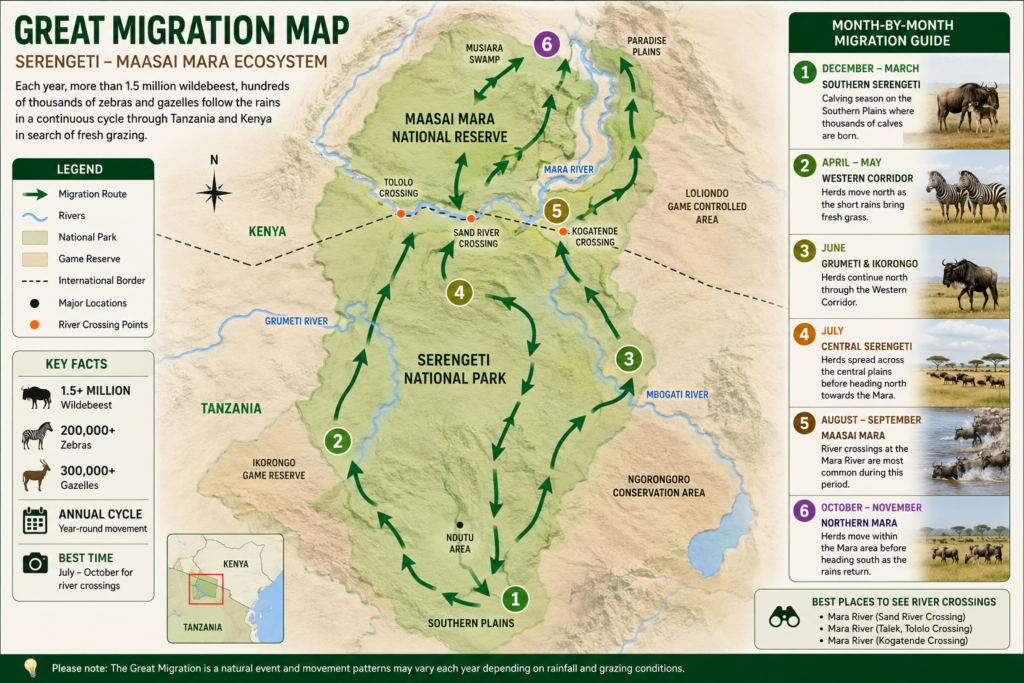
The Great Migration is a continuous circular journey covering nearly 1,000 kilometres (620 miles) each year across Tanzania’s Serengeti National Park and Kenya’s Maasai Mara ecosystem. More than 1.5 million wildebeest, accompanied by hundreds of thousands of zebras and gazelles, move in search of fresh grazing and water after seasonal rains.
Rather than following fixed dates, the migration responds to rainfall patterns. This means the exact timing varies slightly each year, making every safari unique.
📍 Great Migration Route Map
Replace this placeholder with your custom illustrated migration map showing:
- ✅ Southern Serengeti
- ✅ Central Serengeti
- ✅ Western Corridor
- ✅ Northern Serengeti
- ✅ Mara River
- ✅ Mara Triangle
- ✅ Masai Mara Reserve
- ✅ Kenya–Tanzania Border
- ✅ Great Migration Route
- ✅ River Crossing Locations
📍 Annual Great Migration Route
| Period | Location | What Happens? |
|---|---|---|
| January – March | Southern Serengeti | Calving season with thousands of newborn wildebeest attracting lions, cheetahs and hyenas. |
| April – May | Western Corridor | Large herds move northwest following fresh grazing after seasonal rains. |
| June | Northern Serengeti | Animals gather before crossing into Kenya. |
| July – September | Mara Triangle & Masai Mara | Peak migration with spectacular Mara River crossings. |
| October | Northern Maasai Mara | Excellent wildlife viewing before the herds gradually begin moving south. |
| November – December | Southern Serengeti | The migration returns south following the short rains. |
🦓 Did You Know?
The Great Migration is considered the world’s largest overland wildlife migration. Each year, more than 1.5 million wildebeest, around 200,000 zebras and hundreds of thousands of gazelles complete this remarkable journey, closely followed by predators including lions, leopards, cheetahs, hyenas and Nile crocodiles.
⭐ Travel Tip
If witnessing the famous Mara River crossings is your top priority, plan your safari for late July through September. Staying near the Mara Triangle or the Mara River gives you quicker access to the most active crossing points during peak migration season.
Navigating the Masai Mara Migration Map on Your Mara Migration Trip
A detailed look at the Masai Mara migration map is essential for understanding the best vantage points. Popular crossing points on the Mara River include Purungat and Lookout Hill. With a good guide, you’ll be able to track the specific movements of the herds, ensuring you’re always in the heart of the action.
Don’t forget that most Safari travel agencies provide expert trackers who use the migration map to predict animal movements. While it may seem overwhelming initially, you’ll grow to appreciate how vital the map is for a successful Mara Migration Trip. Watching thousands of animals crossing at these strategic points is an awe-inspiring experience you won’t forget.
📸 Great Migration Photography Guide: Capture the Safari of a Lifetime
The Great Migration offers some of the most spectacular wildlife photography opportunities on Earth. Whether you’re using a professional DSLR, mirrorless camera or even a modern smartphone, good planning and patience can help you capture unforgettable moments. From dramatic Mara River crossings to close encounters with lions, elephants and cheetahs, every game drive offers a chance to create remarkable images.
⭐ Quick Photography Tips
- 📷 Photograph during the first and last two hours of daylight.
- 🦁 Focus on animal behaviour instead of just portraits.
- 🚙 Keep your camera ready throughout every game drive.
- 🌅 Use soft morning or evening light whenever possible.
- 🐃 Be patient at river crossings—action can happen unexpectedly.
📷 Recommended Camera Equipment
| Equipment | Recommended | Why? |
|---|---|---|
| Telephoto Lens | 200–600mm | Ideal for distant wildlife and predator action. |
| Standard Zoom | 24–70mm | Perfect for landscapes and nearby animals. |
| Wide Angle Lens | 16–35mm | Captures dramatic scenery and safari camps. |
| Extra Batteries | 2–4 | Long game drives quickly drain batteries. |
| Memory Cards | 128GB+ | Wildlife photography generates thousands of images. |
🦁 Best Wildlife to Photograph During the Great Migration
| Wildlife | Best Time | Photography Rating |
|---|---|---|
| Wildebeest River Crossings | July–September | ⭐⭐⭐⭐⭐ |
| Lions | Year-round | ⭐⭐⭐⭐⭐ |
| Leopards | Early morning | ⭐⭐⭐⭐⭐ |
| Cheetahs | Morning & evening | ⭐⭐⭐⭐⭐ |
| Elephants | Year-round | ⭐⭐⭐⭐ |
| Hippos & Crocodiles | River crossings | ⭐⭐⭐⭐⭐ |
| Hot Air Balloons | Sunrise | ⭐⭐⭐⭐ |
💡 Expert Photography Advice
The best wildlife photographs are rarely taken by rushing between sightings. Spend time observing animal behaviour, anticipate movement and allow your guide to position the vehicle safely for the best angle. Patience often results in more natural and memorable images.
🌿 Responsible Wildlife Photography
- ✅ Keep a respectful distance from wildlife.
- ✅ Avoid asking guides to pressure animals for a better photograph.
- ✅ Turn off your camera flash around wildlife.
- ✅ Follow your guide’s instructions at all times.
- ✅ Respect park rules and conservation efforts.
Checklist and Packing Tips for Your Mara Migration Trip
Preparation is key when venturing out on a Masai Mara migration travel guide from Nairobi. Creating a thorough packing list ensures you’re ready for every eventuality. Comfortable walking shoes, lightweight clothing, and a good Safari Guide Book are essentials. Don’t skimp on binoculars and cameras either—these are a photographer’s paradise.
Check with your African safari travel agency for advice on international travel requirements. If you’re coming from abroad, consult an international travel checklist printable and confirm the necessary documents needed to travel abroad. You may need a valid passport, vaccination certificates, and a flexible itinerary to adapt to any international travel restrictions.
🧳 Complete Great Migration Safari Planner
Planning a Great Migration safari involves much more than choosing your travel dates. Deciding how long to stay, where to sleep, whether to fly or drive, what to pack and how much to budget can all have a significant impact on your overall safari experience.
This planning guide walks you through every stage of organising your safari so you can enjoy one of the world’s greatest wildlife spectacles with confidence.
📋 What’s Included
- ✅ Recommended safari durations
- ✅ Sample itineraries
- ✅ Fly-in vs road safari comparison
- ✅ Budget planning
- ✅ Packing checklist
- ✅ Kenya travel advice
- ✅ Park fees explained
- ✅ Booking timeline
- ✅ Expert travel tips
How Many Days Do You Need?
Although it’s possible to visit the Maasai Mara for only two days, most safari specialists recommend spending at least three to four nights during the Great Migration. This gives you multiple game drives and significantly improves your chances of witnessing river crossings and predator activity.
| Safari Length | Ideal For | Recommendation |
|---|---|---|
| 2 Days | Very limited time | ⭐⭐ |
| 3 Days | Short safari | ⭐⭐⭐⭐ |
| 4 Days | Most visitors | ⭐⭐⭐⭐⭐ |
| 5 Days | Photographers | ⭐⭐⭐⭐⭐ |
| 7 Days | Luxury safari | ⭐⭐⭐⭐⭐ |
💡 Expert Recommendation
For first-time visitors hoping to witness the Great Migration, we recommend a 4-day safari. It offers an excellent balance between cost, wildlife viewing opportunities and flexibility while allowing multiple game drives across different parts of the Maasai Mara ecosystem.
Wrapping Up Your Masai Mara Migration Travel Guide for an Unforgettable Mara Migration Trip
A Mara Migration Trip offers a rare glimpse into one of the planet’s most extraordinary wildlife events. By using this Masai Mara migration travel guide, you’ll know exactly when to go, how to book the best packages, and what to bring to maximize your adventure. With expert help from providers like Safari Bookings and Safari travel Plus, and tools like a Kenya Safari Guide book, your trip is set to be seamless and unforgettable.
Whether you’re drawn to the challenge of river crossings or the chance to witness predator-prey interactions, the Great Migration promises a once-in-a-lifetime spectacle. Don’t wait—start planning your journey today!
🦓 3-Day Great Migration Safari Itinerary
A 3-day safari is ideal for travellers with limited time who still want an opportunity to witness the Great Migration and experience the incredible wildlife of the Maasai Mara. While no wildlife sighting can ever be guaranteed, three days provide enough time for several game drives and a realistic chance of seeing river crossings during peak migration season.
📋 Itinerary Overview
| Duration | 3 Days / 2 Nights |
| Best Time | July to October |
| Safari Type | Road or Fly-in |
| Best For | First-time visitors, couples, families and photographers |
| Highlights | Great Migration, Big Five, Mara River, sunrise and sunset game drives |
📅 Day 1 – Journey to the Maasai Mara & Afternoon Game Drive
Begin your adventure with an early departure from Nairobi. You can travel by road through the scenic Great Rift Valley or choose a short domestic flight directly to the Maasai Mara. After arriving at your lodge or tented camp, enjoy lunch and some time to relax before heading out on your first afternoon game drive.
During your drive, look out for elephants, giraffes, buffalo, zebras, lions and large herds of wildebeest. If you’re travelling during migration season, your guide may head towards the Mara River or nearby crossing points depending on recent wildlife movements.
Typical Schedule- 07:00 – Depart Nairobi
- 12:30 – Arrive at camp and enjoy lunch
- 15:30 – Afternoon game drive
- 18:30 – Sunset over the savannah
- 19:30 – Dinner and overnight stay
📅 Day 2 – Full-Day Great Migration Safari
Today is dedicated to exploring the Maasai Mara ecosystem. Depart before sunrise when predators are most active and wildlife is easier to spot. Your guide will track recent migration movements and take you to areas where the best sightings have been reported.
If conditions are favourable, you may witness wildebeest gathering at the Mara River before making a dramatic crossing. Along the way you’ll also search for lions, cheetahs, leopards, elephants, hippos, crocodiles and numerous bird species.
Highlights- 🌅 Sunrise game drive
- 🐃 Great Migration herds
- 🦁 Big Five wildlife viewing
- 📸 Mara River crossing opportunities
- 🧺 Picnic lunch in the bush (where permitted)
- 🌄 Evening wildlife viewing
📅 Day 3 – Morning Game Drive & Return Journey
Enjoy one final early morning game drive before breakfast. Early mornings often provide excellent opportunities to photograph predators, elephants and other wildlife in beautiful golden light. After breakfast, begin your return journey to Nairobi or continue to another safari destination in Kenya.
Typical Schedule- 06:00 – Sunrise game drive
- 08:30 – Breakfast
- 10:00 – Check out
- Afternoon – Arrive back in Nairobi or board your onward flight
⭐ Wildlife You May See
| Wildlife | Likelihood |
|---|---|
| Wildebeest | ⭐⭐⭐⭐⭐ |
| Zebras | ⭐⭐⭐⭐⭐ |
| Lions | ⭐⭐⭐⭐⭐ |
| Elephants | ⭐⭐⭐⭐ |
| Leopards | ⭐⭐⭐ |
| Cheetahs | ⭐⭐⭐⭐ |
| Hippos & Crocodiles | ⭐⭐⭐⭐ |
💡 Make the Most of Your Safari
- ✔ Stay at least two nights to maximise game viewing.
- ✔ Start game drives early for the best wildlife activity.
- ✔ Keep your camera ready—wildlife encounters can happen at any moment.
- ✔ Follow your guide’s advice to improve your chances of seeing river crossings.
- ✔ Remember that wildlife movements are natural, so every safari is unique.
Frequently Asked Questions
How much does a Masai Mara trip cost?
Masai Mara safari packages price varies based on the duration and inclusions. Affordable options like cheap Masai Mara safari packages start around $250 per person for a 2-day trip. Luxury options or Masai Mara all inclusive packages can cost significantly more.
What is the 12-hour rule for Masai Mara?
The 12-hour rule refers to the recommendation for tourists to limit game drives to 12 hours daily for safety and animal conservation. A 3-day Masai Mara safari from Nairobi often provides ample time for exploration within this guideline.
How many days are enough for Masai Mara?
At least 3 to 4 days are ideal for a thorough experience of Masai Mara. Options like 4-day Masai Mara safari from Nairobi balance game drives with relaxation time.
When to see the great migration in Masai Mara?
The best time to witness the Great Migration is from July to October. Many Masai Mara packages are designed specifically for this peak period.
Which is cheaper, Serengeti or Masai Mara?
Masai Mara tends to be more affordable compared to Serengeti. With cheap Masai Mara safari packages, travelers usually find budget-friendly options.
How much is the transfer from Nairobi to Masai Mara?
Transfers can cost between $70 and $300 depending on the mode of transport. Best Masai Mara safari packages from Nairobi often include convenient transfers.
When to avoid Masai Mara?
The rainy seasons of April to May and November make accessibility and game viewing difficult. Opt instead for dry season trips like a 2 Day Masai Mara Safari from Nairobi.
How much is the entrance fee to Masai Mara?
Entrance fees range from $70 to $80 per day for adult international visitors. Fees are typically covered in Masai Mara safari packages price for convenience.
Can I wear shorts in Masai Mara?
Yes, shorts are suitable during the day when temperatures are high. Ensure they’re paired with comfortable shoes, especially on a 3-day Masai Mara safari from Nairobi.
Which is the best month to visit Masai Mara?
August is highly recommended for optimal game viewing and migration highlights. Look for Masai Mara all inclusive packages for peak season itineraries.
Which one is better, Masai Mara or Serengeti?
Both destinations are fantastic, but Masai Mara offers more compact game-viewing areas at potentially lower costs. Consider a 4-day Masai Mara safari from Nairobi for value and variety.
How to do Masai Mara on a budget?
Opt for budget-friendly Masai Mara all inclusive packages or short trips like a 2 Day Masai Mara Safari from Nairobi. Camping options and group tours also reduce costs.
🗓️ Which Great Migration Safari Duration Is Right for You?
One of the most common questions travellers ask is, “How many days should I spend in the Maasai Mara during the Great Migration?” The answer depends on your budget, travel style and wildlife goals. While even a short safari can be memorable, spending more time in the reserve significantly improves your chances of witnessing river crossings, predator interactions and the Big Five.
⭐ Quick Recommendation
If this is your first safari to Kenya, a 4-day Great Migration safari offers the best balance of wildlife viewing, value for money and flexibility. Wildlife sightings are never guaranteed, but additional game drives generally increase your chances of experiencing memorable moments.
| Duration | Best For | Highlights | Overall Rating |
|---|---|---|---|
| 3 Days / 2 Nights | Weekend trips, first-time visitors | Big Five, Great Migration, sunrise & sunset game drives | ⭐⭐⭐⭐ |
| 4 Days / 3 Nights | Most travellers | More game drives, better river crossing opportunities, relaxed pace | ⭐⭐⭐⭐⭐ |
| 5 Days / 4 Nights | Wildlife enthusiasts & photographers | Excellent flexibility, full-day safaris, multiple river crossing attempts | ⭐⭐⭐⭐⭐ |
| 7 Days / 6 Nights | Luxury safaris & serious photographers | Maximum wildlife viewing, hot air balloon safari, cultural visits and relaxed schedule | ⭐⭐⭐⭐⭐ |
📍 What Can You Expect?
🦁 3-Day Safari
- Perfect for short holidays.
- Morning and afternoon game drives.
- Big Five opportunities.
- Possible migration sightings in season.
- Excellent value.
🐃 4-Day Safari
- More time in wildlife-rich areas.
- Additional river crossing opportunities.
- Less rushed itinerary.
- Ideal for most visitors.
- Best overall choice.
📸 5-Day Safari
- Ideal for photographers.
- Flexible game drive schedule.
- Better chances of dramatic wildlife behaviour.
- More time exploring different regions.
- Outstanding safari experience.
🎈 7-Day Luxury Safari
- Fly-in safari option.
- Luxury camps and lodges.
- Hot air balloon safari.
- Maasai cultural experience.
- Maximum wildlife viewing time.
💰 Typical Budget Guide
| Safari Length | Budget | Mid-Range | Luxury |
|---|---|---|---|
| 3 Days | From US$700 | US$1,000–1,800 | US$2,000+ |
| 4 Days | From US$950 | US$1,500–2,500 | US$3,000+ |
| 5 Days | From US$1,200 | US$2,000–3,200 | US$4,000+ |
| 7 Days | From US$1,800 | US$3,000–5,000 | US$6,000+ |
🌿 Expert Advice
If your primary goal is witnessing a Mara River crossing, avoid planning the shortest possible trip. Spending at least four days gives you more flexibility to follow herd movements and adapt your game drives based on current wildlife activity and weather conditions.
🌍 More Safari Travel Guides
🎒 Ultimate Great Migration Safari Packing List
Packing wisely can make your Great Migration safari far more comfortable and enjoyable. Days in the Maasai Mara are usually warm, mornings and evenings can be surprisingly cool, and weather conditions may change quickly. The key is to pack lightweight clothing that can be layered while keeping your luggage practical and easy to carry.
⭐ Packing Essentials
For most visitors, the following items cover everything needed for a successful safari.
- ✔ Passport and travel documents
- ✔ Travel insurance
- ✔ Camera and spare batteries
- ✔ Binoculars
- ✔ Lightweight neutral-coloured clothing
- ✔ Comfortable walking shoes
- ✔ Wide-brimmed hat
- ✔ Sunglasses
- ✔ Sunscreen (SPF 30+)
- ✔ Insect repellent
- ✔ Reusable water bottle
- ✔ Personal medications
- ✔ Universal travel adapter
- ✔ Power bank
👕 Recommended Clothing
| Item | Recommended | Reason |
|---|---|---|
| T-Shirts | 4–6 | Lightweight and breathable. |
| Long-Sleeve Shirts | 2–3 | Sun and insect protection. |
| Safari Trousers | 2–3 | Comfort during game drives. |
| Fleece or Jacket | 1 | Cool early mornings. |
| Rain Jacket | 1 | Unexpected showers. |
| Walking Shoes | 1 Pair | Comfort and stability. |
| Hat | 1 | Sun protection. |
📷 Photography & Electronics Checklist
📸 Camera Gear
- Camera body
- Telephoto lens
- Wide-angle lens
- Lens cloth
- Memory cards
- Tripod (optional)
🔋 Electronics
- Phone charger
- Power bank
- Universal adapter
- Extra batteries
- Charging cables
- Portable SSD (optional)
🚫 What Not to Bring
| Avoid | Why? |
|---|---|
| Bright white clothing | Can be highly visible to wildlife and becomes dusty quickly. |
| Camouflage clothing | Restricted in some African countries and unnecessary for safaris. |
| Large hard-shell suitcases | Soft-sided bags are easier to transport, especially on light aircraft. |
| Strong perfumes | May attract insects and disturb fellow travellers. |
💡 Expert Packing Tips
- 🧥 Dress in layers to stay comfortable throughout the day.
- 🎨 Choose neutral colours such as khaki, olive green, beige and brown.
- 💧 Carry a reusable water bottle and stay hydrated during game drives.
- 📸 Keep your camera within easy reach—you never know when wildlife will appear.
- 🎒 Pack light if your itinerary includes domestic flights, as luggage limits may apply.
🌍 Final Packing Advice
Remember that a safari is about experiencing nature, not dressing for an occasion. Comfortable clothing, practical equipment and a sense of adventure are the most important things you can bring. Packing efficiently allows you to focus on enjoying the Great Migration and the unforgettable wildlife encounters that make the Maasai Mara one of Africa’s greatest safari destinations.
❓ Frequently Asked Questions About the Great Migration in the Maasai Mara
Planning a Great Migration safari raises plenty of questions—from timing and costs to wildlife sightings and accommodation. Below are answers to some of the most common questions to help you plan your trip with confidence.
When is the best time to see the Great Migration in Kenya?
The best time is generally between late July and September, when large herds move into the Maasai Mara and river crossings are most likely. Exact timing varies each year depending on rainfall.
Can you guarantee a Mara River crossing?
No. River crossings are completely natural events influenced by weather, grazing conditions and animal behaviour. No safari operator can guarantee a crossing.
How many wildebeest take part in the Great Migration?
The migration involves more than 1.5 million wildebeest, together with hundreds of thousands of zebras and gazelles moving between the Serengeti and the Maasai Mara.
How many days should I spend in the Maasai Mara?
A stay of 4 days and 3 nights is ideal for most visitors, providing multiple game drives and flexibility to follow wildlife movements.
Is August the best month for the Great Migration?
August is often considered one of the best months because large herds are usually in the Maasai Mara and river crossings are more frequent, although wildlife movements vary each season.
Is September better than August?
September often offers excellent wildlife viewing with slightly fewer visitors than peak August, while river crossing opportunities can still be very good.
What animals can I expect to see?
Besides wildebeest, you may see lions, elephants, leopards, cheetahs, buffalo, giraffes, zebras, hippos, crocodiles, hyenas and hundreds of bird species.
Is the Great Migration suitable for children?
Yes. Many lodges welcome families and offer child-friendly activities, although minimum age requirements may apply for some camps and game drives.
How much does a Great Migration safari cost?
Costs vary according to travel style, season and accommodation. Budget safaris may start from around US$700 for a short trip, while luxury safaris can cost several thousand dollars per person.
Should I choose a fly-in or road safari?
A fly-in safari saves travel time and maximises game viewing, while a road safari is generally more affordable and allows you to enjoy Kenya’s changing landscapes.
Which is better during the Great Migration: the Mara Triangle or the Maasai Mara Reserve?
Both offer exceptional wildlife viewing. The Mara Triangle is often known for fewer crowds and easy access to several famous river crossing areas, while the Maasai Mara Reserve has a wider range of accommodation and access points.
What should I wear on safari?
Wear lightweight neutral-coloured clothing, comfortable walking shoes, a hat, sunglasses and a warm layer for early morning game drives.
Do I need binoculars?
Yes. Binoculars greatly enhance wildlife viewing, especially for spotting birds, predators resting in the distance and animals across the plains.
Is the Maasai Mara safe for tourists?
The Maasai Mara is one of Africa’s most popular safari destinations. Travelling with a licensed tour operator and following your guide’s instructions helps ensure a safe and enjoyable experience.
How far is the Maasai Mara from Nairobi?
By road, the journey usually takes around 5–6 hours depending on your destination and road conditions. Scheduled flights typically take about one hour.
When should I book my safari?
For travel during the peak migration season (July–September), booking 6–12 months in advance is recommended, especially if you want specific camps or lodges.
Can I see the Big Five during the Great Migration?
Yes. The Maasai Mara is one of the best places in Africa to see the Big Five—lion, leopard, elephant, buffalo and rhinoceros—alongside the migrating herds.
What is the weather like during the Great Migration?
Days are generally warm, while mornings and evenings can be cool. Occasional showers are possible, so packing layers and a light waterproof jacket is recommended.
Is a hot air balloon safari worth it?
For many visitors, yes. A sunrise balloon flight offers a unique aerial perspective of the plains and may provide spectacular views of wildlife across the ecosystem.
Why is the Great Migration considered one of the world’s greatest wildlife spectacles?
The migration combines enormous herds, dramatic river crossings, predator-prey interactions and a continuous annual journey across the Serengeti–Maasai Mara ecosystem, making it one of the planet’s most remarkable natural events.