
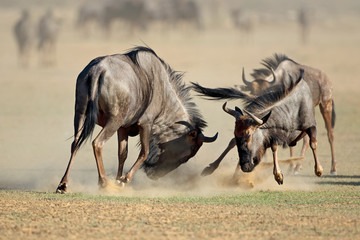
Interesting Facts About the Wildebeest Migration
25 Interesting Facts About the Wildebeest Migration
(2026 Guide)
Discover fascinating facts about the Great Wildebeest Migration, including why it happens, how far the herds travel, Mara River crossings, wildlife, and the best time to witness this spectacular event in Kenya and Tanzania.
The Great Wildebeest Migration is the largest land mammal migration on Earth. Over 1.5 million wildebeest, accompanied by hundreds of thousands of zebras and gazelles, travel in a continuous clockwise loop between Tanzania’s Serengeti and Kenya’s Maasai Mara. The migration is driven by rainfall and the search for fresh grazing, not fixed dates. The most famous part is the Mara River crossings, where thousands of wildebeest brave crocodile-infested waters.
📌 Migration Facts at a Glance
What Is the Great Wildebeest Migration?
The Great Wildebeest Migration is the largest overland migration in the world. It involves over 1.5 million wildebeest, accompanied by hundreds of thousands of zebras and gazelles, moving in a continuous clockwise loop between Tanzania’s Serengeti and Kenya’s Maasai Mara [reference:0]. This incredible journey covers approximately 1,800 miles annually [reference:1] and is driven by the search for fresh grazing and water [reference:2].
The Great Migration is a year-round, continuous movement rather than a single event [reference:3]. The herds follow seasonal rains and the grasses that grow in their wake [reference:4]. The migration is crucial for the survival of huge numbers of iconic predators, including lions, crocodiles, and spotted hyenas [reference:5].
🦓 25 Amazing Facts About the Wildebeest Migration
Migration by the Numbers
Fact 1: 1.5 Million Wildebeest
Over 1.5 million wildebeest participate in the Great Migration each year, making it the largest land mammal migration on Earth [reference:6].
Fact 2: 300,000 Zebras
Around 300,000 zebras travel alongside the wildebeest, often leading the way [reference:7].
Fact 3: 1,800 Miles
The migration covers approximately 1,800 miles (nearly 3,000 km) annually [reference:8].
Fact 4: 800 km Loop
The migration follows an 800 km clockwise loop between the Serengeti and the Maasai Mara [reference:9].
Fact 5: 400,000 Calves
During calving season (January–March), 300,000–400,000 calves are born within a 2-3 week period [reference:10].
Fact 6: 250,000 Deaths
An estimated 250,000 wildebeest die en route due to hunger, thirst, predation, or exhaustion [reference:11].
Why Do Wildebeest Migrate?
Fact 7: Driven by Rain
The migration is driven by rainfall rather than fixed dates. Wildebeest follow the rains to find fresh, lush grass [reference:12].
Fact 8: Search for Grass
Wildebeest are pure grazers, eating and drinking in huge volumes. They move to areas with the best grazing [reference:13].
Fact 9: No Herd Leader
There is no single herd leader. The migration is a collective movement driven by instinct and environmental cues [reference:14].
Mara River Crossing Facts
Fact 10: Dramatic Crossings
The Mara River crossings are the most famous part of the migration. Thousands of wildebeest plunge into crocodile-infested waters [reference:15].
Fact 11: Crocodile Danger
Nile crocodiles lie in wait during river crossings, targeting the weak and injured [reference:16].
Fact 12: Hundreds Drown
Hundreds of wildebeest sometimes drown during crossings due to strong currents and panic [reference:17].
Fact 13: 10ft Leaps
Wildebeest can jump up to 10ft as they cross the Mara River to avoid crocodiles [reference:18].
Fact 14: No Guaranteed Point
There is no single crossing point. The animals can cross anywhere along the 360km river [reference:19].
Fact 15: Ecosystem Feeder
Drowned wildebeest provide a feast for vultures and marabou storks, feeding the river ecosystem [reference:20].
Predators During the Migration
Fact 16: Lions Follow
Lions follow the migrating herds, taking advantage of the abundant prey [reference:21].
Fact 17: Cheetahs Hunt
Cheetahs hunt on the open plains, targeting young and weak wildebeest [reference:22].
Fact 18: Crocodiles Ambush
Nile crocodiles are major predators during river crossings [reference:23].
Fact 19: Hyenas Prey
Spotted hyenas are significant predators, often targeting older animals [reference:24].
Fact 20: Defense Tactics
When threatened, wildebeest come together, stomp their feet, and make loud alarm calls [reference:25].
Fact 21: Predator Saturation
During calving season, predators quickly become satiated, reducing their overall impact on newborn calves [reference:26].
Interesting Wildlife Behaviors
Fact 22: Zebras Lead
Zebras often lead the migration because of their excellent eyesight, while wildebeest have a stronger sense of smell.
Fact 23: Ecosystem Engineers
Wildebeest reshape the Serengeti by grazing, fertilizing, and creating pathways [reference:27].
Fact 24: Rain Detectors
Wildebeest can detect rain from many kilometers away, guiding their movement.
Fact 25: Continuous Cycle
The migration is a continuous cycle, not a single event. It happens year-round [reference:28].
📅 Best Time to Witness the Migration
The best time to witness the wildebeest migration in Kenya is between July and October, when the herds are in the Maasai Mara and the dramatic Mara River crossings occur [reference:29]. The peak of the river crossings is typically in August and September.
For the calving season, the best time is January to March in the southern Serengeti, Tanzania [reference:30]. This is when hundreds of thousands of calves are born, attracting high predator activity.
📸 Photography Tips
- Use a telephoto lens: 100-400mm or 200-600mm for wildlife.
- Shoot during golden hour: Sunrise and sunset offer the best light.
- Be patient: Wait for the perfect moment during river crossings.
- Use burst mode: Capture action sequences.
- Focus on eyes: Sharp eyes make compelling portraits.
“The Great Migration is never the same twice. The timing of the Mara River crossings depends entirely on rainfall and herd behavior. That’s why I always recommend booking at least 5 days in the Mara Triangle—it gives you the flexibility to follow the action wherever it goes.”
— Kevin, Lead Guide, Mara Triangle SafarisWhy Trust Our Migration Facts?
❓ Frequently Asked Questions
© 2026 Mara Triangle Safaris — Your trusted Kenya safari operator
🌍 More Safari Travel Guides
BOOK NOWReady for an unforgettable Kenya safari?
📅 BOOK NOW →⏳ 2026 spots filling fast • Secure your adventure